This week, 13–19 November, is Transgender Awareness Week. Here is a précis of major international and Australian events since the last Transgender Awareness Week.
On 21 May, Australia had a federal election. Several candidates were openly anti-trans, with at least one prominent NSW Liberal candidate, Katherine Deves, being a career anti-trans activist (Wilson, 2022). Labor leader, now prime minister, Anthony Albanese, made some remarks in the media about trans issues which attracted criticism for being transphobic (Iqbal, 2022).
On 16 June, the Union Cycliste Internationale (UCI) — the international governing body for professional cycling — announced a new policy which significantly tightened restrictions on trans women’s participation in professional cycling (Leggett, 2022). The policy is perceived as having intentionally targeted a single British trans woman cyclist, Emily Bridges (BBC Sport, 2022).
On 17 June, the Australian Greens Victoria (AGV) removed their new Convenor, Linda Gale, because she had been elected in an irregular and rule-breaking way that protected her (Baj, 2022b) from having AGV members find out she was a vocal anti-trans activist (Baj, 2022a).
On 20 June, the International Swimming Federation (Fédération Internationale de Natation, FINA) announced a new policy which effectively excluded trans women from competing in professional swimming (“FINA votes to restrict,” 2022).
The conditions under which the FINA Extraordinary Congress passed the policy have been scrutinised — apparently delegates were only allowed to see the 24-page policy 15 minutes before they were made to vote on it (Holmes, 2022). The policy is also perceived as having intentionally targeted a single trans woman swimmer, Lia Thomas (Newberry, 2022).
On 24 June, the Supreme Court of the United States decided Dobbs v. Jackson Women’s Health Organization, overturning Roe v. Wade, the legal precedent which guaranteed abortion access throughout the United States. As well as targeting cis women, the ruling also caused significant new problems and dangers for trans people who can give birth (Rummler, 2022).
In a separate concurrence, Associate Justice Clarence Thomas — who is, incidentally, the subject of lingering and unresolved allegations of corruption (Barnes & Marimow, 2022; Pilkington, 2022; Tomasky, 2022) — proposed that the ruling in Dobbs also provided grounds to overturn several other precedents of the same “substantive due process” type, including:
Griswold v. Connecticut, the 1965 ruling making it federally legal for married people to use contraception;
Lawrence v. Texas, the 2003 ruling making it federally legal to have private, consensual gay sex; and
all of which will have knock-on effects on trans people (for example, if their hormones are considered contraceptives, or if they can’t get legal gender recognition and therefore their straight relationships and marriages are considered gay under the law).
On 19 July, the UK Independent Review of Gender Identity Services for Children and Young People (“Cass Review”) issued a recommendation (Cass, 2022) to NHS England that the UK’s single centralised paediatric trans healthcare service, the NHS Gender Identity Development Service (GIDS) in London, be shut down and replaced by regionalised hubs to provide timelier and more appropriate care (Brooks, 2022).
This was widely misrepresented in international media (e.g., Bannerman, 2022; Ely & Dollimore, 2022; McLoughlin, 2022), at the instigation of anti-trans pressure groups (“The U.K. turns its back,” 2022; Transgender Trend, 2022; Women’s Forum Australia, 2022, etc.) as GIDS being shut down based on (the vague claim of) it being a danger to children.
On 5 August, an attempt was made to kill Canadian streamer Clara “keffals” Sorrenti, who is a trans woman, through “swatting” her (summoning armed police to her home) by calling in a false threat of mass murder in her name (Winslow, 2022). The harassment ultimately escalated to the point that Sorrenti was forced to flee to Europe (Wiggins, 2022).
On 19 August,The Australian published an interview with Oliver “Ollie” Hassett (then Ollie Davies), a detransitioner and activist (Robinson, 2019). They failed to mention that Mr Hassett was affiliated with Genspect (Hassett, 2022), an international anti-trans hate group (Moore, 2022).
On 30 August, the Report of the Inquiry into extremism in Victoria by the Victorian Legislative Council Legal and Social Issues Committee was tabled in the Parliament of Victoria. The report noted transphobia as a path to radicalisation for Australian political extremists (ibid., p. 1), and “public debate” over trans existence as a significant factor in giving those extremists legitimacy (ibid., pp. 45–46).
On 5 October, the Global Project Against Hate and Extremism released a report classifying two anti-trans groups active in Australia, Binary Australia and LGB Alliance Australia, as extremist hate groups (Global Project Against Hate and Extremism, 2022).
On 6 September, the World Professional Association for Transgender Health (WPATH) published its Standards of care for the health of transgender and gender diverse people, version 8 (Coleman et al., 2022), or “SoC 8,” replacing version 7 (Coleman et al., 2012) after an interval of just over ten years.
The SoC 8 attracted controversy at launch, and indeed well before it, during the lengthy period of stakeholder feedback and review. One reason was that it launched with well-sourced, well-evidenced age limits for paediatric medical transition, and then retracted them, restoring a higher age limit for which there was no evidence, under political pressure and the threat of violence (Eckert, 2022). Another reason was that it claimed unearned authority over intersex people (Carpenter, 2021).
A third major reason was that it supported some of its claims with citations to publications (Littman, 2018; D’Angelo et al., 2020; Littman, 2021) which are methodologically unsound (Restar, 2019; Leveille, 2021) and from authors associated with anti-trans pressure groups, like the “Institute for Comprehensive Gender Dysphoria Research” (Jones, 2022) and the “Society for Evidence-based Gender Medicine” (Moore, 2021).
On 17 October, the ABC’s Media Watch broadcast an episode, “ACON & the ABC” (Adams, 2022) which attracted immediate controversy because it was factually inaccurate (Rogers, 2022; Salmon & Sobieralski, 2022) and because multiple anti-trans activists took credit for its content. Conversely, multiple commentators wrote evidence-based pieces responding to the episode, including Melbourne-based analyst Eleanor Evenstar1and me (Moreton, 2022).
On 29 October, UK media announced that new UK Prime Minister Rishi Sunak intends to strip trans people of human rights protections under British law by amending the relevant parts of the Equality Act 2010 (Wakefield, 2022). Jo Maugham, director of the Good Law Project, a major trans-allied legal NGO, issued a public recommendation that trans people should leave England if they could (Maugham, 2022).
On 2 November,Bloomberg reported that Twitter’s new owner and incoming chief executive officer, Elon Musk, had directed staff to review the sections of Twitter’s hateful conduct policy which protect transgender people on the 238-million-user social media platform, with an eye to rewriting those sections or deleting them entirely (Riedel, 2022). Musk has a record of vocal transphobia (see, e.g., McHale, 2022) which has been examined in the context that his partner Grimes left him for activist and whistleblower Chelsea Manning, who is trans (Di Placido, 2022), and that his daughter, Vivian Wilson, came out as trans and disowned him (Saunders, 2022).
On 4 November, the State of Florida’s medical regulators voted to ban paediatric trans healthcare and forcibly terminate provision of care to any young trans people currently receiving it (Baisas, 2022). Significant concerns have been raised over the fact that the Florida state government, led by Governor Ron DeSantis, appears to have arranged the process from the word go to achieve a predetermined politically desirable conclusion (Luneau, 2022; Yurcaba, 2022a).
On 8 November, the United States held midterm elections for the whole US House of Representatives, one-third of the US Senate, 39 governorships, and various state and local elections. Analysts predicted a red wave election (Geraghty, 2022; Siracusa, 2022; etc.) — that is, a substantial victory for the right-wing Republican Party — but in the event, one failed to materialise (Alexander, 2022; Milligan, 2022; Smith, 2022).
The governing centrist Democratic Party will retain control of the Senate (“Democrats retain control of Senate,” 2022); the House of Representatives is likely to go Republican by a hair-thin margin, but may end up deadlocked (Bierman et al., 2022). Analysts have attributed Republicans’ underperformance, in part, to ignoring bread-and-butter issues in favour of constantly promoting anti-trans hate (e.g., Weigel, 2022). Meanwhile, several states elected their first transgender officeholders at county and/or state level (Childress, 2022; Duxter, 2022; Yurcaba, 2022b).
Overall impression
2021–2022 contained some bright spots for trans people, compared to the unremittingly horrible 2020–2021. However, the times that weren’t bright spots became even darker to compensate.
Footnotes
I’ve elected not to cite Ms Evenstar’s piece here not out of disrespect, but because it was published on Twitter, which is expected to experience considerable downtime in the near future. If or when the piece is published elsewhere, I will cite it here.
Cass, H. (2022, July 19). Further advice [Formal letter]. Independent Review of Gender Identity Services for Children and Young People. Retrieved 13 November 2022.
For context, the article is concerned primarily with matters pertaining to “Pride & prejudice in policy,” a panel discussion which took place at the University of Melbourne (UniMelb) on 4 October 2022. As the UniMelb event listing provides a lot of the material to which the original piece and this response refer, here’s an archive copy from the Wayback Machine (UniMelb School of Historical and Philosophical Studies, 2022).
The forum [trans ally protesters] interrupted — and tried to stop completely — was at the periphery of transgender issues …
Faine (op. cit.)
This is a curious assertion. Here’s the blurb from the University’s own event listing, in full:
On the face of it, a diversity and inclusion program and ranking index encouraging organizations to be more inclusive to gender and sexual minorities should not attract more attention or criticism than any other such initiatives (such as for race, or disability). Yet the UK’s Diversity Champions Programme and Workplace Equality Index, run by the LGBTQ+ charity Stonewall, has faced considerable scrutiny and censure, and many important public bodies have withdrawn from the initiatives.
Critics argue that the initiatives embed contested facts and values into policies, compromise public bodies’ independence and impartiality, and facilitate backdoor political lobbying.
Defenders counter that the program and index simply promote best practice in policy, and help employers to foster much-needed inclusion, support and understanding for LGBTQ+ employees. Some also see criticism of these initiatives as reflecting and reinforcing gender conservatism.
With many of our own public institutions signed up to similar initiatives — ACON’s Pride in Diversity employer support program and the Australian Workplace Equality Index — the aim of this event is to open-up a timely and balanced national conversation about the benefits, risks and tensions of these initiatives for Australia’s public institutions, and their employees.
Now, I’m just a simple dickgirl, but it seems to me that this “conversation” revolves around one question: Does free speech permit observing that institutions, social groups, or spaces are transphobic, or trans-allied, when they are in fact the thing in question?
It doesn’t seem to me that that’s “at the periphery of transgender issues”. It seems to me, in fact, that it must be at the centre.
#2
It is a small example of a bigger problem. If you demand respect, then you have to give it.
Faine (op. cit.), emphasis mine
How delightful, this one is getting another outing:
Sometimes people use “respect” to mean “treating someone like a person” and sometimes they use “respect” to mean “treating someone like an authority”
and sometimes people who are used to being treated like an authority say “if you won’t respect me I won’t respect you” and they mean “if you won’t treat me like an authority I won’t treat you like a person”
tumblr user autisticabby (2015)
Because really, that’s very clearly what this is. The kind of respect which trans people “demand” is being called by their correct names and being recognised as their correct genders, as opposed to society pretending names are inborn and everyone was cis before May 2014.
Faine is suggesting here that it’s a fair exchange that to receive the respect they “demand,” trans people are also expected not to say boo when panels like the one at UniMelb discuss whether when they’re walking through a forest absolutely chock full of bear traps, they should be allowed to do so without a blindfold on.
#3
Until I started working at the ABC in 1989, I attended my share of protests. As a university student, I threw a few water bombs at the governor-general in the aftermath of the Dismissal (none of them got even remotely close), I raised my voice marching with many others over our national disgrace of race relations, and I joined in many other worthy and noble causes. I don’t mind a good protest — I consider it a signifier of a healthy democracy.
It therefore came as something of a shock this week to find myself being aggressively accused of transphobia, of creating a risk to other people’s health and safety, simply for wanting to have a discussion.
Faine (op. cit.), emphases mine
This seems like a non sequitur on a couple of levels.
Faine seems to be under the impression that because he protested at some point (the latest date he cites is 19 years before I was born) and he doesn’t mind when other people do it, it’s somehow more shocking or inappropriate that he might be protested himself? I don’t get it.
I’m in at least two demographics currently demonstrating for their own continued existence. I show up to our and others’ protests whenever my health allows. That doesn’t mean I have like … enough allyship tokens that picketing me for being, say, racist, would somehow be unfair.
#4
simply for wanting to have a discussion
Faine (op. cit.)
At the price of flagrantly violating Godwin’s law I will point out that the Wannsee Conference was also a discussion. So was the Last Supper, of course. The point is that “discussions” are perfectly capable of having consequences.
#5
The forum was called “Pride and Prejudice in Policy” and was hosted by the School of History and Philosophy of Science within the Arts Faculty of the University of Melbourne. Hardly a hotbed of reactionary or conservative thinking — quite the contrary.
UniMelb’s faculty also includes Dr Holly Lawford-Smith, associate professor of political philosophy, known (Weinberg, 2021) for No Conflict, They Said, an exercise in activism theatre consisting of the functionally unmoderated gathering of fictional anti-transfeminine smears on the pretext of documenting “the impacts on [cis] women of [trans women] using women-only spaces”.
I don’t normally go “Oh, this institution has a problematic student, that reflects on the school as a whole, we’ve got them now, hohoho!”, except that, for whatever reason, Clayton seems to consider her activism to be something she does in her capacity at UniMelb. For instance, Clayton joined Fine and two others from UniMelb in signing a 2021 open letter in support of Kathleen Stock (herself discussed elsewhere in this piece) and did so specifically as an affiliate of the School (Kaufman, 2021/2022).
Finally, the School’s honorary staff include Professor Sheila Jeffreys, well-known among the trans community for what we will politely call her outspoken views, which are well-summarised by the abstract of one of her papers:
Feminist analysis of transsexualism … has seen it as a deeply conservative phenomenon in which surgical mutilation is employed to maintain the genders of male dominance and female subordination. Transsexualism has a new face … in “transgenderism” which employs queer and postmodern theory to render transsexualism progressive. … “transgenderism” is also deeply problematic from a feminist perspective and … transsexualism should be seen as a violation of human rights.
Jeffreys (2008)
Now, of course, if a veteran of Our ABC says that the University of Melbourne is not a hotbed of reactionary or conservative thinking then as a good citizen I really have no choice but to believe him, countervailing evidence be damned, but presumably one can see how a different understanding could have been arrived at.
#6
The forum was a discussion about how diversity benchmark programs work.
Faine (op. cit.)
And the Dismissal was a discussion between Malcolm Fraser, John Kerr, and Gough Whitlam about how the Australian Government worked, specifically about who would be prime minister of Australia. I can’t see how Faine could reasonably have objected to that.
Seriously — anything done solely through the use of words by one or more parties can be characterised as a discussion. That doesn’t mean that such a characterisation is honest or fair.
Material Girls is a timely and trenchant critique of the influential theory that we all have an inner feeling about our sex, known as a gender identity, and that this feeling is more socially significant than our biological sex.
Professor Kathleen Stock surveys the philosophical ideas that led to this point, and closely interrogates each one, from De Beauvoir’s statement that, ‘One is not born, but rather becomes a woman’ (an assertion she contends has been misinterpreted and repurposed), to Judith Butler’s claim that language creates biological reality, rather than describing it. She looks at biological sex in a range of important contexts, including women-only spaces and resources, healthcare, epidemiology, political organization and data collection.
Hachette (n.d.)
I suppose we’d better not let Stock know that “nobody was questioning gender dysphoria”. She’d be heartbroken.
#8
But apparently some trans activists believe that even discussing benchmarking is to be equated with being transphobic.
Faine (op. cit.)
Anti-trans pressure groups seem to believe so, which is why they keep trying to “discuss benchmarking” explicitly as a vehicle to be transphobic. For example, the UK’s misleadingly-named Safe Schools Alliance, an anti-trans pressure group, are known for being absolutely fixated on the claim that being part of LGBTQ+ charity Stonewall’s Diversity Champions programme definitively meant the Crown Prosecution Service was biased. They were so fixated on it, in fact, that they escalated all the way to HM High Court of Justice for England and Wales, where they got thrown out on the grounds that their claim blatantly could not stand up to any judicial examination whatsoever (Parsons, 2021).
Of course, this is only one of multiple anti-trans legal actions which have targeted the Diversity Champions scheme for no clear reason beyond “it exists”. Around the same time, For Women Scotland, another anti-trans group of dubious provenance, started claiming that by pointing out that the Equality Act 2010 protects trans people, Stonewall was actually inciting people to violate it. We know this because their collaborators at The Sunday Timesgleefully reported on it in autofellatingly extensive detail (Macaskill, 2021).
Weirdly, despite the fact that the legal rationale behind these efforts is shaky enough that they can’t survive the British equivalent of a district court, HM Government’s Equality and Human Rights Commission used them as an excuse to do what it had been under pressure to do for some time and exit the Diversity Champions scheme (McManus, 2021). Getting the human rights watchdog to decide it’s not actually all that interested in human rights — “just discussing” indeed!
#9
Not one word undermining the lived experience of transgender and gender-diverse people was uttered at the forum — nor was ever going to be.
Faine (op. cit.)
Understandable mistake, though, given who was on the panel.
Linda Gale is the former acting convenor of the Australian Greens Victoria, known for, uh … Well, let’s put it this way, at this point in the Twitter edition of this piece, I linked to a Junkee article headlined “The Victorian Greens have been hit with another transphobia scandal” (Baj, 2022). More about Linda in a second.
Professor Alan Davison of the University of Technology Sydney, for his part is a fervent opponent of “postmodern critical theory” — an opposition which, in the case of Davison’s specific ideological strand (Sun, 2019), as in those of his fellow travelers (Wallace-Wells, 2021), is not a coherent and principled philosophical position, as such. Instead, it’s a byword for cloaking entirely vibes-based conservatism in complex technical vocabulary and an academic veneer.
Naomi Cunningham, who contributed a video presentation, is the chair of Sex Matters, a British anti-trans pressure group. Sex Matters is best known because its more prominent executive director, Maya Forstater, believes conversion therapy should be legal as long as it’s anti-trans (Forstater & Joyce, 2021).
best-known in recent years for her trans-exclusionary public and academic discourse on sex and gender, especially for opposition to [amendments to*] the UK Gender Recognition Act and the importance of self-identification to establish gender identity, and for advocating that trans women should be excluded from places like women’s locker rooms or shelters.
Bettcher et al. (2021)
Finally, the whole panel was organised, according to Times Higher Education, by the aforementioned Cordelia Fine (Ross, 2022). This might have led some people to believe there was a non-zero chance that at some point, at least one word undermining the lived experience of trans and gender-diverse people might be uttered.
But no, our bad, clearly. That’s on us.
#10
“the three-person panel”
Faine (op. cit.)
Good point, Jon. Why was it a three-person panel? I’m sure when I originally heard about it, a fortnight before it took place, there were more people than that. Maybe it had something to do with someone securing the participation of Professor Sally Hines by not being entirely upfront with her about the facts:
When I agreed to take part in this event, I was unaware that it was a ‘debate’ with, as [Dr Hannah McCann] says, extreme anti-trans activists, or that it had such a specific focus on trans inclusion in LGBT EDI [equality, diversity and inclusion] policy in HE [higher education]. I am no longer taking part.
As well as Hines, other withdrawals included Nicki Elkin from LGBTQ+ health promotion charity ACON, and the moderator, Paul Barclay, who was replaced by … you, Jon (Thomas, 2022). So you knew all of this already and didn’t mention it. Why was that, I wonder?
#11
To try to stop the forum from even being held, to yell at Peters that she is not allowed to discuss her lived experience — because doing so might be harmful to people who are not even there — is bordering on the absurd.
Faine (op. cit.)
lol.
Interesting that Faine pushes a woman in front of him to serve as a meat shield by claiming all of the criticism was actually directed at her. Bit unchivalrous, innit.
#12
[Linda Gale] was this year removed … after trans lobbyists objected
Faine (op. cit.)
I’ve noted before that Ninefax opinion writers really love the flexibility of the word after, and what it allows them to do (Moreton, 2022b*).
Given that what we know is actually when Linda Gale was removed, why was she able to be removed? — Oh yeah, it was because her election was mysteriously conducted in an irregular way which prevented anyone from finding out about her views:
Earlier this week, I took action under the party’s rules to have our recent election for convenor set aside, as the rules for the election weren’t followed correctly. Specifically, candidates weren’t given the opportunity to communicate with members about their candidacy. […]
Ratnam (2022)
#13
It’s hard to comprehend how a life-long feminist leftie … could be described as transphobic
But a respectful and sensitive discussion of issues that can be a major influence on our community must never be declared off limits.
Faine (op. cit.), emphasis mine
Damn right. When I want a respectful and sensitive discussion, I invite Linda Gale, Kathleen Stock, the Sex Matters lady, and Mr If-critical-theory-has-one-hater,-that-hater-is-me.
Trans people make up maybe half a percent of the population. It’d be a lot cooler if there were more of us, but the reality is that there is precisely one way our issues come to the attention of the broader community. Namely, as García & Badge (2021) prove in both bleak and vivid detail, it happens because the media moguls who believe they own the community hate the shit out of us, and they want the people they think they own to hate us too. Data from Islan (2022a–q), of the United Kingdom, demonstrates how absurdly hostile it is only a few more steps down the road we’re already on.
There certainly is a faction concerned with trans issues that wants more “influence over our community”. Naomi Cunningham, Cordelia Fine, Linda Gale, and Kathleen Stock are in that faction — and when it comes to getting that influence, they’ll climb over as many broken bodies as it takes.
#15
Attacking your friends does not help in the battle against real enemies.
Faine (op. cit.)
Which is why this article is not about Julie Peters, no matter how desperate Jon Faine is to use her as an ideological hostage.
#16
the champions of diversity must show they can embrace a diversity of opinion, too.
Faine (op. cit.)
Ah, the paradox of tolerance. It never gets old — which I suppose given how this decade has panned out so far is something it will have more and more in common with trans people.
* Denotes a citation to a Twitter thread I hadn’t migrated when I wrote this piece. To be removed later.
I am writing on 6 November 2022 and I have every reason to suspect Twitter is going to become completely inoperable for my purposes within the next couple of months.
This is the authoritative list of accounts elsewhere that are me. If an account claims to be me and it actually is me, I will prove it by updating this list and informing you that I did so.
On 17 October 2022, the Australian Broadcasting Corporation program Media Watch broadcast a segment, “ACON and the ABC” (Adams J., 2022b).
The segment has several problems. Here are a few.1
#1
Hello, I’m Paul Barry […]
Adams J. (2022b)
Well there’s yer problem! When it comes to problematic treatment of trans affairs, Doak (2022) informs us this isn’t Paul’s first rodeo. Sainty (2015) lets us know it’s not his second, either. That makes it at least his third, and as we learned in Goldfinger (Fleming, 1959): “Once is happenstance. Twice is coincidence. Three times is enemy action.”
#2
“PROF CORDELIA FINE”
Adams J. (2022b)
Interesting choice! I am familiar with Professor Fine, of the University of Melbourne, partly because of an essay by her, “Agenda bender” (Fine, 2021), published in The Monthly of August 2021. In that essay, Prof Fine:
frames the “impressive[ly] succinct” proposition that “women don’t have penises” so as to suggest that trans women are (at least) faintly ridiculous;
presents Dr Kathleen Stock, a British now-former philosophy professor and well-attested anti-trans activist (of whom more later), as a neutral or even trans-allied source, and falsely represents her as having been “smeared, defamed and deplatformed”;
implies that “a change of pronouns” isn’t sufficient to ‘make’ someone a “woman” (eliding the reality that “a change of pronouns” reflects the reality that someone is a woman);
claims that “gender identity theory” (i.e., trans existence and inclusion) is a “mandate that society divest itself of sex categories and rearrange itself psychologically, conceptually and practically around gender identities”;
claims that trans existence and inclusion is a “wholesale redefinition of concepts,” rather than an acknowledgement and integration of thousands of years of history;
dismisses out of hand any “claims that” the anti-trans ‘gender critical’ movement is anti-trans, and lies that gender critical activists “support trans people’s right to claim and express their gender identity and to live free from discrimination and abuse”;
suggests that systematic misogyny is a “sex-segregated” oppression in such a way as to imply that trans women are too “male” to experience it;
etc., etc., there’s more but by this far down the article I got bored. The point at which I am aiming here is that it might not be the case that Prof Fine is fully committed to an impartial factual account of events.
#3
People engaged in contemporary debates about sex and gender identity have been harassed, intimidated, verbally abused, gratuitously offended, viciously smeared and forced from positions, roles or other professional opportunities. Some of our participants have been victims of these tactics
Fine, in Adams J. (2022b)
For context: as the Media Watch transcript makes clear, Prof Fine is speaking about one of the more recent flashpoints of this campaign — a panel discussion she organised (Ross, 2022), Pride & prejudice in policy: What can our public institutions learn from the UK’s Stonewall controversy?, which took place on 4 October at the University of Melbourne (UniMelb). Those featured at the discussion included both the live panel and presenters on pre-recorded video. In all, the final speakers’ list consisted of (UniMelb School of Historical and Philosophical Studies, 2022):
Jon Faine AM, moderator
Prof Alan Davison, panellist
Linda Gale, panellist
Dr Julie Peters, of Deakin University, panellist
Naomi Cunningham, of Sex Matters, on video
Dr Finn Mackay, of the University of Bristol, on video
Dr Kathleen Stock OBE, late of the University of Sussex, on video
There were also a number of contributors who pulled out prior to the event:
Paul Barclay, original moderator
Nicki Elkin, of ACON, panellist
Prof Sally Hines, of the University of Sheffield, video presenter
Of the claims Prof Fine made about the participants in the event, the one that seemed most likely to produce a paper trail and therefore be possible to verify was “forced from positions,” so I followed it up. The two panelists to whom I determined this claim could be referring were Linda Gale and Dr Kathleen Stock.
Gale recently made headlines because she was removed as Convenor of the Australian Greens Victoria (AGV), the Victorian state member party of the federal Australian Greens alliance. It seems likely that Gale’s “engage[ment] in contemporary debates about sex and gender identity” did play a role in her removal; as I explained in a previous Twitter thread (Moreton, 2022b),2 Gale has a history of, how do you say, vocal and activist transphobia which likely motivated her opponents to search for an escape route.
While that explains why people wanted to find a reason to remove her, it is not, in and of itself, the reason she was able to be, and was, removed. We know that reason because AGV Leader Samantha Ratnam MLC explained it publicly:
Earlier this week, I took action under the party’s rules to have our recent election for convenor set aside, as the rules for the election weren’t followed correctly.
Specifically, candidates weren’t given the opportunity to communicate with members about their candidacy. […]
Ratnam (2022)
That is, Gale was removed because her election was inexplicably conducted in an irregular way which protected her from the possibility of AGV members finding out about her views. She wasn’t illegitimately turfed out for being a brave gendercrit; she was legitimately removed because she had not been legitimately elected. While her opponents were no doubt delighted to find that lever, if the election had been properly conducted, all they could have done was “float and sputter” (Staten et al., 2001).
Meanwhile, Dr Kathleen Stock, who presented by video, is often represented by sympathetic media (e.g., Kirkwood, 2022) as having been forced to resign her position at the University of Sussex. As I explained in a previous Twitter thread, however (Moreton, 2022c), that’s nowhere close to the truth.
To recap briefly: Dr Stock could absolutely have kept her position at the University of Sussex if she’d wanted, as senior University officials defended her with a spittle-flecked passion (see, e.g., University of Sussex, 2021a, 2021b & 2021c). The Guardian — a sympathetic platform for transphobes with an axe to grind if ever there was one (Strudwick, 2020) — relates that Stock resigned because of what they summarise as “a lack of support from her colleagues and the unions” (Adams R., 2021).
They also quote her own words from a BBC Woman’s Hour interview:
There’s a small group of people who are absolutely opposed to the sorts of things I say and instead of getting involved in arguing with me, using reason, evidence, the traditional university methods, they tell their students in lectures that I pose a harm to trans students, or they go on to Twitter and say that I’m a bigot.
Stock, in Barnett (2021)
The Guardian further quotes Stock saying that her “personal tipping point” came:
… when I saw my own union branch’s statement, which basically backed the protesters and implicitly made it obvious that they thought I was transphobic and accused Sussex University of institutional transphobia.
Stock, quoted in Adams R. (2021)
In short — according to The Guardian, literally a byword for trans-hostile journalism — Dr Stock wasn’t forced out. For lack of a more diplomatic accurate term, Dr Stock flounced because people disagreed with and disliked her. Between Ms Gale’s improper election and Dr Stock’s voluntary resignation, the case for “forcing out” looks pretty thin.
Moreover, Professor Fine refers to anti-trans activists being
Now, as a trans woman on the internet, I can’t imagine what that must be like (!) (Collins & Tenbarge, 2022; #DropKiwiFarms, 2022; etc.). No, but really, it’s unfortunate that anti-trans activists are experiencing events they don’t like. The end goal of my activism and many others is for these folks to go away and leave us alone, and they won’t do it if they can’t be happy.
The reason I find the inclusion of this quote from Prof Fine interesting is because it illustrates that Media Watch considers these things to be newsworthy when they happen to cis people, whereas the destruction of trans people’s lives by the same tactics is commonplace, everyday, not worthy of note.
#4
a difficult conversation we need to have
Barry, in Adams J. (2022b)
Mm … not that difficult for Paul Barry, apparently, who as previously noted has been carrying it on without obvious interruption for the better part of eight years.
#5
Faine lamented in The Age
Barry, in Adams J. (2022b)
I was previously aware of this, and even wrote a Twitter thread about it (Moreton, 2022i).3 I am interested to note that Media Watch doesn’t write its own factual summary of events and instead quotes Faine, even though his article (which is clearly marked ‘Opinion’), omits and misleads in several places, including:
characterising the UniMelb School of History and Philosophy of Science in such a way as to avoid mentioning its status as a hotbed of anti-trans activism;
suggesting “[n]obody was questioning gender dysphoria itself” when, for example, Dr Stock’s trademark position is doing precisely that, as the Booktopia blurb for her book Material Girls (Stock, 2021) makes clear (Moreton, 2022k);
suggesting it was ludicrous to expect that even “one word undermining the lived experience of transgender and gender-diverse people” “was ever going to be” “uttered at the forum,” without also mentioning that four panelists and the event organiser, Prof Fine, had either a record of activism in, or an outright formal involvement with, anti-trans organisations and related causes;
suggesting, via post hoc ergo propter hoc, that Linda Gale’s removal as AGV Convenor was because “trans lobbyists objected,” which is inaccurate for reasons already given;
suggesting it was “hard to comprehend” how “life-long feminist leftie” Gale could be transphobic, which was similarly inaccurate for reasons already discussed.
#6
simply for wanting to have a discussion
Faine (2022), in Adams J. (2022b)
I said this in my teardown of Faine’s piece (Moreton, 2022j), but I’m going to repeat it here: Anything done solely through the use of words by one or more parties can be characterised as a discussion. That doesn’t mean that such a characterisation is honest or fair.
#7
two trans activists had pulled out of the discussion, because they refused to share a platform
Barry, in Adams J. (2022b)
This is a tad libertine with the facts. I like a bit of libertinism, but not with the facts.
Prof Sally Hines, who withdrew, publicly explained why:
When I agreed to take part in this event I was unaware that it was a ‘debate’ with, as [Dr Hannah McCann] says, extreme anti-trans activists, or that it had such a specific focus on trans inclusion in LGBT EDI policy in HE. I am no longer taking part.
Hines (2022)
It looks rather unavoidably as if event organisers curiously failed to advise Prof Hines of a few materially relevant facts when they secured her participation. Under those circumstances, it’s a little puzzling that Media Watch chose to represent Prof Hines’ withdrawal as, in effect, a flounce. Apparently “this is not what I agreed to” is only a valid reason to withdraw if it wouldn’t deprive the Right Kind of Person of the opportunity to debate you.
It’s even more puzzling to represent the withdrawal of Nicki Elkin and ACON as a flounce, given that Elkin and ACON withdrew because, according to their statement which Media Watch published and therefore presumably read,
Following a reassessment of risk, we determined that our participation in the event could compromise the safety of our staff and people in our communities.
Parkhill (2022)
Given Media Watch‘s later approving reference to “caution and safeguards,” one might have thought that they would consider concern for other people’s safety to be a good thing. Apparently this is not always the case.
#8
with people they claimed were anti-trans activists
Barry, in Adams J. (2022b)
Realistically, there is no actual question: that claim is true. as I explained in a previous Twitter thread (Moreton, 2022l). Of the announced panel and complement of presenters,
Naomi Cunningham is chair of Sex Matters. Sex Matters is best known because its executive director, Maya Forstater, believes conversion “therapy” — the practice of attempting to force someone to change their gender or sexuality — should be legal to force on trans people specifically (Forstater & Joyce, 2022).
Linda Gale, already discussed, was sufficiently well-known for her transphobia that at least 6 Greens elected officials unequivocally backed the call for her to resign (Baj, 2022);
Dr Kathleen Stock, already discussed, was sufficiently well-known for her transphobia that 600+ of her colleagues in academic philosophy signed an open letter protesting her OBE on the grounds that she was “best-known in recent years for her trans-exclusionary public and academic discourse” (Bettcher et al., 2021).
(Prof Alan Davison has his own problems, but we’ll talk about them later.)
Any debate about whether these people really were anti-trans activists was long past its best-before date by the time this Media Watch episode went to air.
#9
the ABC’s Paul Barclay had also stepped down from hosting the debate after getting slammed on Twitter
Adams J. (2022b)
This is when Mr Barclay stepped down. Despite what I suspect Media Watch would like us to see, it doesn’t actually tell us why. Now, I was not able to locate a public copy of Mr Barclay’s reason for withdrawing from the panel when I went looking on the morning of 18 October. As far as I know, at date, 20 October, it has not been made public.
As I have mentioned on Twitter before, however (Moreton, 2022e & 2022g), in this kind of journalism the simple and apparently innocuous word “after” has a surprisingly checkered history because it can so easily be used to facilitate post hoc ergo propter hoc (“after this, therefore because of this”), a particularly underhanded and probably fairly legally defensible way of leading people to your preferred false conclusion while all the while claiming you only ever told the truth. At this point, I question any usage of “after” that could possibly imply a causal link, as a matter of principle alone.
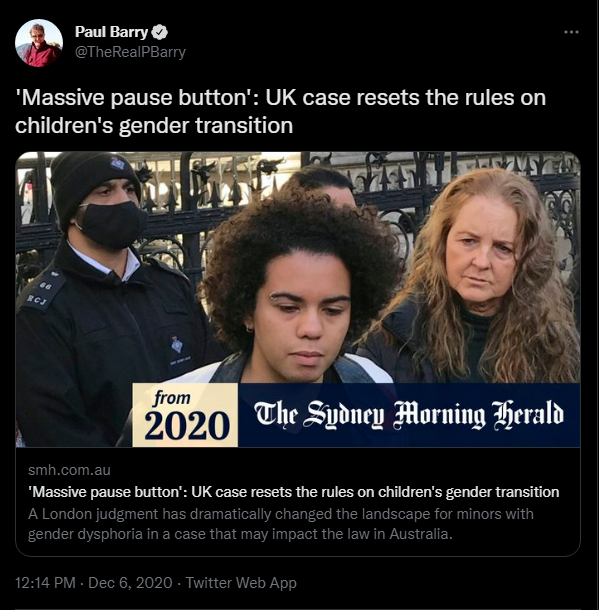
Incidentally, both of my excerpts I cited in the previous paragraph are with reference to articles about the closure of the UK paediatric gender service at the Tavistock Clinic, a subject which also comes up later in this very article. This may have something to do with Paul Barry’s apparent great interest in dealings there, e.g.:
(Barry, 2020)
#10
what exactly was the debate they wanted shut down?
Barry, in Adams J. (2022b)
It’s interesting that Media Watch tries to use its flimsy available excuse to force the framing of “wanting the debate shut down”; even at a first glance, it doesn’t quite fit.
The Media Watch piece earlier mentioned “eight or nine noisy trans activists” who wanted to shut down the debate. I’m hearing conflicting stories about them from trusted sources; I don’t know who they were, where they were, or what they did.
Luckily for me, Media Watch doesn’t seem to either, because it gives them no focus at all. Instead, it focuses on the 2 panellists who withdrew, and the 3 individuals quoted as a representative sample of Paul Barclay’s critics on Twitter.
The problem is that none of those individuals were agitating for the event to be shut down. Hines and Elkin chose not to participate because they felt they would be legitimising transphobia by doing so. Twitter users @EleanorEvenstar, @engagedpractx, and @nick_nobody expressed similar sentiments. Media Watch appears to have inflated this in order to help Faine victimise himself.
Anecdotally, this is representative of a broader pattern I’m witnessing in trans-hostile media coverage: if trans people or allies offer anything less than enthusiastic consent, journalists spin this as aggression justifying an overwhelming, full-spectrum counterattack.
#11
high-profile BBC radio host Stephen Nolan published a 10-part podcast
Barry, in Adams J. (2022b)
This is referring to Nolan Investigates: Stonewall (Nolan & Thompson, 2021). The reference is, naturally, uncritical. It does not mention, to take one example — and I do mean one; I can see at least seven, but I don’t want to get derailed — that Nolan Investigates heavily features Malcolm Clark, co-founder and a director of LGB Alliance, an anti-trans pressure group reported by openDemocracy in April to have intimate access to senior UK ministers (Ramsay & Bychawski, 2022), which among other factors has led some prominent UK-based analysts — such as Moore (2022b) of Trans Safety Network — to characterise it as state-backed.
Clark’s leadership role at LGB Alliance seems relevant given that LGB Alliance Australia, which to the best of my ability to determine is not autonomous from its UK parent, has been identified by the Global Project Against Hate and Extremism (2022), a US-based team of analysts originating from the Southern Poverty Law Center, as a hate group. If I were recommended a podcast on Islamic theology, I’d like to know if they used Pauline Hanson as a primary source.
It also seems relevant because even among LGB Alliance directors — charitably a rather motley lot — Clark’s views are especially Uhhh Hmmm. For instance, he is on record saying the presence of LGBT+ clubs in schools is “unnecessary and potentially dangerous” because “the vast majority of children have not settled on a sexual orientation” and therefore LGBT+ clubs “would be an unnecessary encouragement” to “predatory gay teachers” (Parsons, 2020). Hell of a take from a guy whose mission is purportedly “asserting the rights of lesbians, bisexuals and gay men” (Hurst, 2019) against the onslaught of the tranny horde.
(Media Watch also doesn’t mention that Nolan Investigates‘ episode on British law heavily refers to Dr Kathleen Stock, but that’s understandable; it might give the correct impression that transphobes are not a popular mass movement founded on genuine concern but rather a small, malicious clique with unexplained power.)
#12
which topped the charts on Apple and Spotify
Barry, in Adams J. (2022b)
This statement is slightly over-egging, but don’t worry (!) — it’s for a purpose. The impression this seemingly inconsequential statement seeks to give is that there is a “trans debate,” and that investigations into that “debate” have an organic popularity reflecting real public concern. This doesn’t quite match up with the facts.
First, this claim appears to be linked to a specific reference date, 23 October 2021, on which Nolan Investigates was respectively #3 and #4 in its relevant charts, according to podcast aggregator Chartable (2021). However, the charts in question were for ‘news podcasts in Great Britain,’ which is a slightly less earth-shattering accomplishment than “topped the charts” might be seen to imply.
In ‘all podcasts in Great Britain’ for the same date, Nolan Investigates made it to #32 at Apple and #80 at Spotify. For perspective, on Spotify’s chart for today, the same position is next to Baker Terry’s TV retread of new-’10s internet esoterica classic Don’t Hug Me I’m Scared (Chartable, 2022b).4 This is particularly remarkable given that, as Media Watch knows very well given that it’s in the Variety article which at this point in the broadcast they’re just about to cite, Nolan Investigates‘ marketing was backed by the full weight of the British political and media class:
The podcast, which was the culmination of an eighteen month investigation, quickly rose to the top of the charts on both Apple and Spotify after its release last month and garnered numerous headlines as well as comments from members of parliament.
Yossman (2021); emphasis mine
More generally, claims in this genre (“best-seller,” “most-listened,” etc.) tend to float around any transphobic screed published by someone who knows the right people; I noted this last year (Moreton, 2021) at the release of Trans: When ideology meets reality (Joyce, 2021), by The Economist executive editor Helen Joyce. The thing about “best-seller,” for its part, is that it can mean, among other things:
‘book placed in the store in the position which will best sell it’ (Atkinson, 2022);
‘book the store is best paid to sell’ (Atkinson, op. cit.);
‘book bought in bulk by the author or their supporters with the intention of “hacking” the bestseller list’ (Barnett, 2020).
I have no specific reason to believe anything analogous happened with Nolan Investigates, but I will gently suggest that podcast listening figures might not mean quite as much when, as King (2021) reports, they’re faked often enough that Spotify has started cracking down on it (at least when the little people do it).
#13
This had reportedly turned up: ‘numerous instances of BBC internal policy and editorial output that appeared to breach the corporation’s own impartiality guidelines’
Barry, in Adams J. (2022b)
The Variety article in question is Yossman (2021). Under the circumstances I think this is a particularly interesting choice of pull quote. You see, when I watched the Media Watch episode, I saw this —
(Adams J., 2022b, 2m19s)
— which allows the viewer to take away the impression that Variety independently verified that those “instances” were indeed there.
However, I read the Variety article myself because I’m a pathologically suspicious and paranoid bitch, and I noted that the full paragraph reads as follows:
In the podcast, Nolan and Thompson questioned whether the BBC was too close to Stonewall, providing numerous instances of BBC internal policy and editorial output that appeared to breach the corporation’s own impartiality guidelines, as well as the Equality Act 2010, following communication with Stonewall in connection with these schemes.
Yossman (2021)
That is to say, it restates the original claim without comment, rather than — as Media Watch would seemingly like to convey — backing it up.
#14
These included Stonewall being consulted on the BBC’s style guide and recruitment language
Barry, in Adams J. (2022b)
Far be it from me to oppose Aunty’s brains trust, but as far as I can tell, engaging brand style consultants to develop your corporate style guide seems … pretty normal (Upwork Team, 2022).
Moreover, if I wanted to develop LGBTQ+-specific style guidance, literally my first port of call would be the largest and oldest LGBT rights organisation in Europe, which … wouldn’t you know it, appears to be Stonewall, as hostile source Churchill (2021) admits.
#15
they had appointed the first-ever LGBT+ news correspondent and first gender and identity correspondent in BBC News
Thompson, in Adams J. (2022b)
Based. That’s all.
#16
we’ve corporately adopted the term LGBTQ+, Stonewall’s term
Thompson, in Adams J. (2022b)
Oh, I didn’t realise it was Stonewall’s term; Ring (2016) says it was GLAAD’s term, and judging from Ring (op. cit.), GLAAD appears to think so too. I imagine they’ll be devastated, but I’ll let them know.
Seriously, though, the fact that an entity uses or recommends a term does not mean that term belongs to that entity. That would stress me out enought that I’d be curled up in my bedroom (Shakespeare, 1600/2020, 2.2.57), puking (Shakespeare, 1623/2020, 2.7.151).
#17
That they’re all issues that Stonewall have lobbied on and that BBC has moved on, so that is prima facie evidence of Stonewall having some success
Thompson, in Adams J. (2022b)
What are the rest of us fags and trannies, chopped liver? Anecdotally I was using LGBTQ+ years ago, when I’d never heard of Stonewall the charity and had barely heard of Stonewall the riot. Stonewall the charity are heroes in my book, but they are very much rowing with the current here; they are not the prime mover.
Cultural change cannot be mandated from a single privileged point in the command hierarchy, no matter how high, and I think both the BBC and the ABC are fully aware of that fact.
#18
Many will say those changes are good
Barry, in Adams J. (2022b)
To recap, the changes in question are:
“first-ever LGBTQ+ news correspondent”
“first gender and identity correspondent”
“corporately adopted the term LGBTQ+”
“raising awareness of the importance of gender pronouns”
… Y– yeah, actually. I do think they’re good. Is there some reason they’re not good? Has something changed? The memo hasn’t reached me.
#19
one BBC journalist, Samantha Smith … [said] the BBC’s absolute core principle … was impartiality
Barry, in Adams J. (2022b)
I am going to gently suggest that given the somewhat crude pronouns joke in her Twitter bio —
(Smith S., 2022)
— Samantha Smith (@misssamsmith) may not be impartial on this topic.4
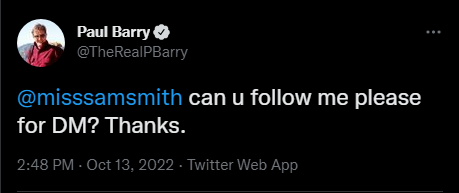
I am going to less gently observe that Paul Barry already knew this, because he was following her on Twitter — presumably related to him asking her to follow him only several days prior so he could send her a Direct Message.
(Barry, 2022)
Nobody was pulling wool over Paul’s eyes here.
#20
And paying money for Stonewall
Smith S., in Adams J. (2022b)
… One typically does pay money for consulting services, yes (?)
#21
and using Stonewall’s language
Smith S., in Adams J. (2022b)
I am tempted to remark that it’s Stonewall’s language; we’re just speaking in it. See #15 and #16, above.
#22
How is that independent? How is that impartial?
Smith S., in Adams J. (2022b)
I will be refraining from ordering Domino’s pizzas from now on, given the possibility that it might prevent me impartially reporting when they take an hour and a half to arrive.
#23
the AIDS Council of New South Wales, or ACON
Barry, in Adams J. (2022b)
This is a thorny one. This is indeed the original expansion of AOCN’s name, but that appears to be deprecated; its current legal name is ACON Health Ltd, and its current trading name is ACON (Australian Business Register, 2019/2022).
On the one hand, it does neatly explain why it’s called ACON. On the other hand, it is clearly not being quoted here in the context of its original purpose as an HIV/AIDS charity, and indeed it is unclear why that purpose is relevant. I would like to assume the best, but in an environment where transphobes often refer to trans people as a contagion (see, e.g., Bauer et al., 2021, p. 224), well …
#24
a women’s anti-trans group called ACON Exposed
Barry, in Adams J. (2022b)
This is an interesting claim. ACON: Exposed (n.d.) notes on its about page that feminists are members, but doesn’t appear to consider itself a women’s or feminist group; it refers to itself as “a loosely affiliated research group with no political links … [consisting of] ordinary individuals who believe that sex matters” (ibid.).
Of course, “anti-trans” is obvious — that’s the most symbolically loaded banana I’ve ever seen, and it’s not close.
(ibid.)
By tacking on the descriptor “women’s,” Media Watch appears to be pursuing either or both of two goals:
adding legitimacy by presenting this as self-defence by an oppressed demographic, namely women;
galvanising support by allowing it to be understood that women are disproportionately or only on the side of which ACON: Exposed is part, from which viewers could very reasonably infer that the opposite side must be misogynistic and hostile.
Unfortunately for Media Watch, the numbers don’t stack up: the women-versus-trannies binary doesn’t actually exist. Even on “TERF Island” itself, cis women have voiced majority support for trans rights by a margin which if applied to an Australian election would be considered an obliterating win (Sonoma, 2020).
#25
ACON’s ABC relationship manager offered editorial tips, including adding a help number
Barry, in Adams J. (2022b)
This is fairly standard practice on stories about queer or trans issues which are potentially distressing or triggering, which these days seems to be most of them. Thomas (2022) provides an example published in August in the venerable Sydney Star Observer.
#26
regardless of how good or worthy these programs are … having them scored by a lobby group raises questions about ABC impartiality
Barry, in Adams J. (2022b)
First and extremely relevantly, as Switchboard Victoria CEO Joe Ball (2022) points out, ACON is not a lobby group; it is a health promotion charity. This is an important difference which I’ll get into in a second, but I am aware that it is true partly because up until all this bullshit I knew of ACON primarily for its health promotion efforts: ACON’s TransHub provides information about Australian trans healthcare to a quality and completeness which is, as far as I know, unparalleled.
What Media Watch is doing here is implying the existence of an improper relationship by relying on you to conflate “lobbyist” with “lobby group” and “state broadcaster” with “public service”. Here’s the shortest version I could get after a couple hours tearing my hair out. This is based on
the Lobbying Code of Conduct, hereafter in this section the Code, which governs lobbyists and the Government.
The deal is this:
Both “lobbyist” and “lobby group” are descended from an original common-language verb, “lobby” (“attempt to persuade public officials”).
“Lobbyist” is a term of legal significance defined by the Code: it is an entity which communicates or engages people to communicate with Government representatives on behalf of a third-party client (Code ss 5(1), 5(2), 5(4)).
“Lobby group” is a common-language term meaning “group participating in public discourse in order to influence policy”. To avoid confusion with actual lobbyists, such groups are often referred to as advocacy groups, campaign groups, or special interest groups.
ACON is a charity (Australian Business Register, 2019/2022), so it is not permitted for it to be a lobbyist (Code ss 5(3)(a), 6(1)(a)) and it would get its ass kicked if it tried (Act s 11). It has specific nonpolitical charitable purposes (health promotion) and is permitted to engage in extremely specific advocacy about policy changes that would make its job easier or harder (Act s 12(1)(l)).
However, this is irrelevant, because the “Government representatives” bound by the Code are ministerial staff, ADF personnel, and people employed or otherwise engaged by agencies which employ under the Public Service Act 1999 (Cth), i.e., public servants and public service contractors. ABC staff might work at the state broadcaster, but they aren’t public servants or public service contractors, so the Code does not govern them.
All this is of fundamental importance because, as this quote demonstrates in black and white, the bulk of Media Watch‘s argument is simply saying that ACON being “a lobby group” is prima facie evidence that its relationship with the ABC is improper, knowing that the viewer will assume the terms “lobby” and “ABC” have the meanings and implications necessary for that claim to be true.
Media Watch assumes it will get away with this based on a belief which it may or may not sincerely hold but which in either case it believes the Australian public to hold. The belief in question is, to paraphrase Vossen (2019), that there are two kinds of relations to gender: cis and “political,” i.e., that by existing, trans people are engaging in a political campaign, and thus that ACON’s advocacy for trans health makes it more likely to be true that any engagement with ACON is problematically political in and of itself.
Media Watch does all this to mask the fact that suggesting that an entity passing public comment on the ABC inherently compromises its impartiality is blatantly absurd; by that standard, I compromised the ABC’s impartiality with the thread this post is based on, and am compromising it further now by publishing the post. Guess I’m the Managing Editor now. That’s free speech for ya!
The obvious follow-up argument is “But it’s different because they’re paying,” to which the answer is apparently not actually. For instance, every company on US-based GLAAD’s Social Media Safety Index is rated fucking abysmal and doing fuck-all about it, despite the fact that they’re all paying to be there (Smith A., 2022). The fact is that you can’t make a corporate big boy do anything it doesn’t want to.
Media Watch knows this. This means that what Media Watch is objecting to is the fact that the ABC wants to be inclusive. That’s a significantly darker and more worrying discussion.
#27
Imagine … the ABC paying thousands of dollars to Greenpeace and winning prizes for running stories attacking the fossil fuel industry. Or paying money to the Australian Republican Movement and being rewarded for stories criticising the monarchy
Barry, in Adams J. (2022b)
Hold up.
Media Watch implicitly sketches out a purportedly problematic editorial approach at the ABC by drawing attention to the following 9 specific actions:
ABC News reporting “having ABC staff march in Mardi Gras”
“the series First Day [Isdale & Stradling, 2020–2022], about a trans child”
“the ABC podcast series, Innies and Outies [Schafter, 2021–present]”
“adding a help number”
“fail[ing] to cover the … closure of the … Tavistock gender clinic” (more on that later)
“scant coverage of the [UK] High Court case [Bell v Tavistock]” (more later)
“ignor[ing] legitimate medical debate about caution and safeguards” (more later)
an alleged “lack of balance” in a Q+A panel (more later)
not citing a specific study in a story in April (more later)
Of these, I am excluding #8 because there’s literally zero chance that anyone making that complaint was acting in good faith (more later). Of the remainder, each can be categorised as being, from the point of view of critics, either ‘positive trans programming’ or being overcautious about risk of harm to the trans community. I can very well imagine circumstances in which the latter could be a problem. That’s not the issue.
The issue is that the hypothetical examples given both imagine attacks on an identifiable entity — “the fossil fuel industry” and “the monarchy,” respectively — which, notwithstanding that they would be objectively based (I’m doing sedition on WordPress! Hi AFP!), could give that entity credible grounds to claim having been harmed. None of the actual actions taken by the ABC and cited by Media Watch are attacks.
The implication here seems to be that either promoting positive programming about trans lives or protecting trans people from harm is itself an attack on someone else.
#28
what if the ABC also steered clear of debate on contentious matters, as it arguably does on transgender issues?
Barry, in Adams J. (2022b)
… are we to believe that trans issues are not contentious? You’re contending about them right now, and not only that, you’re contending about other contention! I’m contending additional to my original contention your contention about their contention! The conclusion here seems pretty clear!
#29
the ABC had failed to cover the controversial closure of the UK’s famous Tavistock gender clinic
Barry, in Adams J. (2022b)
This raises two questions:
In what way was it controversial?
Why should it have been covered?
The process of closing the Tavistock Clinic was initiated pursuant to a May 2021 recommendation from the Cass Review (Cass, 2021). In short, Dr Cass recommended abandoning the overloaded single central clinic in favour of regionalised services. It’s not in any dispute, by the way, that this is why it was closed; even The Guardian, famously transphobia central, has no problem admitting it (Brooks, 2022).
Transphobes were, at least initially, overjoyed at the closure because “the Tavi” was their bête noire; they were led to believe they Got Our Asses and that the clinic was closed To Save The Children (I haven’t checked whether they have yet discovered that this wasn’t the case).
However, trans people were also pretty happy about this, because the Tavi sucked. It was factional, unreliable, chronically and deliberately underfunded, and kept many kids from receiving care until the wrong puberty they had been trying desperately to avert had already irreversibly hit them. Regionalised care, on the other hand, whips the llama’s ass. No one is unhappy about there being more care.
It seems like trans people not creating controversy is controversial itself, the same way when we don’t debate, we’re suppressing debate, and when we don’t say what we’re told to, we’re killing free speech. It’s like being a Millennial teenager all over again.
To the point, though: why would we have covered this? What the UK did was literally switch to our model. We already have regionalised care: the Royal Children’s Hospital Gender Service in Melbourne; the Queensland Children’s Hospital Gender Clinic and Queensland Children’s Gender Service; etc. There is no news for us here. There is nothing to learn.
#30
it had given scant coverage of the High Court case against the clinic from Keira Bell [i.e., Bell v Tavistock]
Barry, in Adams J. (2022b)
This whole passage is just relentlessly Interesting™ from start to finish. For instance, I am Interested™ by Media Watch‘s decision to use the term “High Court,” without clarifying. To any Australian, that has a specific association: the High Court of Australia, the Commonwealth’s highest (“apex”) court.
If that’s what a “High Court” is — as is often the case — then that must be newsworthy, without doubt. There was no question at all that, for instance, apex-level US cases like Obergefell v. Hodges were of significant material interest to Australian viewers.
The problem is that in this case, a “High Court” is … not that. The court which heard Bell v Tavistock is HM High Court of Justice in England and Wales (“EWHC” in the reference list), the highest trial court and second-highest appellate court for England and Wales. In practical terms, suggesting the ABC had a duty to cover any decision of the High Court of Justice is effectively equivalent to suggesting the BBC has a duty to cover decisions of the Supreme Court of New South Wales.
#31
who alleged she had been rushed into treatment with puberty blockers without due care
Barry, in Adams J. (2022b)
Bugger me, that seems pretty serious. Well, what did they find— oh, she lost.
Specifically, the High Court of Justice (“Divisional Court,” in legal jargon) found in Bell’s favour, but in Bell v Tavistock Appeal, the Court of Appeal (“EWCA” in the reference list) reversed, repeatedly asking the Divisional Court what the fuck they thought they were doing, not in those words (see the reference list entry for pinpoint citations). The UK Supreme Court has refused to hear an appeal. The case is resolved, and not in a way which left any questions unanswered.
The inorganic nature of Media Watch‘s concern is rather highlighted by the fact that none of this is news anymore. The High Court of Justice decision was in December 2020, and the Court of Appeal decision was in September 2021, over a year ago, yet only since this August has Media Watch seen fit to bring it up.
#32
We also noted that the ABC had ignored legitimate medical debate about caution and safeguards
Barry, in Adams J. (2022b)
The episode to which Media Watch is referring here is Adams J. (2022a). They may be characterising themselves a little bit charitably. (P.S.: “Safeguards”? We’ll come back to that.)
What Media Watch noted in that story is that a number of other media outlets were reporting on the story. They referred, and only obliquely, to one primary “medical” source: the Interim Report of the Cass Review (Cass, 2022).
The Interim Report identifies several points of disagreement. Rather inconveniently for Media Watch, however, despite the Interim Report‘s commitment to a non-judgemental, neutral tone, reading it quickly puts to bed any question of a “legitimate medical debate”.
Every point of disagreement identified in the Interim Report has a well-established, international-consensus-backed answer:
But what if they stop being trans? (s 1.7): They don’t.
But don’t we need a working definition of what being trans is? (s 1.24): We have one. Look in the DSM-5.
But are trans kids really trans? (s 2.15): Yes. See #1.
But what if they stop being trans? (s 4.15): See #1.
What the Interim Report does, grudgingly and more or less against its will, is confirm (e.g., s 2.15) the existence of a right-wing faction of white-ant clinicians who will simply keep re-asking the question until they get the answer they want.
What it does not do is present any basis for the ABC to report or comment. Neither its context nor its content are applicable here.
#33
Two days later, ABC Sydney’s Josh Szeps invited Dr Philip Morris, who urges caution, to talk about these matters
Barry, in Adams J. (2022b)
First of all, lol, a doctor named Philip Morris. Whoever’s the god of nominative determinism, they’re having a perverse little giggle about that one.
Like everyone else, Dr Morris is entitled to have an opinion on trans healthcare — God knows I can’t stop him — but there’s no obvious reason why that opinion should be promoted as authoritative. Recall again that this is about paediatric trans healthcare. According to his website, Dr Morris specialises in addiction medicine, dementia, forensic psychiatry, general adult psychiatry, geriatric psychiatry, medicolegal assessment, and memory disorders (Morris, n.d., “About Dr Morris”). It’s unclear where trans healthcare of any kind comes in.
Dr Morris is usually quoted in Australian mass media as president of the National Association of Practicing Psychiatrists (NAPP). This may have been avoided here because the ABC gets a bit more scrutiny than the publications usually associated with that trick, which are broadly acknowledged to be rags.
Since Media Watch doesn’t explicitly mention it, I won’t get too deep into NAPP, but I am intrigued to note that Dr Morris used NAPP to effectively self-publish a paediatric trans care “guide” (Morris et al., 2022) co-written with, among others, Dr Roberto D’Angelo, an affiliate of the Society for Evidence-based Gender Medicine (SEGM). I have written before on SEGM. To recap:
they are effectively the executive politburo of a much broader-based anti-trans organisation, Genspect (Moore, 2022a);
of their major characteristics, one is anti-trans activism in a professional context that could be described as intense, bordering on frantic (see e.g. D’Angelo et al., 2020);
the other one is being funded by the internet equivalent of large suitcases full of unmarked bills (Moore, 2021).
Note that I am referring to Dr Morris as “effectively self-publishing” through NAPP on the assumption that they are fairly closely linked; as I noted in the original thread, the main contact number for NAPP is the same number given for Dr Morris’ mobile phone on his website:
(National Association of Practising Psychiatrists, n.d.)Morris (“Home,” n.d.)
#34
complaints from women about the lack of balance
Barry, in Adams J. (2022b)
One wonders if “women” was the most specific descriptor Media Watch felt they could get away with.
The first source quoted here is Angie Jones. I will settle for pointing out that Angie’s Twitter bio identifies her as co-host of a production (a YouTube vlog, as it happens) called TERF Talk Downunder (Jones, 2022) — wonder what that’s about (!)
The second source quoted is Astra Niedra, a wellness influencer who appears (Niedra, 2022a & 2022b) to be a fan of multiple anti-trans activists, including anti-trans dating app founder and failed scriptwriter Sall Grover (Grover, 2020; Runnels, 2020), British author Milli Hill (2021), and British author and failed scriptwriter J.K. Rowling (Rowling, 1997 & 2020; Miller & Erbland, 2018).
#35
A panel of MEN & one woman
Jones, in Adams J. (2022b)
This is a quote from Angie, but its significance here is that Media Watch doesn’t correct it, and indeed implicitly endorses it as correct by calling it a “concern” which the ABC went on to “meet”.
An Internet Archive snapshot (Australian Broadcasting Corporation, 2022a) reveals that the announced members of the 25 August Q+A panel at the time of Jones and Niedra’s complaints (22 August) were Kieren Perkins, Hannah Mouncey, Joe Williams, David Lakisa, and Catherine Ordway, all of whom had been announced 19 August. That includes two women: Hannah Mouncey and Catherine Ordway.
Angie’s Tweet obviously requires that one of the two women on the panel, Hannah Mouncey or Catherine Ordway, was a man. Dr Ordway is, to my knowledge, cis; Ms Mouncey, however, is trans (Zeigler, 2022). When the host of TERF Talk Downunder said one of them was a man, it’s pretty clear who she meant. Media Watch seems to think that’s fine.
#36
ABC then added a female athlete to its panel at the last minute
Barry, in Adams J. (2022b)
Once again, one wonders if “female athlete” was the most specific descriptor Media Watch felt they could get away with. According to the Q+A transcript, the new panelist was weightlifter Deborah Lovely-Acason (Grant, 2022).
Not just any female athlete, our Deb, as we are informed by Binary Australia (2021) — like LGB Alliance Australia, classified by the Global Project Against Hate and Extremism (2022) as a hate group. As the cited press release from Binary attests, Lovely-Acason’s primary belief of current political note seems to be feeling wronged by the existence of trans woman athletes, most prominently her competitive rival Laurel Hubbard.
Of course, that’s current political note. Even Binary, normally so direct, is a little evasive on this one; in order to present the narrative that Deb was an apolitical professional radicalised by being screwed over, they don’t mention she was a failed Family First candidate at the 2012 Queensland state election (Electoral Commission Queensland, 2012).
N.B. I’ll be brutally honest, I didn’t have to do this research ex nihilo; I had the fortune of running into Deb when she was haunting Facebook comment sections last year. She doesn’t like transfem athletes at all, and she really wants everyone to know.
#37
campaigning Liberal senator Claire Chandler
Barry, in Adams J. (2022b)
Ah yes, Senator Chandler, who in February this year said “her ‘Save Women’s Sport’ bill would give clarity to sports clubs that want to exclude transgender women from competition in women’s sport” (McLennan, 2022). Did Media Watch think we’d forgotten so soon?
#38
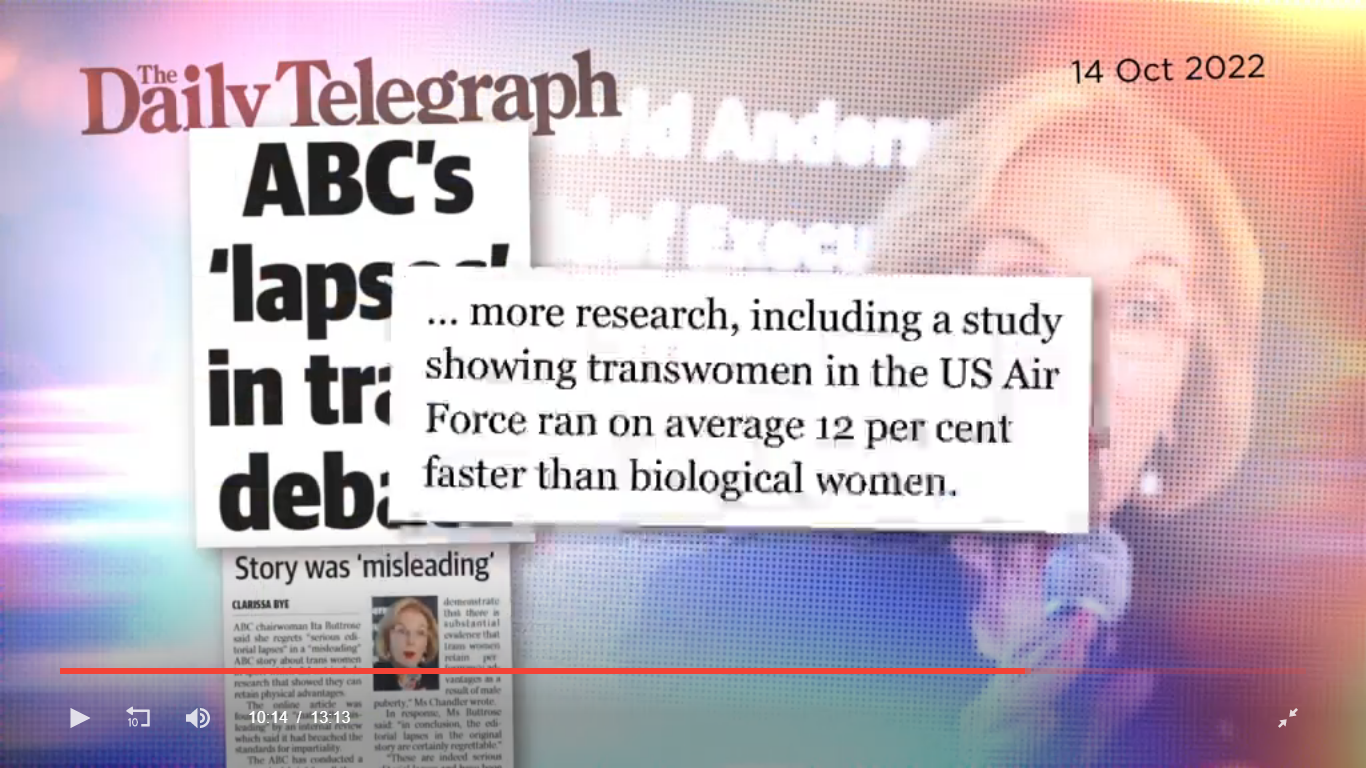
a study showing transwomen in the US Air Force ran on average 12 per cent faster than biological women
The Daily Telegraph, in Adams J. (2022b)
I have to imagine Media Watch were drooling over the chance to fit the terms “transwomen” (no space) and “biological women” into this piece. (We know there’s no space because Media Watch displays pull quotes on screen; this one shows up at approximately 10m14s:)
(Adams J., 2022b, 10m14s)
The study in question is Roberts et al. (2020). As it happens, I am familiar with this study, but it took some frustrating digging to find because seemingly no source wanted to mention the name of the ABC article it was cited in.
As Kirsti Miller, former national sports star and trans woman, pointed out in April (Miller, 2022), the study isn’t as broadly applicable as it’s made out to be, because the trans women and cis women groups weren’t height-matched. Trans women might appear to have an athletic advantage simply because they are taller — a quality which cis women are actually not forbidden from having. How do we know that this might be the reason? Because the study says so (Roberts et al., op. cit., p. 5), and because the lead author firmly restated it to PolitiFact (Valverde, 2021).
Many sources for a popular audience will waffle about height not being an advantage, such as Fritscher (n.d.) for Gannett’s AZCentral, who notes that “the relative advantages of height are frequently offset by other factors”. However, based on Khosla (1985), Fritscher also noted that “In medium-distance running, height may become an advantage” — including in the 1,500m, the exact event length studied by Roberts et al. (op. cit.).
#39
the concern here is that it is not impartial but one-sided
Barry, in Adams J. (2022b)
No way. The ABC, one-sided (Moreton, 2022a)?
Really (Moreton, 2022f)?
… I suppose I can see it (Moreton, 2022h).
#40
does it accept that its partnership with a lobby group, ACON, could be a problem
Barry, in Adams J. (2022b)
Passing over the “lobby group” lie for a second, well, it depends. A problem for whom?
#41
insisting the newsroom remains in control of all content
Barry, in Adams J. (2022b)
I like this tactic because it’s a neat way of implying that the newsroom does not, in fact, retain control of all content, while evading the responsibility of actually making that case.
I am particularly tickled because the ABC FOI Disclosure Log (Australian Broadcasting Corporation, 2022d), which lists requests compelling the ABC to disclose information under the Freedom of Information Act 1982 (Cth) and provides the information that was disclosed, has an entry for the disclosure used for this story, #202223-003. That disclosure yielded 204 pages of documents and correspondence in 2 PDFs (Australian Broadcasting Corporation, 2022b & 2022c). You’d think if there was an impropriety there’d be a slam dunk about it in there somewhere, but apparently not.
#42
it’s worth noting their representative pulled out of that Melbourne debate, claiming it was unsafe to take part
Barry, in Adams J. (2022b)
Unsafe for whom? Here is the relevant part of ACON’s response to Media Watch‘s questions, which one would hope Media Watch had read.
[Q.] Why did ACON/Pride in Diversity withdraw from the Uni of Melbourne panel discussion, Pride and Prejudice in Policy?
[A.] The health and wellbeing of our staff and communities are paramount. Commentary on social media about the panel discussion in the lead up to the event had turned into a debate about trans people rather than our diversity and inclusion work.
It is harmful for our communities when their right to exist is debated in a public forum. Following a reassessment of risk, we determined that our participation in event could compromise the safety of our staff and people in our communities. Safeguarding the welfare of our people was our top priority.
It should be noted that other panelists also withdrew from this event.
Parkhill (2022)
The phrasing used by the Media Watch episode suggests that Elkin confected a tall tale of personal danger as a flimsy cover for pulling out from raw cowardice alone. However, ACON’s statement makes unambiguously clear that the actual concern was the wellbeing of others. In cis people, such concern would typically be considered not cowardly, but laudable.
Was the poor phrasing in the ABC’s report unintentional? If so, accidentally conflating “danger to trans people collectively” with “danger to Nicki Elkin,” and presenting both as cowardice, still implies that Media Watch considers trans people interchangeable and danger to them not worth avoiding.
#43
We also asked ACON if the ABC had ever lost points in the Australian Workplace Equality Index for critical or negative editorial coverage. And they told us:
“The manner in which the ABC covers LGBTQI issues editorially, or the tone or angle in which they are presented, does not impact their AWEI assessment.” (-Email, Nicolas Parkhill, ACON CEO, 14 October 2022)
However, the ABC has won points and awards for positive programming.
Barry, in Adams J. (2022b)
It’s not actually clear how these two things are supposed to be incompatible, which is the clear suggestion given the point vs. counterpoint phrasing here. The only example of points-winning positive programming cited by Media Watch was First Day (Isdale & Stradling, 2020–2022), which is a drama series. That means it’s fictional. That means it doesn’t interact with ABC journalists’ editorial approach in any way.
This whole quote is like saying that it’s incompatible for me both to be aware that the BBC is a viciously transphobic institution and to be delighted when Doctor Who (Strevens et al., 2005–present) does stuff which is extremely trans and cool as hell.
#44
emails … show an ABC journalist … receiving advice from ACON on the correct definition of the word family
Barry, in Adams J. (2022b)
Oh fuck, really? “They’re letting fags and trannies redefine the family?” I already sat through the Australian Marriage Law Postal Survey, I don’t think I can do this again.
#45
changing the language and internal culture of a media organisation may still influence editorial values and programs’ story selection
Barry, in Adams J. (2022b)
If you persuade people not to be arseholes, they’re less likely to do arsehole things. Wait one, new wire story coming in from the Associated Press: SKY SUBJECTIVELY BLUE, WATER WET.
#46
Professor Alan Davison of the University of Technology Sydney
Barry, in Adams J. (2022b)
For the sake of decorum we’ll pretend I assumed Prof Davison must have extensive relevant experience. After reviewing his résumé (University of Technology Sydney, n.d., “Prof Alan Davison: About”), however, I was unable to determine from which part of his accomplished academic career in, apparently, musicology, it was supposed to derive. (My degree is also in music, but as proud as I am of our shared field, it has limits.)
I therefore consulted UTS’ record of Prof Davison’s publications (University of Technology Sydney, n.d., “Prof Alan Davison: Research outputs”), whereupon things became somewhat clearer. I was enthralled to note that Prof Davison’s most recent publication had the short title “Multiculturalism, social distance and ‘Islamophobia’” (Davison, 2022); I thought the quote marks around ‘Islamophobia’ were a particularly spicy choice.
My eyes were drawn, however, to a somewhat less recent publication in the same journal: “A Darwinian approach to postmodern critical theory: or, How did bad ideas colonise the academy?” (Davison, 2020).
As Wallace-Wells (2021) illustrates in The New Yorker, in 2020s political discourse, the academic meaning of critical theory observed by its original theorists has been decisively overtaken both in popular and academic discourse by its status as a floating signifier — no fixed, uncontested strict, meaning, but only a string of connotations, “hostile, academic, divisive, race-obsessed, poisonous, [and] elitist,” making it “the perfect villain” (Rufo, quoted in Wallace-Wells, op. cit.). This is particularly true of the subject with which Wallace-Wells is concerned: critical race theory (CRT).
Trans people will already be familiar with such empty signifiers; most will have dealt with an absolutely mindnumbing onslaught of cries of “gender ideology,” a slogan invented by the Catholic Church in the early-to-mid-1980s and going strong ever since. With the rise of CRT, however, right-wing activists are explicitly trying to link the two (see, e.g., Kao, 2021).
Davison (2020), boldly going where no (well, probably almost no) musicologist has gone before, certainly had plenty to say about critical theory, specifically postmodern critical theory (PMCT), its application in the social sciences (Agger, 2012). In the abstract alone, he calls it
a peculiar set of misbeliefs
Davison (2020)
characterised by
prevailing antirational explanatory models
(ibid.)
and
religious-like performativity and self-validating arguments
(ibid.)
I strongly suspect a combination of the political moment and Prof Davison’s publishing record, more than any relevant specialist expertise, may be the primary factors explaining his presence on the panel.
#47
we’re not suggesting the ABC should abandon its commitment to diversity and inclusion
Barry, in Adams J. (2022b)
Fair enough. You are simply suggesting that everything it does ot implement that commitment is evidence of bias, or even institutional capture. That’s not the same thing at all.
#48
The problem here is a media group partnering with and being rewarded by a lobby group — any lobby group. And how that could lead to perceptions of bias in coverage or to bias itself
ibid.
… You know, I’ve changed my mind. I think I can see the problem now.
(@Peggysknapsack, 2022)
For anyone not sure what they’re seeing here: fuck, I wish I was you. No, but seriously … but I am being serious. No, but for real:
This is a collection of receipts from the private Facebook discussion group for the Coalition for Biological Reality.
The Coalition for Biological Reality (here “CBR”) are an anti-trans hate group. (see, e.g., Jones J., 2022).
Nastassja Freischmidt (“Stassja Frei”) is CBR’s founder (Frei, 2022).
Catherine Anderson-Karena (“Kat Karena”) is or was a community liaison for LGB Alliance Australia (see, e.g., Anderson-Karena, 2022).
Rachael Wong is the CEO of Women’s Forum Australia, an explicitly anti-trans lobby group (see, e.g., Women’s Forum Australia, n.d.) which incidentally is named suspiciously closely to the rather more legitimate and reputable International Women’s Forum‘s Australian branch.
Kit Kowalski is a conspiracy theorist who was as of Saturday 15 October — anecdotally as of Tuesday 18 October, but the 15th is the last archive snapshot — contending in her Twitter bio that “ACON controls [the] Aussie govt” (Kowalski, 2022a). As of 19 October she had changed it to the rather more innocuous “AMA about ACON and the ABC” (Kowalski, 2022b), possibly because I had rather inconsiderately pointed it out the previous day (Moreton, 2022n).
Between them, based on their remarks, Anderson-Karena, Freischmidt, Wong, and possibly a few others appear to have effectively ghostwritten the episode through Media Watch‘s “senior producer,” who they refer to with she/her pronouns — suggesting they probably mean supervising producer Gabrielle Clark (Australian Broadcasting Corporation, 2022e).
I cannot say this surprises me overmuch; as I mentioned earlier, I noticed the piece referred to “safeguards,” specifically “safeguards in treating gender dysphoria in children”. “Safeguard” is a common word, but in the context of “the trans debate,” and especially the “debate” around paediatric trans healthcare, it is a specifically British term of art (see, e.g., Care Quality Commission, 2022) meaning looking after the welfare of vulnerable people, particularly children.
“Safeguarding” is often used by the British government, via “think of the children,” as a way of illegitimately-to-outright-illegally blocking trans people from accessing medically necessary care (e.g., Topping, 2022). It doesn’t have an organic presence in specialised or general Australian English; it gets here exclusively through people whose brains have been marinating in British TERFism for a while.
To the point, however, this makes it a lot easier for me to agree with Media Watch. This case is open and shut: The ABC has indefensibly compromised its impartiality and balance by partnering with a lobby group and giving it wholesale editorial control! Just not the one Media Watch meant.
I can certainly see how this would lead to “perceptions of bias in coverage,” given that it clearly led to “bias itself”! Given that this clearly cannot continue, the question — with all due respect — is:
What the fuck does the ABC intend to do about it?
Footnotes
#1
I obviously set about reformatting this from a Twitter thread and therefore had to build a proper reference list and in-text citations.
Superscript numerals are for footnotes.
Most citations are in APA 7 style (the style given by the Publication manual of the American Psychological Association, 7th edition).
Per APA style, legal citations are in AGLC 4 style (the style given by the Australian Guide to Legal Citation, 4th edition).
#2
A few too many self-cites in this piece [gigantic jerking-off motion]. Sorry!
#3
I reported Faine’s piece as being in The Sydney Morning Herald. This has to do with a technical quirk in Nine Entertainment’s web presence; namely, they serve a central corpus including at least most of their op-eds separately under all of their mastheads, which include both the Herald and The Age, and the Herald version is the one that reached my inbox. Given Faine is in Melbourne, describing events that took place in Melbourne, The Age version (Faine, 2022) is presumably the canonical one. (They are identical.)
#4
I like steelmanning, so I would normally have used Apple’s chart here because, as noted, Nolan Investigates ranked much higher on that one. However, Spotify’s chart was the only one which contained a nearby “landmark” that I recognised. The nearest production I recognised in Apple’s chart (Chartable, 2022a) was Off Menu with Ed Gamble and James Caster (24 spots above, at #8).
#5
Since “Samantha Smith” and “Sam Smith” are common names, yes, I’m quite sure it’s the same one. @misssamsmith has previously noted having “used to edit politics programmes in one of the BBC regions”. Devaney (2017) writes in HuffPost concerning Inside Out South West, a newsmagazine program broadcast by BBC South West, one of the BBC English Regions, in the context of focusing on Samantha Smith, its editor.
Smith is quoted as saying “long experiences of … both reporting and presenting”. An archived 2014 webpage for Inside Out South West (British Broadcasting Corporation, 2014/2021) identifies an extremely similar-looking woman also named Sam Smith as its presenter.
Rather more prosaically — and infuriatingly after all that detective work — I found an Archive Today snapshot from close to nine years ago (Smith S., 2014) which establishes that at that time Samantha Smith @misssamsmith was the presenter of Inside Out South West. Oh well.
Interestingly, if Devaney (op. cit.) is an accurate representation then Ms Smith seems to have a newsworthy record of opinions about what her colleagues should look like, characterised by being conservative about skirt length and not overfond of “PC”.
P.S. If you wish to, you can financially support whatever it is I’m doing here through Ko-fi. However, please don’t feel obliged.
References
ACON: Exposed (n.d.). About. Retrieved 19 October 2022.
Adams, J. (Director) (2022b, October 17). ACON & the ABC (Season 2022, Episode 35) [TV series episode]. In T. Latham (Executive producer), Media watch. Australian Broadcasting Corporation. Retrieved 19 October 2022.
Agger, B. (2012). Ben Agger. In P.M. Nickel (Ed.), North American critical theory after postmodernism: Contemporary dialogues (pp. 128–154). Palgrave Macmillan. doi:10.1057/9781137262868_7. Retrieved 19 October 2022.
Australian Broadcasting Corporation (2022d, September 29). FOI disclosure log. Retrieved 19 October 2022.
Australian Broadcasting Corporation (2022e, October 20). Media Watch: About. Retrieved 20 October 2022.
Australian Business Register (2022, October 20). Current details for ABN 38 136 883 915. Australian Government. (Current record version published 9 April 2019.) Retrieved 20 October 2022.
Australian Charities and Not-for-profits Commission (2021, November 24). ACON Health Limited. Australian Government. Retrieved 20 October 2022.
Grant. S. (Host) (2022, August 25). Sports, inclusion and redemption [TV series episode]. In E. Vincent (Executive producer), Q+A. Australian Broadcasting Corporation.
Disclaimer: I am not a medical professional or a scientist. This is a lay summary of popular and scientific coverage surrounding the event.
Sudden infant death syndrome (SIDS) is the leading cause of infant mortality in the Western world (Raven, 2018). It is a condition where a child less than one year old dies suddenly (“Sudden infant death syndrome,” 2017). For a diagnosis to be made, a cause of death must not be found after an autopsy and an investigation of the scene of death (“Sudden unexpected infant death,” 2013).
In the time since SIDS was originally indexed, nobody has been able to determine why it happens (“What causes SIDS?”, 2017). We’ve assumed that it’s multifactorial, i.e., that multiple risk factors have to line up (Kinney & Thach, 2009; Byard, 2018). Most of the proposed risk factors are temporary and are not intervenable, i.e., they can’t be prevented from happening — things like a specific inborn susceptibility and a specific time in development.
The only intervenable risk factor which has been proposed is the presence of environmental stressors, i.e., factors in the environment or in the way the environment directs the baby’s behaviour (Kinney & Thach, op. cit.). Environmental factors which have been proposed include co-sleeping, i.e., parents keeping their babies in the same bed as themselves, potentially causing the babies to suffocate; overheating; side sleeping; stomach sleeping; and prenatal exposure to nicotine (Fleming et al., 1993; Sullivan & Barlow, 2001; Bajanowski et al., 2007; Moon et al., 2007; Lavezzi et al., 2010; Moon, 2011; Moon & Fu, 2012; Carpenter et al., 2013; Horne, 2014; Moon et al., 2016; Carlin & Moon, 2017; Young & Shipstone, 2018; Anderson et al., 2019; “What causes SIDS?”, op. cit.).
The death of one’s child is an unimaginably traumatic experience. SIDS further compounds that. Like unexpected deaths from unknown causes in general, deaths from SIDS must be extensively investigated (Kinney & Thach, op. cit.). We’ve thought for some time, and with some degree of confidence, that the mechanism by which SIDS causes death is through hypoxia (Duncan & Byard, 2018), i.e., it deprives vital organs, particularly the brain, of oxygen. Because of this, SIDS has to be distinguished from other hypoxia-related deaths.
One cause of hypoxia-related death is intentional child murder by suffocation (Kinney & Thach, op. cit.). Another mechanism (Bajanowski et al., 2005) is shaken baby syndrome (SBS), thought to result from physical abuse by vigorous shaking, which may not, however, have been intended to kill — that doesn’t make it any better but it does make it different from murder. SBS is mechanically the same condition as whiplash in adults, but while whiplash mostly causes injuries to the muscles, ligaments and discs of the neck, SBS appears able to cut off oxygen to the brain (Miehl, 2005).
In cases of SIDS, suspicion of both murder through suffocation and involuntary manslaughter through SBS necessarily falls on parents, who are very probably innocent and grieving the loss of their child. Even without alleging criminal or unethical conduct, however, parents — and particularly mothers — whose children die of SIDS often bear the stigma of having been careless, even if they took every possible precaution.
Dr Carmel Harrington, a sleep medicine researcher at The Children’s Hospital at Westmead, in Western Sydney, NSW, is a mother whose son died of SIDS 29 years ago (“World first breakthrough could prevent SIDS,” 2022). On 6 May 2022, eBioMedicine, a division of The Lancet, published Harrington et al. (2022), who found that, compared to blood samples taken from healthy babies, blood samples from babies who died of SIDS contained considerably lower levels of butyrylcholinesterase (BCHE).
BCHE appears to play a role (Eggermont, 2014, pp. 278–280) in the ascending reticular activating system (ARAS), the part of the brain that regulates the ability to wake up (Tapia et al., 2013; Peters, 2020). The ARAS is the same system which causes adults with sleep apnea of the obstructive (OSA) or central (CSA) types to wake up if they stop breathing for too long. BCHE deficiency may prevent the ARAS from kicking in, meaning that a baby who stops breathing simply continues to not breathe, and never wakes up.
This discovery is significant because if further research verifies a strong link between low BCHE and SIDS, it may be possible to develop screening to identify infants at risk of SIDS before they can die, and then to develop medical interventions to massively reduce or prevent SIDS altogether (Connell & Vidal, 2022; Ravikumar, 2022; Van de Riet, 2022).
Bajanowski, T., Brinkmann, B., Mitchell, E.A., Vennemann, M.M., Leukel, H.W., … & Beike, J. (2007, February 7). Nicotine and cotinine in infants dying from sudden infant death syndrome. International Journal of Legal Medicine, 122, 23–28. doi:10.1007/s00414-007-0155-9. Retrieved 14 May 2022.
Byard, R.W. (2018). Chapter 1: Sudden infant death syndrome — Definitions. In J.R. Duncan & R.W. Byard (Eds.), SIDS — Sudden infant and early childhood death: The past, the present and the future. University of Adelaide Press; US National Library of Medicine. Retrieved 14 May 2022.
Duncan, J.R., & Byard, R.W. (2018). Chapter 2: Sudden infant death syndrome — An overview. In J.R. Duncan & R.W. Byard (Eds.), SIDS — Sudden infant and early childhood death: The past, the present and the future. University of Adelaide Press; US National Library of Medicine. Retrieved 14 May 2022.
Kinney, H.C., & Thach, B.T. (2009, August 20). The sudden infant death syndrome. New England Journal of Medicine, 361, 795–805. doi:10.1056/NEJMra0803836. Retrieved 14 May 2022.
Moon, R.Y., Horne, R.S.C., & Hauck, F.R. (2007, November 3). Sudden infant death syndrome. The Lancet, 370(9598), 1578–1587. doi:10.1016/S0140-6736(07)61662-6. Retrieved 14 May 2022.
Moon, R.Y., & Fu, L. (2012, July 1). Sudden infant death syndrome: An update. Pediatrics in Review, 33(7), 314–320. doi:10.1542/pir.33-7-314. Retrieved 14 May 2022.
Raven, L. (2018). Chapter 4: Sudden infant death syndrome — History. In J.R. Duncan & R.W. Byard (Eds.), SIDS — Sudden infant and early childhood death: The past, the present and the future. University of Adelaide Press; US National Library of Medicine. Retrieved 14 May 2022.
Sudden infant death syndrome (2017, January 31). US National Institute of Child Health and Human Development. Retrieved 14 May 2022.
Sudden unexpected infant death (2013, March 7). US National Center for Chronic Disease Prevention and Health Promotion; Internet Archive. Retrieved 14 May 2022.
Young, J., & Shipstone, R. (2018). Chapter 11 — Shared sleeping surfaces and dangerous sleeping environments. In J.H. Duncan & R.W. Byard (Eds.), SIDS — Sudden infant and early childhood death: The past, the present and the future. University of Adelaide Press; US National Library of Medicine. Retrieved 14 May 2022.
The last three parts of this series covered the shape that the anti-trans culture war is taking in Australia, why the people prolonging the war say it is happening, and why it is actually happening.
The question becomes:
What can people opposed to the further marginalisation and silencing of trans communities do to fight back?
Write to your elected officials
At present, the primary venue for transphobic legislation in Australia is the Commonwealth Parliament. The federal Coalition government is openly trans-hostile to the point that discussing it further here is likely to be unproductive.
However, the federal Labor Opposition’s stance on trans rights has also been less than stellar. Caucus voted to pass the Religious Discrimination Bill 2022 (Cth) without amendments if they considered it necessary (Karp, 2022). Senator Kristina Keneally, the Shadow Home Affairs Minister, told ABC TV’s Insiders that Labor religious discrimination legislation would likely allow anti-trans employment discrimination (“Kristina Keneally,” 2022). Also in February, Anthony Albanese MP, the federal Opposition Leader, told The Monthly that he thought trans people expecting not to be deliberately misgendered was “just not a reasonable thing to do” (Bryant, 2022).
In 2022, the Parliament of Queensland will most likely consider legislation brought by the Palaszczuk government which will harmonise Queensland law with the laws of other states by abolishing the existing requirement to have sex reassignment surgery (SRS) in order to qualify for a legal change of gender (Hirst, 2021). Consequently, there will likely be an uptick in culture warfare in Queensland specifically.
Local (city, region, shire, etc.) government has not yet formed a significant theatre of the anti-trans onslaught in Brisbane. However, local governments are starting to become battlegrounds in other states (MacDonald, 2019; Lewis, 2021; Maley, 2021). In 2022–2023 it is probably best to keep a weather eye.
There are two kinds of lobbying in which you can engage:
Reactive lobbying. This involves contacting your representatives to demand they vote a certain way on a measure being considered by their legislative chamber. I will be using this blog to provide rolling coverage of anti-trans bills as they come up.
Proactive lobbying. This involves contacting your representatives to demand they take action on an aspect of the law which is not currently the subject of a measure in their chamber. I am working on developing a summary of legislative measures which have broad support from the trans community in Australia.
Materially support trans people
Bretherton et al. (2021) surveyed 928 participants in Australia from September 2017 through January 2018. 47% of respondents had tertiary qualifications, compared to approximately 27% of the general population at the time (Hughes, 2022); however, 19% were unemployed, compared to 5.5% of the general population throughout the same period (“Labour force,” 2017; “Labour force,” 2018). 33% of respondents reported experiencing anti-trans employment discrimination, which is illegal under Australian federal law. Trans people who find themselves out of work will spend longer searching for a job, and will most likely burn through more of their savings doing so.
Illness and disability can impair a person’s capacity to work. However, trans people’s access to appropriate healthcare is often impaired by a trans-hostile healthcare environment, and by “trans broken arm syndrome,” the tendency of cis medical practitioners to attribute literally every possible health problem, metaphorically (and occasionally literally) up to a broken arm, to a trans person’s medical transition, and refuse to investigate or treat it in any other way (Bisshop, 2017).1 Consequently, trans people who are kept out of the workforce by a medical condition may be kept out for longer.
Donate to trans people’s transition and survival crowdfunds; transition therapy coverage on the Australian public system is woeful, worse than in much of the rest of the English-speaking world (Aidone, 2021). Give them food, or invite them to eat with you, so they can spare the expense of a meal — and because being trans is often a deeply lonely experience (Bowling et al., 2020) even though trans people have done nothing to deserve that. We do these things for each other; please join us and help out.
Be an active ally
Observe basic etiquette
Deadnaming is the act of referring to a trans or nonbinary person by a name they used prior to transitioning, but no longer use. Misgendering is the act of labelling a person with a gender that does not match their gender identity. Please do not do either of these things.
Put in the work to see your trans family and friends as their correct gender
Keep in mind that the traits often treated as indelible marks of gender are actually shared across multiple genders; I am a baritone, and a few years ago I worked with a cis woman who had my exact vocal range. Keep in mind also that many societies and cultures, both ancient and modern, have recognised trans people and their genders — there is nothing “politically correct,” “woke,” or denialist about this.
While intent matters, impact matters more. It is absolutely understandable that you might slip regarding a trans person’s name and pronouns the first couple of times you speak to them. After the fiftieth time, after a year of it, regardless of how well-intentioned you believe yourself, it starts to look like you just don’t care. Please put in the work to call people by their correct names — the fact that we draw the distinction between “maiden” and “married” names establishes quite clearly that we are already happy to do this for people who are cis.
If you see someone deadnaming or misgendering someone, and you know that they know or reasonably should know the correct name and pronouns of the person they’re referring to, step in and correct them. Don’t simply ignore it because it’s “not your fight”. The mistreatment of our friends and colleagues absolutely should be our fight.
Consider “virtue signalling”
“Virtue signalling” is a faux-academic-sounding snarl phrase used to describe the act of expressing a moral or political standpoint for social reasons; stereotypically, to show how “virtuous” you are. People who say others are “virtue signalling” usually treat it as a bad thing.
However, the present state of things is that the apathetic or outright malicious mistreatment of trans people and willful ignorance of their needs is the norm. Under those conditions, actively signalling that you are a trans ally can be a powerful source of comfort to the trans people around you. There are enough of us, and we come in enough different shapes, that there probably is a trans person around you somewhere, even if you don’t yet know.
Ways you can express trans allyship include: including your correct gender pronouns (he/him, she/her, they/them, etc.) in your email signature; wearing a pronoun pin at the office; overtly expressing support for trans people, even if you know there are people around who disagree. Don’t let the trans people around you be the only people who have to visibly care about this; it isolates us and makes us targets.
You may cop a little bit of flak for this. Pronouns are a particular focus for this kind of thing; it is a bitter in-joke among trans people that the easiest and quickest way to ensure you are consistently referred to as either he/him or she/her is to wear a pronoun pin indicating the other. However, the fact is for a cisgender ally this will be both less distressing and less dangerous over time because it has no meaningful effect on your life and it makes your interlocutor look like a fool. For trans people, deadnaming and misgendering can be a source of significant distress and, worse, danger; for us, unfortunately, it is no laughing matter.
Don’t immediately trust everything the media tells you about trans people
A 2021 Sydney Corpus Lab (SCL) study found that by October 2019 The Australian was publishing a median one trans-hostile article per day, and by late 2020 The Sydney Morning Herald and The Age had joined in at about the same frequency and intensity (Garcia & Badge, 2021).
Hallmarks of this coverage included
the use of alarmist headlines, misleading information, and the exclusion of transgender voices
García & Badge (op. cit.)
False anti-trans narratives that the SCL team noted were becoming increasingly prominent across all Australian media coverage included
poorly supported claims on the ‘dangers’ of the transitioning process for children … the imagined ‘erosion’ of women’s rights … and then alleged ‘attack’ on freedom of speech for those who hold tradiitonal beliefs about gender and sex.
García & Badge (op. cit.)
If you see an article or broadcast segment about one of these topics, keep your eyes open, start Googling, and assess those claims very, very critically indeed.
This also extends to interpersonal relationships. Virtually everyone who has a negative impression of trans people in general gets it through the media. If someone starts reeling off what sounds like a very well-put-together case against trans liberation, do due diligence. Look it up. It’s okay to believe things that are true — nobody denies that! — but please at least treat trans rights as being important enough that you would care if someone were wrong.
Join our fight
If you hear about petitions for trans rights — such as the recent petition to expand Medicare coverage of gender-affirming care — please sign them. If you hear about demonstrations for trans rights, and you can safely join them, please do so. Show up for us today and we will show up for you tomorrow — and many of us will have shown up for you yesterday, because solidarity is the only way many of us are getting out of this intact.
Closing
There is a war against trans people in other countries and in this one. It is being fought with many weapons and for many reasons, none of them good. The news this year has been bad.
I hope next year the news will be better, but only by working together can we make it so.
Footnotes
1 — For instance, I presented about a year ago to my then-GP with brain fog, chronic pain, dizziness, headaches, and visual disturbance. My GP responded by withdrawing my progesterone prescription and cutting my estradiol dose by half, placing it below the normal safe range.
The actual problem turned out to be chronic venous insufficiency (blood leaving my upper body to pool in my legs) due to a common connective tissue defect. The presence or absence of progesterone did not impact the issue at all. Cutting estradiol made things worse.
In the previous installment, we explored the stated reasons of the global anti-trans movement for its current war on trans people. However, those reasons were united, perhaps only united, by a single problem: they contradict each other. For instance, some anti-trans organisations say they oppose trans people because (in their view) transition is anti-gay conversion therapy; they work shoulder to shoulder with organisations which continue to endorse anti-gay conversion therapy.
The reasons given are not sufficient to explain the behaviour and structure of the international anti-trans movement. Consequently, it falls upon us to find reasons which do.
In analysing the activity and thus the motives of the global anti-trans movement, it should first be noted that a significant part of the apparent activity of the global anti-trans movement is astroturf.
A political movement which arises naturally from the people in a given community or region is called a grassroots movement, and is said to be grassroots. Astroturfing (named after a popular brand of artificial turf for sporting fields) is the process of creating a movement which appears to be grassroots, but is actually under the control of, and has the material support of, existing centres of power, and exists to advance their interests.
Therefore, to determine the actual motives of the global anti-trans movement, it is first necessary to strip away the stratum of astroturf and determine which groups actually meaningfully exist, as opposed to only nominally existing and being leveraged to give the impression of broad support.
After having done that, the genuine motives of the anti-trans movement seem to look something like this.
Primary opposition
This is active anti-trans activism which is based primarily in an ideological belief about trans people, or about a topic related to trans people. Major motive clusters under the primary opposition umbrella include oppositional sexism, traditional sexism, palingenetic ultranationalism, and Great Replacement theory.
Oppositional sexism
Oppositional sexism is
the belief that female and male are rigid, mutually exclusive categories, each possessing a unique and nonoverlapping set of attributes, aptitudes, abilities, and desires.
Serano, 2007/2016
Oppositional sexists are opposed to trans people because trans people existentially threaten oppositional-sexist thought: if people who seemed to be men could be women, and vice versa, that would disprove the contention that male and female are rigid, mutually exclusive, “opposite” sexes.
Traditional sexism
Traditional sexism is the belief that maleness and masculinity are objectively superior to femaleness and femininity (Serano, op. cit.).
Traditional sexists are opposed to trans people because trans people existentially threaten traditional-sexist thought: if it is the case that a person being given manhood as their birthright could rationally choose womanhood instead, then it cannot be the case that manhood is objectively superior to womanhood.
Palingenetic ultranationalism
Nationalism is the movement promoting the interests of a particular nation (Smith, 2010, pp. 25–30). Ultranationalism is the movement promoting the assertion of control by that nation over other nations, to their detriment, in order to pursue its own interests (Bugajski, 2000, p. 61).
Palingenesis is a Greek word literally meaning “being born again.” It, or rather its variant form palingenesía, is given in the original Greek text of the Gospel according to Matthew as the word used by Jesus Christ to describe the Last Judgement and the regeneration of the world (Matt. 19:28).
In politics, palingenetic ultranationalism is the movement seeking to promote a nation’s interests, at the expense of all other nations, by causing it to be reborn in its alleged ancient, original form, one which is alleged to be strong and dominant. Palingenetic ultranationalism is the central engine of fascist thought (Griffin, 1991, p. 26).
In order to justify this national rebirth, it is necessary for fascists to identify decadence and corruption in the national body. Right-wing figures, such as Jordan Peterson and Joe Rogan, have begun to point to the existence of trans people as a sign of this decadence (Paterson, 2022; Tannehill, 2022), with the implication that violently purging them from the national body can move the nation toward this purification and rebirth (Kallis, 2011).
White replacement
The white replacement conspiracy theory, often colloquially but incorrectly1 called the Great Replacement theory, is a component of white supremacist ideology. It states that there is a deliberate plot, which it typically blames on a Jewish elite (Wilson, 2018), to cause the extinction of white people. One of the ways this plot is alleged to achieve its ends is by causing low fertility rates among white people (Stern, 2019, p. 99).
At present, medical transition unavoidably compromises fertility. White supremacists feel that every white person has a duty from birth to contribute to the perpetuation of white supremacy. Consequently, they can only contextualise transness and medical transition as a weapon deployed by the “globalist cabal” against the white master race.
White supremacists have an ideological interest in preventing white trans women from transitioning — to them, transfemininity represents a corruption of what they believe to be the strength and purity of the Aryan male. However, they are much more directly concerned with preventing white trans men from transitioning; they believe they are entitled to force trans men to be white “women,” and to reduce them to “breedstock” for the propagation of the “white race.”
Consequently, white supremacist transphobia is concerned secondarily with the violent elimination of trans women, who are seen as being in any case dysgenic (evolutionarily unfit) and too far gone, and are also seen as agents of a Jewish “gender ideology,” “the pernicious force which seeks to dominate and even erase the sensuous, simple and concrete sexual dimorphism and the natural binary gender roles which flow from it” (Cohen, 2018). However, it is concerned with the coercive cisgendering and reproductive “preservation” and “recovery” of white trans men.
For this reason, white supremacist anti-trans activism tends to focus on preventing trans men from transitioning. For instance, Abigail Shrier’s Irreversible damage: The transgender craze seducing our daughters (Shrier, 2020) — a hit with the anti-trans conservative niche — was published by Regnery Publishing, founded by the conservative and white supremacist Regnery family (Roston & Anderson, 2017), and was entirely concerned with young trans men.
Secondary opposition
This is active anti-trans activism which is not based primarily in an ideological belief about trans people or about a topic related thereto. Organisations under the secondary opposition umbrella are anti-trans because anti-trans activism is a pragmatic way of serving another of their ends.
Geopolitical gain
While the anti-trans movement represents itself as a grassroots movement of people, some covert actors in the movement are states, state proxies, or major political institutions. These actors do not have a constitutional ideological investment in the oppression of trans people (i.e., they don’t “really care”), but can use sponsorship of anti-trans activism as one of a suite of options to advance the geopolitical interests of the state.
For instance, a briefing filed by Strand et al. (2021) with the EU Special Committee on Foreign Intereference in all Democratic Processes in the European Union (INGE) noted that
the Russian government is repeatedly identified as the main foreign actor when it comes to attempts ‘to influence European politics and decision-making most’ […] Europe is … targeted using a divide-and-rule approach … Equal rights for lesbian, gay, bisexual, transgender and intersex people … appear to have been singled out as a particularly opportune topic to sow friction and disunity between EU Member States.
and that
The Russian government’s interference is motivated by a desire to ensure long-term regime security and the resurrection of its world-power status, which are contingent on a weakened EU and NATO[.]
Material gain
Some actors in the anti-trans movement have professional goals which do not directly require the oppression of trans people in any sense. However, they stand to benefit materially from participating in that oppression, so they engage with it.
For instance, psychoanalysis has largely been replaced as a mainline therapeutic discipline by psychodynamic psychotherapy (Freedheim et al., 2015, pp. 348 et seq.). However, psychoanalysis has played, and continues to play, a major role in the theoretical foundations of anti-gay and anti-trans conversion therapy (Barrett, 2014). The continued legality of anti-trans conversion therapy is directly harmful to trans people and trans liberation. However, it is professionally beneficial to psychoanalytic therapists.
This can be noted in, for example, the Society for Evidence-based Gender Medicine (SEGM), an anti-trans advocacy group fronted by medical professionals. Of SEGM’s “academic and clinical advisers,” 8 are mental health professionals; of those, 5 are explicitly psychoanalysts, considerably disproportionate to their representation in the profession.
SEGM seems to be doing fairly well out of it. Not only are its individual practitioners remaining at least marginally relevant, a recent Trans Safety Network investigation found that one of SEGM’s recent crowdfunding rounds was over 70% funded by three separate anonymous five-figure payments (Moore, 2021).
Political diversion
It isn’t at all uncommon for political institutions, typically political parties, to engage in and promote transphobia either to draw attention away from, or to justify, political actions with much wider-ranging effects.
In 2020 and 2021, the Hungarian government, a coalition between Fidesz and the Christian Democratic People’s Party (KDNP), led by Prime Minister Viktor Orbán, implemented a salvo of anti-LGBTQ+ measures which caused justifiable outrage. This forced attention away from other changes which the Fidesz–KDNP coalition forced through, including erosion of human rights law, a reduction in the transparency of public accounts, and a revision of electoral law (Mijatović, 2021).
On 20 March 2021, the Republic of Turkey denounced the Council of Europe Convention on preventing and combating violence against women and domestic violence (Istanbul Convention), and withdrew from it with effect 1 July 2021. Turkey claimed it did so because the normalisation of LGBTIQ+ status “is incompatible with Turkey’s social and family values”. However, withdrawing from the Istanbul Convention also relieved Turkey of its international legal obligation to outlaw psychological violence, stalking, physical violence, sexual violence, forced marriage, female genital mutlilation, forced abortion, forced sterilisation and honour killings.
Occasionally, political institutions seem to act through public figures who have a sufficiently large platform to be meaningful political actors on their own. On 10 June 2020, for instance, Joanne Murray (“J.K. Rowling”), creator of the Harry Potter franchise, posted a lengthy essay to her website (Rowling, 2020), the main themes of which were identified by a number of respected LGBTIQ+ advocacy groups and activists as strongly anti-trans (Calvario, 2020; Parsons, 2021).
Professor Alyoxsa Tudor of the University of London, writing for the London School of Economics, noted — as did a number of contemporary sources (Al-Kadhi, 2020; Fleming, 2020) — that Rowling’s attack on trans people could not have been better-timed to distract and diffuse attention from the Black Lives Matter movement, which at that time was experiencing an extraordinary global upswing in direct action (Tudor, 2020).
Arguments like the above, however, are often interpreted, particularly by cis people, to mean that transphobia is a distraction — that the correct response is to ignore it. Unfortunately, this is not the case. Transphobia is a diversion — a genuine, actual attack, the objective of which is to draw resources away from other sectors of the line of battle.
Refusing to be “distracted,” taking no action, and thereby abandoning trans people, is not a viable response to transphobia — all it does is sacrifice trans people pointlessly and make the whole line of battle weaker. This may be a culture war, but, considering its consequences for the people it targets it could just as well be fought with real bullets.
Conclusion
This third installment explored the reasons why the war on trans people is actually being fought, shorn of the layers of propaganda and narrative that are placed atop it as camouflage.
The fourth and final installment will explore which options are available for the reader to help fight back.
Footnotes
1 — “Great Replacement” is the English translation of “Grand Remplacement,” the name of Renaud Camus’ original iteration of the theory, which alleges the replacement of the white French population of France by Arab, Berber, Turkish, and sub-Saharan African populations.
The theory known to Anglophones and discussed here is based on, and structurally extremely similar to, Camus’ Grand Remplacement. However, it differs in several key respects. Camus’ theory pertains to France specifically; white genocide theory pertains to “the West” in general. More prominently, Camus’ Grand Remplacement theory places ultimate culpability for the Replacement at the feet of Muslims (Cosentino, 2020); white replacement theory typically blames Jews (Wilson, op. cit.).
Bugajski, J. (2000). Nationalist majority parties: The anatomy of ethnic domination in Central and Eastern Europe. In J.P. Stein (Ed.), The politics of national minority participation in post-communist Europe: state-building, democracy, and ethnic mobilization (pp. 61–96). EastWest Institute.
Serano, J. (2016). Whipping girl: A transsexual woman on sexism and the scapegoating of femininity (2nd ed.). Seal Press. (Original work published 2007.)
Shrier, A. (2020). Irreversible damage: The transgender craze seducing our daughters. Regnery Publishing.
Smith, A.D.S. (2010). Nationalism: Theory, ideology, history. Polity.
Stern, A.M. (2019). Proud Boys and the white ethnostate: How the alt-right is warping the American imagination. Beacon Press.
It is convention that if we want to know why there is currently an international attack on transgender people, the first people we should ask are the attackers. While this assumption is questionable, it’s productive for fact-finding, so let’s go with it.
Here’s why anti-trans activists say they are attacking trans people.
Two headnotes
First, I deliberated whether to directly include verbatim statements by anti-trans activists in this post. In the end, I decided not to include them in the published post.
This is because, in maintaining this blog, I observe a policy of “no platform” — my blog must not serve as a vehicle to amplify reactionary rhetoric. Since republishing the words of people I consider reactionary always carries the risk of amplifying their rhetoric, I am morally obliged not to do so unless their specific words are central to the analysis, which in this case they are not — the content of their arguments is what matters, and I am perfectly capable of summarising that without platforming and quoting them. However, if you need citations, please let me know and I will provide them on request.
Second, this post is not intended to be read straight through. It can’t be — there is no single straight-through narrative uniting all the individuals and organisations who oppose trans liberation. There can’t be: many of the narratives they use to justify opposing it directly contradict each other. For instance, some organisations say that transness is actually a patriarchal plot to eliminate gay people. Other organisations, traditionally mainline conservative groups, say that transness is actually an extension of the homosexual agenda.
Consequently, this post is a catalogue. Instead of reading it straight through, you can scroll through it looking for subject headers recounting arguments you recognise. Unfortunately the territory of the anti-trans onslaught is only comprehensible if mapped out in the greatest possible detail.
Lines of attack
Ahistorical
This group of narratives holds that trans people, acceptance of transness, etc., are a new invention and that they did not exist at some point in the past.
The claim that transgender people did not exist in the past is false; see below. This makes the “ahistorical” narrative group inherently historically negationist — that is, it is false representation of the historical record. This is a tactic which has been used before by, among others, the Communist Party of the Soviet Union (CPSU), sympathisers of the National Socialist German Workers’ Party (NSDAP; Nazi Party), and sympathisers of the Confederate States of America.
A definable tendency within the “ahistorical” narrative group is the “memetic” narrative subgroup. “Ahistorical” narratives simply claim that trans people never used to exist, without giving a specific reason why; “memetic” narratives build on that by advancing the hypothesis that trans people exist now due to the creation of a meme of transness, a transmissible idea.
“Transgenderism is a new thing; there weren’t any trans people fifty years ago.”
Sources: Drescher (2016).
Transness is not, in fact, a new thing.
It is accurate to say that the words we currently use to describe transness are new. “Transsexual” was loaned into English from German in 1949 (Cauldwell, 1949/2001). “Transgender” was coined in 1965 (Oliven, 1965). “Cisgender” was coined in 1994 (Dame, 2017), and appears to have entered academic usage in 1998 (Sigusch, 1998).
However, transness has existed for as long as recorded history. To sparingly choose a few examples:
The galliwere a Roman religious order dedicated to the goddess Cybele, who Romans called Magna Mater. They appear to have been trans women; they adopted feminine dress and behaviour, voluntarily castrated themselves, were referred to with feminine-gendered language, and were accepted as women by numerous ancient sources (Gabriel, 1994; Carla-Uhink, 2017, pp. 16 et seq.).
Elagabalus, Roman Emperor (r. 218–222), is said to have preferred to be referred to with feminine language (Varner, 2008), presented as a woman, and offered a substantial reward to any physician who could provide her1 with a vagina (Scott, 2018; Varner, op. cit.).
The Institute for Sex Research (Institut für Sexualwissenschaft), a private nonprofit sexology research institute and gender clinic, was operational in Tiergarten in Berlin, German Reich, from 1919 through 1933. The term “transsexual” was coined by the Institute’s founder and director, Magnus Hirschfeld, and the clinic issued what would now be referred to as gender recognition certificates (Gross & Beachy, 2014).
After the Nazi Party took control of the German government, militia under their direction destroyed the Institute’s archives and libraries (Diavolo, 2017). Some of the work which was attempted at the Institute, such as uterine transplantation for transgender women (“Lili Elbe,” 2015), is only starting to be discussed again now, a century later (Jones et al., 2021).
Dangerous
This category of attacks holds that the full social participation of trans people in their actual genders poses a danger to other people in some way. The most common groups alleged to be targeted are children, cis women, and “the vulnerable.”
“Dangerous to children”
“It’s inappropriate to discuss these topics in front of kids.”
This argument assumes that we don’t already discuss gender with kids. In fact, we do. It is overwhelmingly conventional to refer to kids as “boys” or “girls” from the moment of their birth, long before we reach the age where we can be sure that is true — namely the age where current clinical consensus says transness and dysphoria can be clinically identified, shortly after the onset of puberty (Hembree et al., 2017).
We already discuss these topics in front of children — we assign gender to them, we make the expectations of gender clear to them, and we enforce it on them. We are perfectly happy to discuss gender with kids as long as the discussion embodies an exclusively cis analysis of gender. We already discuss these topics in front of kids — we just exclude the parts of them we consider inconvenient.
“It’s too easy for kids to access medical transition.”
It actually is not.
The first-line medical intervention for youth transition is puberty suppression, which, when used in accordance with protocol,2 halts the progress of puberty for the duration of treatment. Even though puberty suppression is fully reversible and carries virtually no risk, access to it is screened tightly enough that it has a dropout rate of less than 1%.
Since the Family Court of Australia’s 2020 decision in Re Imogen (No 6), it is now de facto necessary for any trans child in Australia who wants to access puberty suppression to have the full and unanimous support of their family. Less than a third of trans kids have this level of support (Baum et al., 2014).
Access to hormone replacement therapy, the first actual transition intervention, is not permitted in standard care until at least 16 (Hembree et al., 2016). Every trans child seeking access to HRT has had at least several years to reconsider.
No child in Australia is independently getting gender-affirming surgery of any sort, not least because they do not have the financial independence to do so. Gender-affirming surgical interventions have virtually no coverage on the Medicare Benefits Schedule (MBS).
The best-known gender-affirming medical intervention for female-assigned trans people, top surgery, costs up to $18,000 out of pocket (ACON, “Top surgery,” 2021). The two best-known gender-affirming medical interventions for male-assigned trans people, sex reassignment surgery (SRS) and facial feminisation surgery (FFS), cost up to $30,000 and up to $40,000 out of pocket respectively (ACON, 2021, “Genital reconfiguration surgery”; ACON, 2021, “Facial surgery”).
The assertion that it is too easy for children to access medical transition amounts to the assertion that even if a child, their doctors, and their family all agree to a specific transition intervention, and even if they are willing to pay for it themselves, that isn’t enough. At that point, it becomes clear that the idea that “it’s too easy for children to access transition” is less about children being rushed into transition and more about anti-trans activists wanting the power to unilaterally override families’ medical decisions for their own satisfaction.
“Dangerous to cis women”
“‘Cis’ makes women a subset in their own sex class.”
Literally any adjective placed before the name of a class identifies a subset of that class. Cis women are a subset of all women; so are trans women.
If the fact that a vast majority of a class is still a subset of that class is worthy of complaint, one might also complain that, in regards to Australian women, “Australian-born”, “Christian”, “European Australian”, “monolingual English-speaking”, and “under 45 years of age”, make women a subset in their own sex class.
However, if one were to insist on referring to “women and non-Australian women,” “women and non-Christian women,” “women and non-European Australian women,” “women and non-monolingual-English-speaking women,” or “women and over-45-women,” the inappropriateness might be slightly more apparent.
“Letting trans people use ‘single-sex spaces’ is dangerous.”
Sources: Lopez (“Myth #3,” 2018).
There is no evidence that letting trans people use gender-separated spaces in accordance with their correct gender is dangerous (Bianco, 2015; Percelay, 2015; Brady, 2016; Barnett et al., 2018). There is plenty of evidence that not letting trans people use gender-separated spaces in accordance with their correct gender is exceptionally dangerous (Sutton, 2016; Price-Feeney et al., 2020).
In any case, the assertion that it will be dangerous to let a minority use utilitarian, functional spaces that the majority people use will be dangerous is not a new one. It was part of the rhetoric used to justify racial segregation in the 19th and 20th centuries; some time later, it was used to justify forcing gay people to stay in the closet (Griffin, 1994).
“Letting trans people use ‘single-sex spaces’ is dangerous, and the existence of this trans predator proves it.”
This is an attempt to exploit the availability heuristic. A heuristic is a mental shortcut. The availability heuristic is the brain’s hardcoded assumption that if something is available for recall (i.e., can be remembered) then it must be important.
There are millions of trans people worldwide, and most likely over one hundred thousand in Australia. For every conceivable law-breaking act, no matter how horrific or conversely how innocuous, some trans person, somewhere, at some time, has probably done it. This is also true for every other existing demographic group.
There is no evidence that trans people are more likely to commit any kind of crime (e.g. Price-Feeney et al., 2020). There is significant evidence that, as with many other marginalised groups (e.g. Sun, 2018), crime committed by trans people is over-prosecuted and over-reported, i.e., the same acts are more likely to be prosecuted and to be reported in media if they are committed by trans people than if they are committed by cis people (“Consistent respect,” n.d.; Jones, 2021).
Because of the availability heuristic, a person’s impression of the level of “inherent criminality” in a particular demographic group is determined roughly by the ratio of the number of criminals in that group of whom they have heard to the number of people in that group of whom they have heard. For the average cis person, that ratio is almost certainly higher for trans people than it is for cis people. Consequently, even well-intentioned people often subtly perceive trans people as more criminal.
The tactic of hyperfocusing on and hyperemphasising the individual crimes and criminals of a specific marginalised group is not new or particular to anti-trans activism. For example, during his administration, US President Donald Trump openly and explicitly deployed it against undocumented immigrants to the United States (Dreyfuss, 2017; Kentish, 2017), despite the fact that immigrants of any kind to the United States are statistically less criminal than people born there (Nowrasteh, 2015).
In every instance, it is intended to exploit majority-group citizens’ availability heuristic and bias it even further, to the point that they perceive a given marginalised group as so criminal that they begin to think it might legitimately be “in their blood”.
“Trans people shouldn’t participate in sports; they have unfair biological advantages.”
Sources: Human Rights Campaign Foundation (n.d.); Strangio & Arkles (2020).
In the first place, there is no evidence this is the case. While many arguments have been made that trans women should have a biological advantage, some of them quite superficially convincing, no individual trans athlete has demonstrated a commanding advantage (despite media coverage skating as close to suggesting the contrary as it can without violating defamation law), and no systematic analysis of trans women athletes has shown that trans women en bloc enjoy an athletic advantage over cis women.
In the second place, we actually do not ban people from sports for having unfair biological advantages — or, more accurately, the only people we ban from sports for having unfair biological advantages are the already marginalised.
For instance, Michael Phelps, the most decorated Olympian of all time, is rightly considered to have entirely earned his success. This is despite the fact that Phelps has a genetic variation which causes him to produce half the lactic acid of a typical athlete — he literally accumulates fatigue at only half the ordinary rate (Hesse, 2019). This, as well as his disproportionately long arms and hypermobile ankle joints, provides him with an advantage in his sport which other athletes cannot duplicate simply by putting in the same or more work.
However, Caster Semenya, a South African Olympic medalist who is a Black cis woman, has been excluded from competition under World Athletics rules since 2019 because she is intersex (Swarr et al., 2009). and has naturally elevated testosterone levels (Savage, 2020); therefore, she has been forbidden from competing unless she takes hormone-suppressing treatment (Agence France-Presse, 2020).
In the third place, while the vast majority of cases cited to justify the exclusion of trans people from sports have concerned high-level professional athletics, the vast majority of bills actually proposed and laws actually passed to effect that exclusion have targeted community and children’s athletics.
For instance, the Australian Senate is currently considering the Sex Discrimination and Other Legislation Amendment (Save Women’s Sport) Bill 2022 (Cth). Putting aside the Bill’s attempt at the broad, sweeping rolling back of anti-discrimination law, discussed in the previous part of this series, the Bill’s major legislative contribution to its alleged primary purpose is that, for the first time, it allows sporting organisations to discriminate against children under the age of 12 (Martin, 2022).
This is crucial because the purpose of school sport is not the rigorous comparison of athletic performance — it is to promote “physical fitness, health benefits, cognitive development, personal wellbeing, and social integration” (May, 2022). The purpose of excluding trans kids from sports isn’t to maintain fairness or protect anyone’s rights — it’s to stop them from getting fit and having friends.
“Dangerous to the vulnerable”
Narratives in this group, while often professing tolerance of the right of adults generally to transition, hold that members of specific groups do not have the full capacity to decide whether they wish to transition, and must therefore be prevented from doing so.
“‘Transitioning’ is dangerous to autistic people; they are black-and-white thinkers,” or “they are simply obsessed with gender transition.”
There is evidence that autistic people are more likely to be trans, and that trans people are more likely to be autistic (Strang et al., 2014; Strang et al., 2016). There is no evidence that autistic people are more likely to be wrong about being trans (Jones, 2016 & 2017).
There is significant evidence that clinicians are likely to incorrectly under-treat autistic people based on the misperception that they may be more likely to incorrectly transition (Glidden et al., 2016). There is significant evidence that transness and dysphoria may give rise to intense and specific interests mistaken for autistic special interests by clinicians (VanderLaan et al., 2015).
Alienating
This group of narratives is called “alienating” because it holds that trans people will always be “aliens” in the historical sense — foreigners — to their correct gender.
A definable tendency in this narrative group is “essentialist”. Narratives in this subgroup hold that trans people will always be aliens to their correct gender because they are in some way fundamentally and unchangeably members of their assigned gender.
“Trans people are denying the biological reality of sex.”
This is obviously untrue. Trans people do not and cannot deny the biological reality of sex; that reality is what causes their dysphoria.
Moreover, there is no coherent “biological reality of sex” for trans people to deny. The “biological reality of sex” spoken of is supposed to cleanly divide two groups, one containing cis men and trans women, the other one containing cis women and trans men.
However, sex is not that predictable. Any biological characteristic or combination thereof which is used because it supposedly divides people as above, in reality, leaves several hundred thousand to several million of the “other,” “wrong” group on each side of the line. Sex is a bimodal distribution with two peaks, not a binary distribution with everyone perfectly divided into two bins.
Functional
This category of attacks holds that it is not necessary to provide medical transition services because they don’t or cannot work.
“‘Transitioning’ doesn’t work, because it doesn’t make trans people happier; they’re still unhappy afterward.”
Sources: Osborne (2021).
Anti-trans activists often quote Dhejne et al. (2011), stating that it shows that transition actually makes trans people more suicidal. However, Cecilia Dhejne-Helmy, the lead author of the study, emphatically rejected that interpretation as untrue when interviewed by The TransAdvocate, noting that what her team actually found was that “[m]edical transition alone won’t resolve the effects of crushing social oppression: social anxiety, depression and posttraumatic stress” (Williams & Dhejne-Helmy, 2015).
In short, anti-trans activists who argue that transition doesn’t work because trans people aren’t happier afterwards are intentionally ignoring the fact that they themselves are responsible for that — like saying “defending yourself clearly isn’t effective because you’re still developing massive bruises and bone fractures” while leaving out “because I’m hitting you with a cricket bat.”
“‘Transitioning’ is a lifetime subscription to medicalisation.”
Sources: Lopez (“Myth #5,” 2018).
Another thing which is a lifetime subscription to medicalisation is life. It is an extremely common and normal experience to develop a medical condition which requires you to undergo clinical monitoring and treatment for an indefinite amount of time.
If you are over 40 you should get your blood pressure checked yearly (Better Health Channel, 2015). If you have high blood pressure then you are expected to take antihypertensives indefinitely or until you don’t need them any more. If you don’t do this you are at elevated risk of cardiovascular disease (Law et al., 2003).
People are quite happy to take on a “lifetime subscription to medicalisation,” or encourage its taking-on, when they think the cause is worthwhile. The reason this argument appears when discussing transition is because most people don’t think transition is a worthwhile cause.
“Transitioning leads to regret and detransition.”
Sources: Osborne (2021); Zwickl et al. (2021).
This is incorrect.
The percentage of people who undergo gender-affirmation surgery who regret it later is 1% (Bustos et al., 2021). The percentage of people who undergo any gender-affirming intervention who regret it later is 1.4% (Smith et al., 2004). By comparison, the percentage of people who regret undergoing all surgeries, in aggregate, is 14.4% (Wilson et al., 2017).
There is absolutely no question that detransition occurs. The rate at which it occurs is unclear due to methodological differences and discursive controversies. Some older mainstream sources quote numbers as high as 5% (e.g. Goldberg, 2014); more recent methodologically rigorous investigation places the number at or below 0.5%, with the vast majority retransitioning later (Davies et al., 2019). Turban et al. (2021) found that, among people who had detransitioned, only 2.4% reported “uncertainty or doubt around gender” as their reason, or one of their reasons, for detransitioning.
Disproportionate focus on detransition by media outlets for the sake of sensationalism and engagement causes general audiences to feel that detransition is much more common than it is due to exploitation of the availability heuristic, discussed above (Knox, 2019).
Majoritarian
This category of attacks holds that the full social participation of trans people should not be allowed because, “in actual fact,” most people oppose it.
This is fundamentally the “silent majority” argument pioneered, in its modern form, by supporters of the Vietnam War, most prominently including US President Richard Nixon. The big problem with the silent majority is that they’re silent — they are defined by not expressing their position in any tangible way. What the silent majority allegedly believes is no more or less than what the speaker invoking them reckons they can get the audience to believe.
It is also not accurate. The well-developed UK theatre of the anti-trans culture war provides excellent evidence of how consent is being manufactured for majoritarian-type anti-trans narratives in the field.
Attempts have been made to give the impression that anti-trans sentiments enjoy widespread support in the UK by causing hashtags which indicate endorsement of transphobia to trend on Twitter. However, trans community intelligence and analysis group Trans Safety Network demonstrated that the hashtags were actually being boosted by a very small and determined crew of hardcore activists using weaknesses in Twitter’s algorithm (Allsopp, 2021; Moore, 2022).
By June 2020, attempts were being made by anti-trans sources to indicate that there were organised anti-trans groups in the Conservative Party, Labour Party, Liberal Democrats, Scottish National Party, and Women’s Equality Party. However, Scottish actor and trans ally activist David Paisley showed (Paisley, 2020a) that the groups in question had no significant links to the parties they claimed to be affiliated with, but did have strong links with multiple prominent anti-trans organisations, including in one case a “party group” using substantial copy from an anti-trans organisation verbatim and without attribution (Paisley, 2020c).
By November 2020, attempts were being made by anti-trans sources to indicate that UK anti-trans groups had sufficient grassroots popularity that they had gained international chapters. However, Paisley (2020b) again showed that the actual following and membership of these groups, including LGB Alliance Australia, was based overwhelmingly in the UK, and that every international chapter of LGB Alliance was registered using the same UK email address and phone number.
Pathological
This category of attacks holds that being trans is a sickness.
“Transgenderism is a mental illness.”
Sources: Lopez (“Myth #8,” 2018).
Transness is a normal human variation. It is not considered a disease because the distress it causes isn’t inherent to being trans; it’s inherent to being both trans and unable to transition. Access to transition care largely resolves dysphoria; the parts of it that are so far irresoluble can be resolved by future refinements in gender-affirming care.
“Transgenderism is the result of trauma.”
This hypothesis has been floated in research circles for at least 50 years, and, as Malone (2017) mentions, many clinical social workers treat it as if it were true. However, as Giovanardi et al. (2018) note, “to date, no solid empirical support has been produced” to suggest that this is the case.
Combination
This category of attacks combines aspects of other defined categories of attack.
“Kids aren’t old enough to know their gender identity.”
Sources: Lopez (“Myth #7,” 2018); “Some common myths about gender” (2019).
This combines elements from two other narrative groups,
“ahistorical–memetic” (because transness is implied to be a transmissible idea that kids get infected with, rather than an inborn trait); and
“dangerous” (for obvious reasons).
The narrative is not true. Gender identity appears to be durably formed and impossible to change by the age of 3 (Hine et al., 1983, p. 106); invariably, when kids are expressing their wish to transition, gender identity is a reality, not something a parent can wave or wheedle away.
“Transgenderism is a sexual fetish.”
This combines elements from two other narrative groups,
“pathological” (because transness is implied to be a paraphilia, a sexual pathology); and
“dangerous” (because the idea that transness is sexual means that trans people are dangerous sexual predators).
A keyword often used here is autogynephilia (“love of oneself as a woman,” from Greek autós “self” + gyné “woman” + philía “love”). The concept was developed by Ray Blanchard, a Canadian sexologist, who determined that some trans women were aroused by the thought of having sex as women.
However, Blanchard’s contention that trans women were often aroused by the thought of having sex as women, and that their womanhood was therefore in fact autogynephilia, a sexual fetish, did not account for the fact that based on the same questionnaire, 93% of cis women also qualified as autogynephilic (Davy, 2015). It also did not attempt to explain trans manhood, which obviously could not be explained by fetishising the idea of oneself as a woman (Ekins & King, 2006, pp. 86 et seq.).
“Transgenderism is a social contagion.”
This combines elements from two other narrative groups, “ahistorical–memetic” (because transness is alleged to be a transmissible idea) and “pathological” (because that idea is seen as a sickness, typically as a mass psychogenic illness or “mass hysteria”). This argument is also known as the “rapid-onset gender dysphoria” (ROGD) argument, because of the specific form of gender dysphoria that “socially-acquired” transness is alleged to cause.
There is no evidence that transness is socially acquired. The paper usually cited to support this argument is Littman (2018). There are fatal methodological flaws with Littman’s paper, the overriding one being the sampling methodology: she handpicked subjects who would support her predetermined hypothesis and made no attempt to acquire subjects who wouldn’t (Restar, 2019).
Bauer et al. (2021) investigated whether the “ROGD”/”social contagion” hypothesis stood up to empirical evaluation, and determined conclusively that it did not.
“Trans people are demanding change too fast for society to tolerate.”
This combines aspects of “ahistorical” (because it is asserted that change has never happened like this in the past), “dangerous” (because if trans people are given what they want it will cause damage to society), and “majoritarian” (because an assertion is made about the preferences of the majority of society).
This is basically just conservatism — the belief that cultural, social, and political institutions should be preserved in their present form. It is of an entirely political nature and doesn’t make a claim on reality that can be tested or verified.
Projective
This group of narratives is heterogeneous. Narratives in this category may have features of other categories, but what distinguishes them is that they accuse trans people and transness of doing something that anti-trans activists and transphobia are actually doing.
“Transgenderism is just anti-gay conversion therapy.”
Sources: Lopez (“Myth #2,” 2018).
The proposition here is that the intent of transition is to turn queer cis people into straight people by switching their genders. This is fundamentally based in the idea that trans people are simply Ultra Gay, which is not accurate.
If it were the case that transness was intended to reduce the number of queer people, it would not be very effective: in a 2015 survey of US trans people (James et al., 2015), of the 27,715 respondents, 89% reported being something other than heterosexual.
One popular variant of this argument is that “the patriarchy is trying to get rid of lesbians by transitioning them into men”. This, of course, simply ignores the existence of trans women; of the trans women who responded to James et al. (op. cit.), 27% reported being gay (i.e., attracted to women), lesbian, or same-gender-loving specifically.
“Transgenderism is just the sexist performance of stereotypical gender norms.”
This is inconsistent with trans people’s actual performance of gender.
Many trans people do not conform to presentations that are normative for their correct gender; for example, there are stone butch trans women and high femme trans men.
Many trans people have genders which simply have not been widely enough by convention to have stereotypical norms. It is difficult to accuse a nonbinary person of performing stereotypical norms of gender when for much of modern history society has avoided even acknowledging that their gender exists.
Inasmuch as trans people have historically performed gender norms it’s because they’ve been forced to; access to transition therapy has often been gated behind demands that trans people be conventionally attractive in their correct gender, or that they present themselves in a way the clinician considers “consistent” with their correct gender.3
As Amnesty International (“Stop trans pathologisation worldwide,” 2017) noted, the stereotypical performance of gender norms in trans people is forced by the conservatism and unquestioned prejudice of clinical staff — not the desires of trans people themselves.
Closing
This second installment explored why the architects of the war on trans people say it must happen.
The next installment will explore the much less chaotic, much more consistent reasons why the war is actually happening.
Footnotes
1 — The author chose to use feminine pronouns for Elagabalus because she felt that to do otherwise would be morally wrong. Readers are, of course, entitled to their own views.
2 — To clarify, this is a stronger condition than it sounds. On the face of it, the condition sounds weak because medicine is generally perceived as self-administered, and when medicine is self-administered it is possible easily to deviate from treatment protocol — for instance, the author has managed to frighten her GP in the past through overenthusiastic chronic use of paracetamol.
However, puberty suppression medications are invariably administered and monitored by the treating practitioner. This isn’t a case of “they should always be,” it’s a case of “they are”; puberty blocker supply is so tightly controlled that the price of a single blocker injection without PBS coverage is $951. Any deviation from protocol is thus wholly the responsibility of the practitioner.
3 — The author, a 27-year-old trans woman who began her transition in 2020, has on one occasion been questioned by a practitioner for wearing jeans to an appointments (women’s jeans with no unusual or distinct features).
References
ACON (2021). Facial surgery. TransHub. Retrieved 29 March 2022.
Baum, J., Brill, S., Brown, J., Delpercio, A., Kahn, E., … & Nicoll, A. (2014, February). Supporting and caring for our gender-expansive youth. Human Rights Campaign Foundation; Gender Spectrum. Retrieved 29 March 2022.
Better Health Channel (2015, October 20). Regular health checks. Victorian State Government, Australia. Retrieved 29 March 2022.
Carla-Uhink, F. (2017). TransAntiquity: Crossdressing and transgender dynamics in the ancient world. Routledge.
Cauldwell, D.O. (2001, April–June). Psychopathia transexualis. International Journal of Transgenderism, 5(2). (Original article published 1949 in Sexology.) Retrieved 28 March 2022.
James, S.E., Herman, J.L., Rankin, S., Keisling, M., Mottet, L., & Anafi, M. (2016, December). The report of the 2015 U.S. Transgender Survey. US National Center for Transgender Equality. Retrieved 30 March 2022.
Varner, E.R. (2008). Transcending gender: Assimilation, identity, and Roman imperial portraits. In S. Bell & I.L. Hansen (Eds.), Memoirs of the American Academy in Rome — Supplementary volumes (Vol. 7): Role models in the Roman world — Identity and assimilation. American Academy in Rome; University of Michigan Press.
In the leadup to Transgender Day of Visibility (31 March) 2022, I am posting Our silent war, an analysis and research series concerning the ongoing and intensifying global war on trans people as it has unfolded in the year to TDoV 2022. I intend for the series to be read by people who are cisgender (or “cis”; i.e., not transgender).
The purpose of the series is to summarise:
What is happening;
Why it is said to be happening;
Why it is actually happening;
What can be done about it.
This post is the first installment in that series.
What is happening?
Internationally and in Australia, trans people are under attack.
I am an Australian — specifically a Queenslander — so this post focuses primarily on the Australian federal and state theatres of the attack, with references made for the sake of context to relevant incidents in Australia’s major international partner states.
The fronts on which the international attack is taking place include national and subnational legislatures, major non-governmental organisations, and the mass media. This analysis focuses primarily on the legislative front of the attack, whose existence and effects are easier to demonstrate to a general audience.
For the sake of remaining current, this analysis focuses primarily on legislative efforts which have seen some sort of activity (bills passed, blocked, referred to committee, etc.) in the year to 31 March 2022. Where appropriate to provide context, some earlier bills are also referenced. All Australian Acts, Bills, and motions mentioned in the text have an entry in the reference list.
Choose your weapon
The legislative instruments which are being used at present to press the attack are of the following kinds.
“Human wrongs” laws
This term describes a category of laws which are supposedly intended to protect an acknowledged basic human right, but which, in effect, actually create a new right to discriminate against trans people in circumstances where it would otherwise be illegal.
“Religious discrimination” laws (RDLs)
This term describes a category of measures which purport to protect a right to freedom of religious expression, observance, and practice. However, in effect, they actually establish a right to discriminate against trans people which is sufficiently broad and unchecked that it impedes trans people’s participation in secular society.
The most prominent RDL in Australia in the last year was the Religious Discrimination Bill 2022 (Cth) (“the RDB”). Had it been passed in its original 2019 draft, the RDB would effectively have rendered otherwise-unlawful anti-trans discrimination lawful if it was undertaken nominally on religious grounds, including (Equality Australia, 2020a & 2020b):
refusing to provide medical care
refusing to fill entirely legitimate prescriptions
creating a hostile work or medical care environment environment through discriminatory and hateful statements
damaging the reputation of one’s employer by being overtly transphobic.
In its final 2022 draft, the RDB would have still allowed educational institutions to exclude trans students and engage in employment discrimination against trans staff (Karp, 2022). While the Bill was voted down partly on those grounds, Senator Kristina Keneally, the Shadow Home Affairs Minister, confirmed that the Australian Labor Party intended to pass an RDB of its own if elected to government, and that a Labor RDB would likely make the same allowances (Cockburn, 2022).
At a state level, the Parliament of New South Wales also considered the Anti-Discrimination (Religious Freedoms and Equality) Bill 2020 (NSW), introduced by Mark Latham MLC (PHON), which would have had extraordinarily similar effects to the 2019 draft of the federal RDB (Equality Australia et al., n.d.).
“Free speech” laws (FSLs)
This term describes a category of laws which purport to protect a right to freedom of opinion and expression. However, in effect, they actually establish a right to degrade, vilify, and menace trans people which is sufficiently broad and unchecked that it impedes trans people’s participation in society generally.
The argument underlying FSLs likely emerged, in its modern form, from the debate surrounding the Parliament of Canada’s Bill C-16 of 2016, which amended the Canadian Human Rights Act and the Criminal Code to outlaw anti-trans discrimination in services, employment and accommodation, and to ban hate propaganda and incitement of genocide against trans people.
Shortly prior to Bill C-16’s passage, a member of the University of Toronto’s psychology faculty, Jordan Peterson, claimed that Bill C-16 would have the effect of compelling speech, and would make people who accidentally failed to use a trans person’s correct pronouns subject to prosecution for hate speech. Legal scholars quickly established that Peterson’s argument was a lie (Khandaker, 2016; Dragicevic, n.d.), but it brought him international prominence and provided the archetype of the modern anti-trans FSL as a genre.
The most recent prominent FSL bill in Australia was the Anti-Discrimination (Right to Use Gender-Specific Language) Bill 2018 (Qld), introduced by Robbie Katter MP (KAP–Traeger), which was voted down by the Parliament of Queensland in August 2020.
“Sex-based rights” laws
This term describes a category of laws which assert the existence of a human right to the use of “single-sex spaces.” These are spaces to which access is controlled on the basis of sex assigned at birth; i.e., rather than requiring men to use men’s spaces and women to use women’s spaces, these laws force anyone born with a penis to use “men’s” spaces, and anyone born with a vagina to use “women’s” spaces.
Bathroom bills
This term describes a category of laws which require trans women to use men’s bathrooms, and require trans men to use women’s bathrooms.
The rationale given for this is typically “women’s safety.” However, allowing trans people to use the correct bathroom for their gender has no impact on cis bathroom users’ safety (Percelay, 2015; Hasenbush et al., 2018).
Meanwhile, enforcing the expectation that trans people will use the bathroom corresponding to their assigned sex provides an excuse for violence against them (Broverman, 2018/2019; Kaur & Rivera, 2020), and causes them to develop significant health problems attempting to avoid that violence (Herman, 2013), as well as dangerous levels of stress from being placed in a position where they can’t exercise a basic bodily function because it might cost them their life (Price-Feeney et al., 2020).
The standalone bathroom bill as a legislative measure is, at present, more or less in eclipse in Australia. However, rhetoric and non-state measures against trans people having access to bathrooms have formed and continue to form a significant component of anti-trans activism in Australia (McAvan, 2017; for an example of anti-trans bathroom propaganda in the wild, see Smith & Stevens, 2020).
“Save women’s sport” (SWS) laws
This term describes a category of laws which purport to protect the fairness and integrity of women’s sports by barring transgender women from participating, on the grounds that transgender women pose a safety risk and/or have an unfair advantage.
Efforts to implement SWS measures continue in spite of the fact that their architects refuse to consult cis sportswomen and sporting organisations, who have repeatedly been extremely clear that they don’t need or want restrictions of this kind (e.g. Alvarez, 2017; Webb, 2020a & 2020b; Kliegman, 2022; etc.).
Moreover, previous attempts to implement these restrictions through non-state bodies have been met by discord and rebellion among cis female player bases (e.g. Brassil & Longman, 2020) to the point that the bodies tasked with implementing those rules have instead chosen to ignore or overrule them (e.g. USA Rugby, 2020; Rugby Canada, 2020; Donnelly & Kidd, 2020; etc.).
The most prominent Australian SWS measure of the last year is the Sex Discrimination and Other Legislation Amendment (Save Women’s Sport) Bill 2022 (Cth), introduced in the Australian Senate on 10 February 2022 by Senator Claire Chandler (Lib.–Tasmania). As usual, “no major sport [was] consulted on the move,” and Netball Australia responded by explicitly “suggest[ing] sports should be left to make their own decisions” (Robinson & Ward, 2022).
Section 28 laws
This term describes a category of laws which ban public institutions, historically local governments and state schools, from discussing the existence of gender diversity and queer sexuality, to avoid “promoting” them. The name is a reference to a UK statute, Section 28 of the Local Government Act 1988, which banned discussion of homosexuality from 1988 through 2003 (“When gay became …,” 2000; “Section 28 …,” 2003).
Section 28 bills in Australia in the past year include the Education Legislation Amendment (Parental Rights) Bill 2020 (NSW), introduced in the New South Wales Legislative Council by Mark Latham MLC (PHON). Had it been passed, it would have prohibited schools from teaching that trans and gender diverse people exist; prohibited school counsellors from acknowledging trans students’ correct genders; and put teachers at risk of dismissal if they acknowledged trans students’ correct genders (Equality Australia, n.d.).
Youth transition bans
This term describes a category of laws which ban people under 18 from entering transition. So far these laws have focused primarily on barring access to medical transition therapies; statute and case law banning social transition (which consists simply of changing clothes and pronouns) has to date been relatively rare.
The usual rationale for enacting these bans is to “protect children.” To be clear, there is no chance that these bans protect children, nor is there any chance that their sponsors think they do. Paediatric and medical peak bodies consistently agree that paediatric medical transition therapies are safe, medically necessary, and must be made available. This view is consistent across all organisations, no matter how conservative; it is shared by, among others:
the American Academy of Pediatrics (Rafferty et al., 2018);
the Endocrine Society (Hembree et al., 2017), which issues standards of care for endocrine (hormone-related) healthcare worldwide;
the Royal Australian College of Physicians (Taylor, 2020), which regulates paediatric care in Australia;
the World and Australian Professional Associations for Transgender Health, WPATH and AusPATH (Coleman et al., 2011; Telfer et al., 2018).
The therapies available to minors are extremely conservative. The first-line treatment is puberty suppression (Hembree et al., op. cit.), whose sole effect is to safely halt the progression of puberty for the duration of treatment (Alegría, 2016), with effects that can be fully reversed if necessary (Rew et al., 2020). It is already deployed for precisely this reason for the treatment of precocious puberty in cisgender children (e.g. Boyar, 1978; Comite et al., 1981).
In June 2021, Senator Malcolm Roberts (PHON–Queensland) introduced a motion in the Senate condemning the provision of youth medical transition services. The motion was supported by the Government, but failed because six Liberal Senators crossed the floor. It has not so far been followed up by a coherent Bill.
In 2020, however, the Family Court of Australia (FCA) decided Re Imogen (No 6), which held that if one parent does not consent to a child’s access to puberty suppression, then in order for the child to access that treatment, an order must be made by the FCA, or at present its successor, the Federal Circuit and Family Court of Australia (FCFCA).
This decision, both in terms of its impact on children’s medical autonomy generally and its impact on trans people specifically, was broadly greeted with dismay even by the relatively cisgender-dominated and conservative medical community; medicolegal scholarship on the ramifications of Re Imogen continues to evolve (Kelly et al., 2022).
Puberty suppression is a time-sensitive treatment, and current practice holds that the necessity for puberty suppression can only be determined after the initial onset of puberty (Hembree et al., op. cit.). Forcing trans kids to wait for a court order to start puberty blockers, even though blockers have a risk burden of effectively zero, often means forcing them through the exact same irreversible changes that puberty suppression would have avoided.
In effect, making it easy for trans kids who need puberty suppression to be forced to seek the approval of the FCFCA largely nullifies puberty suppression as a therapeutic option.
Note: On legislative ambition
The categories above only relate to a measure’s primary purpose according to its originator. Any given measure may have effects significantly broader than its category implies.
For instance, the Sex Discrimination and Other Legislation Amendment (Save Women’s Sport) Bill 2022 is nominally a “save women’s sport” measure. However, s. 4 of Schedule 1 of the Bill amends the Sex Discrimination Act 1984 (Cth) (SDA) to define “man” and “woman,” for the purposes of the whole of that Act, to exclude trans people.
Federal law against anti-trans discrimination is in the SDA, per the Sex Discrimination Amendment (Sexual Orientation, Gender Identity, and Intersex Status) Act 2013, so passing the Save Women’s Sport Bill 2022 would actually be de facto repealing all Australian federal law against anti-trans discrimination in a single stroke.
Coming up
This first installment explored the form of the war against trans people in the Australian theatre.
The next installment will explore why the war is happening, according to its architects.
Boyar, R.M. (1978, February). Control of the onset of puberty. Annual Review of Medicine, 29, 509–520. doi:10.1146/annurev.me.29.020178.002453. Retrieved 26 March 2022.
Equality Australia, ACON, Women’s Electoral Lobby, Gay & Lesbian Rights Lobby, Public Interest Advocacy Centre, & New South Wales Teachers Federation, et al. (n.d.). Bill explainer. Protect Us All Equally. Retrieved 26 March 2022.
Rafferty, J., AAP Committee on Psychosocial Aspects of Child and Family Health, AAP Committee on Adolescence, AAP Section on Lesbian, Gay, Bisexual and Transgender Health and Wellness, Yogman, M., … & Sherer, I.M. (2018, October 1). Ensuring comprehensive care and support for transgender and gender-diverse children and adolescents. Pediatrics, 142(4), e20182162. doi:10.1542/peds.2018-2162. Retrieved 26 March 2022.
I am writing to you concerning the Sex Discrimination Amendment and Other Legislation (Save Women’s Sport) Bill 2022, moved by Senator Claire Chandler (Liberal—Tasmania) on 10 February. The Bill is the subject of renewed national media coverage after Prime Minister Scott Morrison endorsed it while campaigning in the Division of Lyons earlier today (Bower et al., 2022).
The Bill is unnecessary. The problem which it is nominally intended to solve does not exist; organisers of women’s sports are already permitted to exclude trans women if in their opinion there is a functional basis to do so (Knott, 2022). The Bill further breaks unappealing new ground in the persecution of transgender people by providing, for the first time, for discrimination against trans children under the age of 12 (Martin, 2022).
To be blunt, I have been deeply dissatisfied by Labor’s performance on the issue of LGBTQ+ rights and wellbeing during the 46th Parliament. I was displeased to hear that a number of policies materially essential to the wellbeing of queer and trans people were dropped from the National Platform in early 2021 on the personal initiative of the Leader of the Opposition (Harris, 2021). I was further incensed by Federal Labor’s tepidity on the recent Religious Discrimination Bill 2022, which could justifiably have been construed as game-playing, and which extended to a willingness to pass the Bill unamended even if Labor’s amendments failed (Karp, 2022). One might be forgiven for thinking that Caucus’ failure to agree on even symbolic opposition to a Bill rolling back the existing rights of queer and trans Australians, including children, represented Labor “abandon[ing] its commitment to social justice” (Emerson & Weatherill, 2019, p. 38).
For myself, I am politically far enough left that there are some parts of the Greens’ platform I consider uncomfortably far right. Nonetheless, I regularly preference Labor above the Coalition. Lately, however, I have begun to wonder whether it ought not to be otherwise. I am fully aware that the Liberal Party, with which my MP caucuses, is the party directly responsible for my people’s situation. However, I now know that in the event that the Liberal party room decides to strip away our rights, up to 5 MPs will cross the floor. If a simple majority of Caucus decides to allow the Liberal Party to proceed, it appears that the number of rebels will be 0. Paradoxically, Labor has shown less willingness to keep us safe than the Coalition, the bloc whose primary objective is our endangerment.
I do not appreciate being put in this position. I am currently finding it impossible to trust the Labor Party. I imagine a number of other transgender people do not trust the Party either. I am asking you to work to repair that. Specifically, I am asking you to proactively advocate in Caucus and in your community for the preservation and where necessary and judicious the consolidation of the rights which transgender people already enjoy and those which they clearly deserve and need. I am asking you to do the necessary work in the Party that, should this Bill be considered by the Senate again, especially at present but generally for the rest of your tenure in office, you are able to vote against it.
I am asking you to do this because I and many others want to be able to vote for you. Please don’t let us down.
Bower, S., Morrison, S., & Ley, S., et al. (2022, February 22). Press conference Triabunna, TAS: Transcript. Department of the Prime Minister and Cabinet. Retrieved 22 February 2022.