My SP Press email address, isabelle@severalproblems.press, has not worked since I migrated over from WordPress hosting, because I’m a music performance major and I get cute little question marks over my head when someone says the words “SMTP authentication” or “MX record”.
Every man has two deaths: when he is buried in the ground, and the last time someone says his name.
Ernest Hemingway (attrib.)
On 25 February 2024, an anarchist protester self-immolated outside the Embassy of Israel to the United States at 3514 Continental Drive, North Cleveland Park, Washington, D.C., to protest the Zionist colonisation and genocide in Palestine. The protester self-identified, and was identified by media, as Aaron James Bushnell (he/him), a United States Air Force cyberdefence operations specialist with the grade of senior airman. Bushnell died in hospital from burn injuries 7 hours after the act.
On the basis of certain unusual features of Bushnell’s martyrdom, community members including Isabelle Moreton (IM) of SP Press began an inquiry. What we found, and our attempts to document and preserve Lilly Bushnell’s legacy, is catalogued below.
Project timeline
Entries are listed in reverse chronological order.
On 22 March 2024, IM published “Redemptio memoriae,” version 2.
On 24 March 2024, this version was republished, with consent, by Immer Autonom, a project of anarcha-feminist collective Judith’s Dagger; IA contributor narcissus described it as a “a project that reflects our concern for militant remembering, de-erasure, and anarchism as a radical form of grief”.
On 13 March 2024, IM published version 1 of “Redemptio memoriae: the destruction(?) and re(?)construction of Lilly Bushnell,” the document from which this collection takes its name.
On 17 February, BMJ Mental Health published a paper by a Finnish research group, “All-cause and suicide mortalities among adolescents and young adults who contacted specialised gender identity services in Finland in 1996–2019: a register study,” by Sami-Matti Ruuska et al. (2024). Right-wing media (Arain, 2024; Harrington, 2024; Lane, 2024; Smith, 2024) have published a flood of laudatory coverage about the study, claiming that it shows that trans kids aren’t actually at a higher risk of suicide if they’re denied gender-affirming medical care and that psychotherapy is enough. Under the circumstances it seems material that the fourth-credited author (who I suspect is probably the lead author in all but name) is Riittakerttu Kaltiala-Heino, a well-established anti-trans disinformation operator linked to the Society for Evidence-Based Gender Medicine (SEGM) (Jones, 2022; James, 2023; Reed, 2023).
I’m hoping for someone less sleep-deprived than me to publish an actual critique of the methodology; at a quick skim, it looks like it might literally boil down to “the trannies are less suicidal if you control for suicidality”.
Some right-wing media reporting the story are also using it to attempt to resurrect the zombie claim that Dhejne et al. (2011) shows that medical transition is ineffective in relieving suicidality in adults, or that it actively increases it. This claim has been exhaustively debunked, including directly by that study’s PI, Cecilia Dhejne (Williams, n.d.).
CPAC 2024: Same as CPAC 2023, but 2024
From 21 through 24 February, in National Harbor, Maryland, United States, the 2024 Conservative Political Action Conference (CPAC 2024) took place. While this is a US-based event focused primarily on US politics, attendance was international and CPAC US has affiliates abroad, such as CPAC Australia, for which it is essentially the ideological lodestar, hence its inclusion in this section. Notable speakers at CPAC 2024 from the point of view of this publication include:
Kari Lake, currently a candidate for the 2024 Republican nomination for United States senator from Arizona and a transphobic opportunist (Kaczynski & Steck, 2022);
Ken Paxton, Attorney General of Texas, in the news recently for pursuing Texan trans kids across state lines (Rubin, 2024);
Donald Trump, former President of the United States and current frontrunner for the 2024 Republican presidential nomination, who has vowed to stamp out “transgender insanity,” among other things, if reelected (Pollard, 2024);
Liz Truss, British MP (CUP—South West Norfolk, England), former Prime Minister of the United Kingdom, and outspoken transphobe (Factora, 2021);
Tommy Tuberville, Republican Senator from Alabama and advocate of banning trans women from women’s sports (Kane, 2024).
Asseler et al. (2024): T is not birth control
On 22 February, Cell Reports Medicine published a report, “One-third of amenorrhoeic transmasculine people on testosterone ovulate,” by Joyce D. Asseler et al. (2024). If someone is ovulating that means they can theoretically get pregnant. Testosterone causes amenorrhoea (lack of periods), and it’s often assumed that amenorrhoea means anovulation (lack of ovulation). However, Asseler et al. found that of a sample of 52 people who’d undergone gender-affirming oophorectomy (removal of the ovaries), in 17 participants the ovarian tissue “show[ed] signs of recent ovulation”. In the study’s press release (Amsterdam University Medical Center, 2024), Asseler said “we cannot explain this difference by the type of testosterone, or how long someone has been taking testosterone”.
Warner Bros. Discovery: Potter grinding inexorably forward
On 23 February, during that day’s Warner Bros. Discovery earnings call, chief executive officer David Zaslav confirmed the target air date for HBO Max’s planned Harry Potter TV series1 and reaffirmed previous remarks indicating creator Joanne Rowling is playing an active role in the production (Spangler, 2024). After the Hogwarts Legacy debacle I feel compelled to note that Rowling’s involvement has nothing to do with whether she’s getting paid; she was getting paid either way.
Australia
Federal
Sky News Australia: Transgenderism is forcefemming the ADF
On 18 February, in an appearance on Sky News Australia’s The Jury (De Giorgio, 2024), Lincoln Parker, the Liberal Party of Australia’s chair for defence and national security policy, suggested the Australian Defence Force (ADF) should stop paying for trans personnel’s healthcare, saying, “I don’t think that China is paying for gender reassignment surgery … I’m just not really quite sure that fits into the overarching objective of what the military should be”. He also suggested the ADF should pull out of LGBTQ+ health promotion charity ACON’s Workplace Equality Index (De Giorgio, op. cit.; Watson, 2024).
New South Wales
Orange Christians take on Rainbow Festival (bit unfair; 7 vs. 1?)
The Orange Christian Alliance (“OCA”), a small Christian dominionist group based in Orange, is lobbying the City of Orange to withdraw its support for the Orange Rainbow Festival.
In an interview with The Orange News Examiner (Holmes, 2024), OCA spokesperson Kris Dhillon — herself a long-time activist with the Australian Christian Lobby (ACL) — said the group opposes “transgender ideology” because it is “an affront to the Creator God” and “an extremely harmful ideology for those who are enticed into its tentacles”.
While Dhillon says adults transitioning is “not an issue for” OCA, she alleges an “ideological move that accelerated about a decade ago … that when a child or a young teen presents with mental health issues and social issues they are diagnosed … with gender dysphoria”. The News Examiner also provides some examples of correspondence between OCA and local politicians, which I would characterise as standard conspiracy fare leaning heavily on the “irreversible damage” and “rapid-onset gender dysphoria” stock tropes, and which apparently quote LGB Alliance favourably. I would recommend reading the whole interview; for me, it was a spiritual experience.
The Orange Rainbow Festival will run from 22 through 24 March 2024.
Western Australia
Government buys our loyalty; Quigley calls it quits
On 23 February, the Government of Western Australia (2024) issued a press release indicating it was allocating $900,000 to develop and implement an LGBTQIA+ inclusion strategy. It announced that funding “to support the development and implementation of the strategy” would be provided to Living Proud, TransFolk of WA, and GLBTI Rights in Ageing, Inc. While this is, I assume, welcome news, my impression is that, due to a broader sense of betrayal by and disappointment with the Government, it is not being received with the unqualified joy it might otherwise have been.
The legal treatment of trans people in Western Australia is extraordinarily conservative even by Australian standards. The core of the state’s legal gender recognition regime is the Gender Reassignment Act 2000 (“GRA“). The GRA provides for the Gender Reassignment Board of Western Australia, which issues Gender Recognition Certificates (GRCs). A GRC is a prerequisite for recognition as trans for purposes of Western Australian state law, including for the purposes of the Equal Opportunity Act 1984, the state’s primary body of protections against anti-trans discrimination. Since GRCs require medical transition and recognise transition to “the opposite sex” (GRA s 3) nonbinary people and people not seeking medical transition cannot receive GRCs under the GRA as written and therefore are not protected from discrimination by the Equal Opportunity Act.
Western Australia also does not have a law banning conversion practices (Equality Australia, 2024; Fiore, 2024), and it is understood that if the present Government were to introduce a bill for such a law, it would not provide for civil prosecutions of conversion practitioners, rendering it effectively useless (“Attorney-General John Quigley calls time,” 2024). Additionally, Western Australia does not have laws against anti-trans vilification (Kelly, 2023; Equality Australia, op. cit.).
The state attorney-general, John Quigley MLA (ALP–Butler), this week announced he would retire from politics at the election of 8 March 2025. Since his appointment as Attorney-General in 2017, and especially since the Final Report of the Review of the Equal Opportunity Act (Law Reform Commission of Western Australia, 2022), Quigley had undertaken to remedy some of the above problems (WA Equal Opportunity Commission, 2022). He has so far done somewhere between “very little” and “nothing at all”. On the news of Quigley’s retirement, Just.Equal Australia spokesperson Brian Greig OAM urged him to either begin to act decisively, or step aside so someone else could actually do the job (“Attorney-General John Quigley calls time,” op. cit.).
Canada
Federal
Poilievre stages least surprising coming out in history
Opposition Leader Pierre Poilievre MP (CPC—Carleton, ON) has now officially come out in support for the sweeping anti-trans provincial policy package introduced by Alberta Premier Danielle Smith MLA (UCP—Brooks–Medicine Hat), and for broader sanctions on trans people, particularly trans women, in general (Poilievre, 2024; The Canadian Press, 2024).
India
Tamil Nadu
Thennarasu announces free money, less-free money
On 18 February, Thangam Thennarasu MLA (DMK—Tiruchuli), Tamil Nadu state Minister for Finance and Human Resources Management, announced in his 2024–2025 Budget speech that the Tamil Nadu Transgender Welfare Board would receive an additional allocation of ₹20 million which would be used to fully cover higher education expenses for trans students.
Thennarasu also announced that the Government of Tamil Nadu will introduce a scheme to incentivise businesses to hire workers who are disabled, trans, and/or women by providing any industrial unit employing over 500 Tamil Nadu residents who fall into those categories with a subsidy of 10% of each worker’s salary for a period of 2 years (Sivapriyan, 2024).
United Kingdom
England
Pool-itical correctness gone mad
On 16 February this year, the English Blackball Pool Federation (EBPF) announced it was being sued by Harriet Haynes, a pool player who is a trans woman. On 3 December last year, new EBPF policies took effect which replace its Ladies’ and Men’s Tours with a Female Tour (for people assigned female at birth) and an Open Tour (for people assigned male at birth). EBPF asserts that they “believe that people who have gone through [testosterone] puberty have a competitive advantage over [cis women]”.
Haynes alleges the new eligibility rules constitute unlawful discrimination on the ground of gender reassignment under the Equality Act 2010 s 19. EBPF, relying on s 19(2)(d) of the Act, asserts that the rules are “necessary to secure fair competition and a justified means of promoting female participation in the game,” and that Haynes was “in any event” “ineligible for the Female Tour … as a result of having turned professional” (Pinches, 2024).
Resolution pond-ered as TERF war escalates
On 3 March, at its Annual General Meeting (AGM), the Kenwood Ladies Pond Association (KLPA), which represents users of Kenwood Ladies’ Pond on Hampstead Heath, may consider a resolution to amend its constitution to “ban” trans women from using the pond. The quotation marks are because, although right-wing media — for instance Corless (2024), the main source for this story — have striven to imply otherwise, the KLPA does not actually have the authority to ban trans women from using the pond; instead, the constitutional amendment, if adopted, will bind the KLPA to “seek to influence” the facility’s manager, the City of London Corporation, to impose such a ban.
The reason the AGM “may” consider the resolution is because the KLPA’s Management Committee has advised that “the amendment may be removed from consideration at the AGM,” as it has said that it “is in receipt of legal opinion that the proposal is likely to be unlawful” (Corless, op. cit.).
United States
Federal
Labrador v. Poe: Emergency motion pending
On 16 February, in the Supreme Court of the United States, Idaho Attorney General Raúl Labrador (R), with the assistance of Alliance Defending Freedom (ADF), a fascist legal advocacy group, filed an emergency motion asking the Court to lift the injunction blocking Idaho’s Vulnerable Child Protection Act, HB 71 of 2023, from going into effect. The injunction on HB 71, which bans gender-affirming care for under-18s in Idaho, was issued in the U.S. District Court for the District of Idaho in December 2023 (Guido, 2024a). Labrador’s motion follows a previous unsuccessful request to the District Court and an appeal to the Ninth Circuit (Guido, 2024b).
B.E. v. Vigo County School Corporation: Our long nationalist nightmare is over?
On 22 February, in the U.S. District Court for the Southern District of Indiana, plaintiffs’ and respondents’ attorneys in B.E. v. Vigo County School Corporation filed a request for a settlement conference. The plaintiffs are two transmasc students at Terre Haute North Vigo High School who allege they were illegally denied the use of correctly gendered school bathrooms and locker rooms, in violation of Title IX and the Equal Protection Clause of the Constitution of the United States (“VCSC transgender lawsuit,” 2024).
California
M. v. Komrosky: Preliminary injunction denied
On 23 February, in the Superior Court of California, County of Riverside, in the case of M. v. Komrosky, Judge Eric Keen denied a motion for a preliminary injunction blocking several policies adopted by Temecula Valley Unified School District, including one requiring district officials to notify parents if their child comes out as trans (Horseman, 2024).
Colorado
HB 24-1039, -1071, -1170: Small victories for Big Trans
On 23 February 2024, in the Colorado House of Representatives, 3 bills passed second reading, meaning they have been agreed to in principle (Richard, 2024):
HB 24-1039, which, if adopted, will require schools to use a student’s preferred name if the student requests it, even if they haven’t legally changed their name;
HB 24-1071, which, if adopted, will make it easier for convicted felons who are trans to change their names to suit their gender identity.
HB 24–1170, which, if adopted, will establish certain rights for trans youth in juvenile detention, for instance the right to use their preferred name and gender and to have access to showers and bathrooms consistent with their gender identity.
Florida
HB 1639: Florida GOP determined to make us pay
On 22 February, the Infrastructure Strategies Committee of the Florida House of Representatives referred HB 1639 back to the House with a favourable recommendation. If passed, HB 1639 will require, with effect 1 July this year, that (Walker, 2024):
a person’s driving license must list their assigned sex at birth;
insurance companies must cover conversion therapy.
Montana
All this has happened before …
On 20 February, the Montana Department of Health and Human Services announced it would reinstate an administrative rule preventing trans Montanans from changing the gender on their birth certificates. The American Civil Liberties Union of Montana has already indicated it will sue (Silver, 2024).
Mississippi
HB 585: Prisoner transvestigation bill advances
On 24 February, the Corrections Committee of the Mississippi House of Representatives referred HB 585, the Dignity and Safety for Incarcerated Women Act, back to the full House. HB 585 — drafted at least in part by Alliance Defending Freedom, according to its sponsor Rep. Gene Newman (R—HD61) — would require inmate restrooms, changing rooms, and sleeping quarters in correction facilities to be designated for use only by members of a specific sex assigned at birth, and establishes a civil cause of action for inmates who encounter someone of a different assigned sex in any of those areas. How this will be determined is unclear (Goldberg, 2024).
New Hampshire
HB 1664: Lying in (20 years of) wait
On 21 February, the Judiciary Committee of the New Hampshire House of Representatives heard HB 1664, which would amend New Hampshire medical malpractice law to allow people who underwent “gender transition surgery, administration of puberty blocking drugs, and/or the administration of cross-sex hormones” while under the age of 21 to sue for “injury” resulting therefrom for up to 20 years after the fact (Freedman, 2024).
New Jersey
Old Bridge school board revokes trans protections
On 20 February, the Old Bridge Board of Education, in Middlesex County, voted 5–4 to rescind Policy 5756 (Flanagan, 2024), a policy adopted by the previous Board which protected trans students by establishing that staff members were not required to notify parents or guardians of changes in their children’s gender identity or expression, and by allowing trans students to participate in gendered activities with their correct gender and to use correctly gendered school facilities (Gross, 2023). The Board rescinded the policy despite one board member noting that of public comments received by the Board, comments favouring retention of Policy 5756 outnumbered comments favouring rescission by a margin of 2.7:1 (Flanagan, 2024).
New York
Cecilia Gentili’s funeral and its consequences
On 6 February, Cecilia Gentili, 52, trans liberationist and sex workers’ rights activist died of causes that have not as yet been publicly released (Asher, 2024). On 8 February, memorial services were held for Gentili at St Patrick’s Cathedral in Midtown Manhattan. When cathedral staff realised who she was, they cut the service short by an hour, claiming “irreveren[t] … disrespect[ful]” behaviour by mourners (Hannon & Millman, 2024).
On 17 February, Rev. Enrique Salvo (2024), the cathedral’s pastor, issued a statement claiming the Archdiocese of New York had been deceived, and announcing that the clergy had offered a Mass of Reparation. On 20 February, on a podcast distributed by the Archdiocese’s digital platform The Good Newsroom, Timothy Cardinal Dolan, Archbishop of New York, said he supported the cathedral’s response (Dwyer, 2024).
On the same date, CatholicVote, a Catholic political NGO, sent a letter to Letitia James, New York State Attorney General, demanding she investigate the funeral as a hate crime (Burch, 2024). His legal argument is that the fact that the organisers weren’t fully upfront qualifies the funeral as criminal trespass per People v. Segal, which means it can be prosecuted as a hate crime under the New York Hate Crimes Act. This legal argument seems novel but I am not a lawyer, much less licensed to practice in the State of New York, so take my opinion with a grain of salt.
Gays and Lesbians Living in a Transgender Society, the organisation which arranged the funeral service, assert they “advised cathedral staff to look up Cecilia Gentili, her work, and the community she served”. They also assert St Patrick’s Cathedral violated the 1983 Code of Canon Law — I am guessing can 1181 — by forcing the service to be conducted without a Mass (Hathaway, 2024). Again, this seems like bullshit — Gentili lived a full, decent, worthwhile life so would probably be disqualified under cann 1184(1)(1) and 1184(1)(3) — but IANACL,2 and anyway I like Gentili’s people more so they get a pass.
Bruce Blakeman saves women’s sports (eye roll, wanking motion)
On 22 February, Nassau County Executive Bruce Blakeman (R) issued an order banning women’s sports teams and leagues from using any of Nassau County’s ballfields and athletic facilities, numbering 100 or so, unless they affirm in writing that trans athletes are not competing. The order also bans trans women from women’s locker rooms (Ingle, 2024). From context, the effect of the order appears to be specific to trans women athletes; trans men are not similarly constrained from competing on men’s teams, and the order establishes a process by which they may be permitted to do so (Fahy, 2024).
In a press release, Letitia James, New York State Attorney General, said the order was “transphobic and deeply dangerous” and that “we are reviewing our legal options” (Office of the New York State Attorney General, 2024). The Gender Equality Law Center (Williams & Anderson, 2024), LGBT Network (Ingram, 2024), and the New York Civil Liberties Union3 (Campanile & Sheehan, 2024), have all gone further by explicitly describing the order as illegal. Bobby Hodgson, Director of LGBTQ+ rights litigation at the NYCLU, specifically asserted the executive order contravenes the New York Civil Rights Law and the New York Human Rights Law (Barmash, 2024), and said the NYCLU was reviewing its legal options (Ingram, 2024; New York Civil Liberties Union, 2024).
Caveat: At date, 26 February 00:19 AEST (25 February 14:19 UTC), I still haven’t been able to read the order itself because the Nassau County Executive website is unresponsive. Judging by the way all of my sources are hedging about specifics I have a feeling I’m not the only one with this issue.
Iowa
Linn-Mar decides it easier to just pay PDE to go away
On 7 February, Nex Benedict, a 16-year-old student at Owasso High School, Tulsa County, was physically assaulted by three cis girls in a bathroom, sustaining head injuries (Ayer et al., 2024), bruises and scratches (Algar, 2024). The attack came amidst an ongoing campaign of bullying targeting Benedict over his gender (Talt, 2024).
Owasso HS staff did not call police or an ambulance, claiming Benedict had been medically cleared by a registered nurse (Owasso Public Schools, 2024), even though since-released surveillance footage (Drennen, 2024) makes it extremely obvious that he was displaying cardinal signs of a concussion. Benedict ultimately only received treatment at Bailey Medical Center when his grandmother Sue took him there there. The next day, 8 February, Benedict abruptly stopped breathing and lost consciousness; he was pronounced dead that evening.
The specific pretext for the attack is unclear; it may have been sparked by Oklahoma’s anti-trans bathroom law (Hurley, 2024a), 70 Okla Stat § 1-125, with which Benedict was complying at the time of the attack (Rajkumar, 2024). The attack took place in a broader context of anti-trans forces being allowed to act with increasing impunity in Oklahoma; a teacher to whom Benedict looked up, Tyler Wrynn, was forced to resign after being targeted by fascist influencer Chaya Raichik (a/k/a Libs of TikTok) over a video in which he told students, “If your parents don’t accept you for who you are, fuck ’em.” In January this year, Oklahoma Public Schools Superintendent Ryan Walters (R) appointed Raichik to the Oklahoma Library Media Advisory Committee (Carless, 2024; Hurley, 2024a).
The Tulsa County District Attorney’s office has not filed charges at date, pending the results of an investigation by Owasso Police Department (“Owasso PD”). Owasso PD, for their part, are claiming the autopsy results indicated that Benedict “did not die as a result of trauma” (Owasso Police Department, 2024). They also say they have not yet received toxicology and “other ancillary testing” results; they also say that the official autopsy report will be released “at a later date” (Alfonseca, 2024). Benedict’s family have announced they will conduct their own independent investigation (Hurley, 2024b). The New York Times reports that Owasso HS students have said that — aside from informing students that counselling is available (Owasso Public Schools, op. cit.) — staff have taken no meaningful action to address the issue (Goodman & Sandoval, 2024).
On 21 February, Kelley Robinson, president of the Human Rights Campaign, a liberal LGBTQ+ advocacy group, requested in a letter to Merrick Garland, U.S. Attorney General, that the Department of Justice initiated a federal investigation into Benedict’s death (Robinson, 2024). That request has since been echoed by U.S. Representative Ritchie Torres (D–NY-15) (Torres, 2024).
Tennessee
HB 878: Because one Kim Davis wasn’t enough
On 21 February, Governor Bill Lee (R) signed HB 878 into law. HB 878 provides that “A person shall not be required to solemnize a marriage if the person has an objection to solemnizing the marriage based on the person’s conscience or religious beliefs”. HB 878 does not permit officials to deny marriage licenses (Sforza, 2024); however, a marriage license only allows the recipient to marry. Solemnisation is the process by which the marriage becomes legally official and binding.
There are, to my knowledge, no restrictions on which reasons of conscience constitute sufficient grounds to refuse to solemnise a marriage. The bill’s sponsor, Rep. Monty Fritts (R–HD32), has claimed that the bill is intended to combat “young folks … trying to marry older folks to get to their financial accounts” (Migdon, 2024). Notwithstanding the impressive chutzpah required to try that one on, LGBTQ+ advocacy groups including Lambda Legal and the Tennessee Equality Project have identified the bill as primarily targeting queer couples; however, I am inclined to agree with commentators who say that interracial and interfaith couples are likely to be primary targets as well (Faqiri, 2024; Salerno, 2024).
On 20 February, in the U.S. District Court for the Western District of Texas, Austin Division, in the case of Fox v. City of Austin, Alliance Defending Freedom filed a motion for summary judgement on behalf of plaintiff Dr Andrew Fox. On 9 December 2023, Fox was dismissed in his role as Austin Fire Department chaplain after a series of blog posts which his colleagues characterised as “male chauvinis[t], racis[t], and transphobi[c]” (Abrams, 2024).
Lakewood Church shooting: Right-wing bullshit intensifies
SP Weekly #3 covered an extensive operation aimed at pretending the Lakewood Church shooter was trans. The case is now being used by a number of fascist activists to pretend there is a growing trend of violence by trans and nonbinary people (Mahlburg, 2024; Trump, 2024). As USA Today notes, this is unequivocally not the case (Settles, 2024).
San Antonio college transphobe reinstated
On 20 February, First Liberty Institute (2024), a fascist legal advocacy group, announced that a plaintiff they represented, Johnson Varkey, had been reinstated as an adjunct professor at St. Philip’s College in San Antonio. Varkey had been dismissed from the College in January 2023 (“Biology professor fired,” 2023) for “religious preaching, discriminatory comments about homosexuals and transgender individuals, anti-abortion rhetoric, and misogynistic banter” (Dawson, 2023). In July of that year he had filed a complaint with the U.S. Equal Employment Opportunity Commission alleging unlawful discrimination under Title VII and the Texas Commission on Human Rights Act. His reinstatement appears to be part of the Alamo College District’s settlement of that complaint.
Utah
Natalie Cline incapable of taking a break
On 19 February, Utah State Board of Education Member Natalie Cline (R–District 11) — who, as reported in SP Weekly #2 and #3, was censured by her colleagues and the State of Utah was censured for transvestigating a teenage cis girl — announced she would stand for re-election. The announcement also functioned as a response to the Board’s demand that she resign by that date; the Board currently does not have the power to expel her (Schoenbaum, 2024).
West Virginia
HB 5297: Suicidal trans kids? Let ’em die
On 23 February, the Health and Human Resources Committee of the West Virginia House of Delegates took up HB 5297. West Virginia imposed a ban on gender-affirming care for people under 18 last year, with an exemption for those at risk of harming or killing themselves. HB 5297 removes that exemption. Del. Amy Summers (R–HD49), the Committee chair, scheduled deliberation on the bill specifically so as to prevent a public hearing (Culvyhouse, 2023).
Wyoming
SF 98 and 99: There is no kill like overkill
On 21 February, the Labor, Health and Social Services Committee of the Wyoming Senate held hearings on:
Senate File (SF) 98, which would extend the statute of limitations for causes of action relating to youth gender-affirming care, allowing recipients of such care to sue their practitioners until their 21st birthday — in contrast to Wyoming malpractice law in general, which requires a malpractice lawsuit to be filed within 2 years of the injury (Beaudet, 2024);
SF 99, Chloe’s Law, named for Chloe Cole, an ideologically motivated detransitioned activist, which would ban gender-affirming care in Wyoming for people under 18 (Wolfson, 2024).
Several Problems Press
Change of hosting
On 24 February, I migrated Several Problems Press to a new hosting provider. Previously SP Press was on a paid WordPress.com plan, meaning my hosting provider was Automattic, Inc., which operates WordPress.com and tumblr. Anecdotally, over the years, tumblr moderation has displayed an intensifying pattern of transmisogyny, overpolicing and wrongly penalising transmisogyny-affected (TMA) people, such as trans women and other transfeminine people, for content which is objectively compliant with tumblr’s terms of service (TOS), while refusing to action complaints from TMA people even when doing so is clearly warranted.
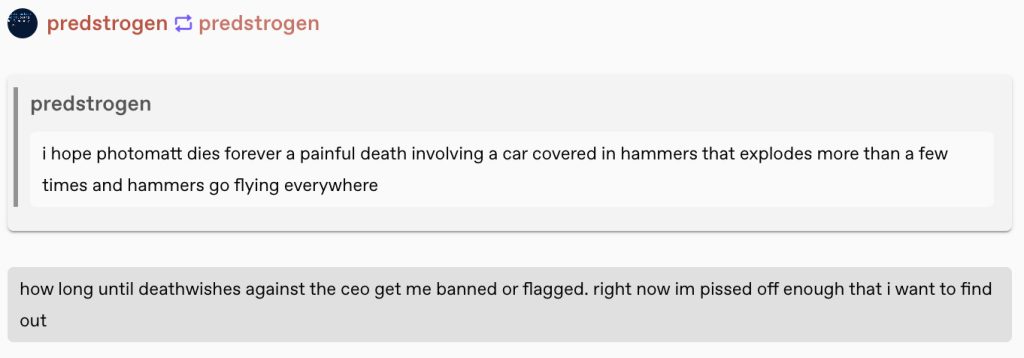
In the past week or so, in reaction to someone sending him a Tumblr ask about this (Mullenweg, 2024a), Matt Mullenweg, Automattic’s chief executive officer (CEO), has engaged in what I can only describe as a spree of transmisogynistic stalking and harassment, including grossly violating data protection law by posting the usernames of all the alts of the trans woman whose suspension he was being asked about (Mullenweg, 2024b), and by pretending to believe that the following post by her was a legitimate threat to his life which justified reporting her to the FBI (Mullenweg, 2024a):
Unlike, for example, Twitter, where the reactionary failson CEO who runs the platform as a dictator is also the sole owner, Automattic is a public company, so it is in theory possible that Matt could be forced to pull his head in. However, the subsequent statement released by tumblr staff (2024) has not filled me with confidence; it reads like pushing out Automattic’s queer and trans staff in front of the enraged crowd as meatshields and forcing them to release a statement which makes a big show of performatively disowning Matt while committing to fixing precisely none of the systematic issues which have been highlighted by his conduct.
Under the circumstances, I feel that remaining a paying customer of Automattic is being a turkey paying for Christmas. Because SP Press also has a policy of allowing pseudonymous contributions, the fact that Matt’s malicious disregard for data protection law did not get him immediately extremely fired does not fill me with confidence that I can protect the privacy of my so far majority transfem contributors.
Accordingly, I have moved to a new WordPress.org hosting provider. Since the WordPress CMS is open-source, Automattic is not getting one red cent from me. That said, I get sweaty and nauseous when I see words like “cPanel,” so I don’t know how well the migration worked. Please let me know if you find any issues.
Feedback: Where are the pictures?
I have received feedback suggesting SP Press needs more pictures. I agree. Unfortunately I don’t know how to make that happen without violating copyright: I am a single person who is financially underwater so my image licensing budget is $0. I could use royalty-free stock images but they wouldn’t be relevant to the stories and it would quickly become obvious that I just had pictures to have pictures, which I feel is sort of missing the point of having pictures. Please contact me if you have any ideas.
If you found this article at all useful, please consider supporting me via Patreon, Ko-fi, or PayPal.
Footnotes
1 — It’s in the sources but I’m not providing it on SP Press. If Joanne wants advertising she can pay me.
2 —Iam not acanon lawyer.
3 — For the avoidance of doubt, the NYCLU is the affiliate of the American Civil Liberties Union in the State of New York.
Asseler, J.D., del Valle, J.S., Chuva de Sousa Lopes, S.M., Verhoeven, M.O., Goddijn, M., … & van Mello, N.M. (2024, February 22). One-third of amenorrhoeic transmasculine people on testosterone ovulate. Cell Reports Medicine, online ahead of print. doi: 10.1016/j.xcrm.2024.101440. Retrieved 23 February 2024.
Dwyer, D. (Host) (2024, February 20). February 20, 2024 [Podcast episode]. In Conversations with Cardinal Dolan. The Good Newsroom (Archdiocese of New York). Retrieved 21 February 2024.
Mahlburg, K. (2024, February 22). When can we talk about trans mass shooters?. The Daily Declaration (Australian Heart Ministries Inc); Archive Today. Retrieved 22 February 2024.
On 14 February 2024, The Australian Financial Review republished a piece from The New York Times, “As kids, they thought they were trans. They no longer do,” by Pamela Paul (2024b).
This piece has several problems.
Here are a few.
Headnotes
Paul’s piece was originally published in The New York Times (“The Times“) on 2 February (Paul, 2024a). I didn’t do a Several Problems of it then because I was exhausted and because United States-based subject matter experts like Erin Reed (2024), Assigned Media‘s Evan Urquhart (2024), and Whipping Girl author Julia Serano (2024) had already jumped on it and done a great job. However, Nine went out of their way to syndicate the piece into a local masthead and put it in front of Australian readers, and I felt like that made it my problem.
For my Australian readers, The New York Times has a consistent record of polite, “just asking questions”-style transphobic propaganda (Yang, 2023) which has already attracted fierce resistance from trans people, allies (Accountable for Equality et al., 2023), and its own contributors (Andrews et al., 2023). Paul is the hand they use to do it (Bibi, 2023). She was already The Times‘ book editor, but became a regular opinion columnist in April 2022, two weeks after The Times dropped its only trans regular columnist, Jennifer Finney Boylan (Hollar, 2022; GLAAD, 2023). The Times Company press release announcing her onboarding in the role (“Pamela Paul’s next chapter,” 2022) uses language like “her keen desire to write about what people really think and believe but are often too afraid to say” — skating, not for nothing, very close to a slogan by Senator Pauline Hanson (PHON–QLD) about “ha[ving] the guts to say what you’re thinking” (Harris, 2020).
For my foreign readers, Nine Entertainment Company, the publisher of The Australian Financial Review (“the Financial Review“), also have a record of this kind of bullshit. Offhand I think it is the biggest single Australian contributor to the Several Problems Special corpus, and that’s in Australia, the company that gave us News Corp and modern Fox. Nine’s newspapers, including the Financial Review, used to be published by John Fairfax and Sons, which Nine acquired in 2018; under Fairfax management, they accumulated a lot of prestige and became newspapers of record. Since Nine acquired them, the editorial orientation of the ex-Fairfax, now “Ninefax,” newspapers has taken a sharp right turn, but they still retain enough prestige that bad actors find them very attractive.
1
The narrative [Powell] had heard and absorbed was that if you don’t transition, you’ll kill yourself.
First, there is no such narrative. There is no “narrative,” because that implies someone put one together. What there is is the common understanding that access to gender-affirming care is associated with lower depression and suicidality. That understanding is based in solid empirical fact (Bauer et al., 2015; Turban et al., 2020; Green et al., 2021; Tordoff et al., 2022; etc.).
Second, there’s clearly no broad message that “no matter who you are, if you don’t transition, you’ll kill yourself,” because if there were, a hell of a lot more people would be transitioning. There may be a common understanding that “if trans people don’t transition, they’ll kill themselves,” because that would make sense as a simplification of the actual facts. If Powell heard that as “if you don’t transition, you’ll kill yourself,” then that reflects something material about her internal experience. It does not demonstrate the existence of a broad spray of pro-trans propaganda in all directions.
2
At 160cm, [Powell] felt she came across as a very effeminate gay man.
This is a cute little jab because this is clearly intended to play on trans men’s and transmascs’ dysphoria — “No matter what, Powell’s transition was doomed from the start! No italics real end italics man is that short!”
In reality, that’s approximately the 4th percentile for male height in the United States (U.S. National Center for Health Statistics, 2017). Does that sound extremely low? Yes, it does. But if you divide a very large number, like the number of people in the US, into 100 pieces, each of those 100 pieces is still going to be very large. Being at the 4th percentile means Powell is taller than about 7 or 8 million men in the United States alone; about 300 million in the world (Jelenkovic et al., 2016). Height dysphoria, or the attempt to inflame it, cannot be treated as neutral, objective fact.
3
At no point was [Powell] asked about her sexual orientation
neither the therapists nor the doctors ever learned that she’d been sexually abused as a child
I’m going to take the mask of sarcastic, laconic criticism off for a moment and say this: Powell’s experience of child sexual abuse (CSA) victimisation is both horrifically broadly shared (Pereda et al., 2009; Mathews et al., 2023, Box 1) and, individually, simply horrific. I sincerely hope that she’s been able to get care and that she has some kind of peace.
With equal sincerity, I do not believe Pamela Paul cares a jot. She’s leveraging Powell’s trauma to restate an old homophobic canard, namely that queerness — or, in this updated form, transness — is caused by CSA (Schlatter & Steinback, 2011). At the time I wrote the Twitter version of this piece, there was a meme on the topic by fascist webcartoonist Stonetoss merrily doing numbers. Bluntly put, this is Nazi shit.
5
Many … well-meaning liberal … people … have been attacked … and intimidated into silencing their concerns.
Who? By whom? Given how potent a weapon this claim is for the article’s central ideological line of attack, it would be really helpful to back it up with a source.
6
Laura Edwards-Leeper, the founding psychologist of the first pediatric gender clinic in the United States
I have always found this kind of appeal to authority really interesting, because it sounds great if you’re not the patient. It sounds great because of certain beliefs we have about healthcare as a “caring” occupation and therefore about what personal qualities must be required to accrue medical authority. If you are the patient, at least if you’re the patient for long enough, it becomes more apparent that that the personality traits with which medical authority is associated are only those which are associated with authority everywhere else — the propensity to seek it and the competence to do so successfully. People may want medical authority for good reasons, like effectively assisting patients they care about, or they may not, but there is no way to know in advance. The proof of the pudding is in the eating.
Given the tone of the last paragraph it will probably therefore come to you as no shock that Laura Edwards-Leeper is not actually being quoted here for her genuine concern for the wellbeing of trans kids. She’s being quoted here because she’s a conservative clinician who has been a dial-a-quote for other conservative and anti-trans commentators since no later than 2018 (James, 2024a), and has done a little bit of anti-trans commentary herself (see, e.g., Edwards-Leeper & Anderson, 2021).
7
Others refer to this phenomenon, with some controversy, as rapid onset gender dysphoria
Frequently, they have mental health issues unrelated to gender
The intentionally ambiguous wording, “mental health issues,” is supposed to imply that they have diminished capacity to give informed medical consent. Of course, they’re always just talking about stuff like anxiety and depression, using its commonness among trans people (Wanta et al., 2019) as a lever.
Of course, sometimes it’s stuff like autism, again because it’s common (Strang et al., 2018). In that case, the lever is that a lot of allistic people think that autistic people are too childish or eccentric to make decisions. There is no actual evidence to support this position. For instance, there is no evidence of increased transition regret among autistics (Gratton et al., 2023). The only material impact that autism has on transition is that allistic practitioners use it as a pretext to improperly deny care to autistic trans people based on vibes (Strang et al., 2016, p. 5).
And, of course, what all this is missing is that even disorders that do compromise decisional capacity — psychotic disorders, those that include delusion or hallucination — don’t automatically disqualify you as a medical decision maker, because it would be fucked up if they did. The direction given in the WPATH Standards of Care is that a patient who has such a condition should be assisted in stabilising it and then allowed to proceed with transition (Coleman et al., 2022, pp. S36–S37); this is consistent with the capacity standard in every other field which has to consider this scenario (Morris & Heinssen, 2014). I realise that it would be very convenient for the right if there were a category of people who they could use as precedent for a blanket permanent all-circumstances denial of healthcare that they don’t like, but there isn’t! The world doesn’t work that way!
9
several researchers have documented [rapid onset gender dysphoria]
There are several hyperlinks in The Times‘ source copy of this passage. Those links lead to, in order:
the website of Lisa Littman, a professional anti-trans disinformation operator (Billard, 2023);
a paper by two other such operators, J. Michael Bailey (on whom more later) and Suzanna Diaz, in its republication (Diaz & Bailey, 2023c) in the fringe Journal of Open Inquiry in the Behavioral Sciences, neatly concealing the fact that its first publication (Diaz & Bailey, 2023a) in the Archives of Sexual Behavior — on which more later (#25) — was retracted for research misconduct (Diaz & Bailey, 2023b);
a paper by Littman (2021) which, as Lee Leveille (2021b) notes, relies heavily on extremely biased sampling for politically reliable subjects, leading questions, and p-hacking, and still fails to massage its data into supporting its conclusions, which have no obvious factual basis.
However, while I’m including these findings to illustrate the depth of Paul’s duplicity here, it’s actually not strictly relevant to my critique of the Financial Review‘s copy of the piece, because in the Financial Review‘s copy, those passages do not contain those links. More on this later (#66).
10
many healthcare practitioners have seen evidence of it in their practices
The plural of anecdote is not data.
11
Britain’s Tavistock gender clinic, which … until it was ordered to be shut down, was the country’s only health center dedicated to gender identity
This feels incidental compared to everything else, but fuck it, I’m a completionist: it’s not true. The Tavistock was the only paediatric gender clinic in England and Wales. Scotland, which geography enjoyers will remember is also in Great Britain, has the Sandyford paediatric gender clinic. The UK as a whole has the adult Gender Identity Clinic (GIC) system, which is still running, insofar as it has ever run at all. It wouldn’t suit Paul’s angle to note this, though, so she simply lies about it.
12
[The Cass Review’s Interim Report] noted that ‘primary and secondary care staff have told us that they feel under pressure to adopt an unquestioning affirmative approach’ …
From the way this is placed, you’re clearly supposed to think it’s a key finding. It’s not. It’s in there (The Cass Review, 2022, p. 17, clause 1.14) but it’s in there as evidence, without a judgement on its veracity. The finding would still be in the report, in the same place, even if, for example, the review’s chair Dr Hilary Cass and her team knew that it was false, because the existence of a false assertion of that nature would be relevant to the Review.
Can we assume it’s true? No, not really. While the NHS England Gender Identity Development Service (NHS GIDS) — the paediatric gender clinic at “the Tavistock,” which is a broader medical entity which provides non-gender-related care — was still operating, there was deep political division between evidence-based providers and anti-trans clinicians, broadly acknowledged by both (Moore, 2021a) sides (Brooks, 2023).
Paul obliquely admits to knowing this later in the article by way of her casual mention of Grace Powell’s therapist, who she describes as a non-gender-affirming practitioner from the Tavistock. Paul therefore knows about the political division at the Tavistock, and knows that the mere fact that someone at the Tavistock said this means nothing. But she lies about it anyway.
13
In 2021, [Stephanie Winn] spoke out in favour of approaching gender dysphoria in a more considered way
Did she, though? I had the temerity to click on the link that Paul provided and it looks like what Winn actually spoke out in favour of was forcing trans men onto estrogen:
Furthermore:
When a natal female tells us she feels unfeminine & dysphoric, & thinks this might mean she’s trans, shouldn’t a doctor first check her hormone levels? Could low estrogen/progesterone be the cause of both her depression, and her sense of being less feminine?
This is more likely to occur if she has experienced complex trauma, especially early sexual trauma, which would also correlate with feeling disconnected and unsafe in her body.
Could it be that women who want testosterone actually need estrogen instead?
That seems like a different thing from what Paul described! Actually a totally different thing! And also kind of evil!
14
Some threatened to send complaints to [Winn’s] licensing board, saying that she was trying to make trans kids change their minds through conversion therapy
Winn’s licensure is in Oregon, meaning she is banned from practicing conversion therapy on people under 18 under Oregon Revised Statutes (Or Rev Stat) § 675.850(1) per Or Rev Stat § 675.850(2)(b)(A)(v). The definition of “conversion therapy” in Oregon state law is in Or Rev Stat § 675.850(2)(a)(A): “attempting to change a person’s … gender identity, including behaviors or expressions of self”.
But who says Winn was “attempting to change [any] person’s … gender identity, including behaviors or expressions of self”? Well, Winn, for one thing, who as well as proposing to subject trans kids to the Alan Turing treatment (see Meyer, 2013) also, for example, advised parents to put them through acupuncture in the hopes of provoking a hatred of needles because “the child’s hatred of needles could also help spark desistence [sic]” (Winn, 2022).
Winn stated an intention to engage in conversion therapy, and, to my understanding, actually did so. Oregon law says this is the point where, at minimum, the Board should get involved. Call me crazy but I actually think it is good when people Pamela Paul doesn’t like and people she does are equally bound by the law.
15
which has left [detransitioners] open as attacks as hapless tools of the right
If they are choosing to allow themselves to be used to achieve the right’s broader strategic ends — which the detransitioners with the most media prominence verifiably are (Alfonseca, 2022; Doyle, 2023; Henry, 2024) — then they are, objectively, tools of the right, regardless of any other quality of the relationship.
Under those circumstances, assuming that they are simply hapless — unfortunate — is the charitable, reasonable thing to do. The alternative would be assuming that the very specific and by no means representative subset of detransitioned people who engage in this activism are actually intentionally complicit.
16
These are people who were once the trans-identified kids
To me, this is a revelatory phrase, because it really cuts to the heart of what Paul is trying to pull here.
Transness is an internal experience with no empirical test. The way you know if someone is trans is if they tell you — if they identify themself to you as trans — if they “trans-identify,” if you like. The hostile “trans-identified” (TransActual, n.d., 3(d)) and the neutral “trans” overlap 1:1.
Paul wants you to think that her angle is that it was wrong to treat these specific people, and that it was wrong ab initio, from the start, because sufficient care wasn’t taken to ensure that they were trans — which logically requires that there must be a level of care which would be sufficient for that purpose.
However, Paul also says that these people “were,” without condition or qualification, “trans-identified kids,” i.e., trans kids. So there is no distinction between these people when they were kids, and trans kids. There may be a standard which could be used to distinguish the two but that standard has in all of human experience so far failed to do so.
That’s interesting, because that leads us inescapably to another conclusion: that all actually existing trans kids, jointly and severally, can’t be distinguished from these people by any measure. Meaning that no trans kid has received sufficient assessment to make sure they are really trans. Meaning affirming any trans kid is wrong. This isn’t an argument for more careful care, this is an argument for total prohibition, now, everywhere.
17
that so many organisations say they’re trying to protect
I couldn’t help but roll my eyes at the “say” in this passage, dropped in with such pointed lightness and delicacy. Read: “But they’re lying! They’re filthy degenerates who have designs on your children! I tell you they’re lying!”
18
Several of those who questioned their child’s self-diagnosis …
Paul calls knowing you’re trans a “self-diagnosis” to make it sound complex and technical. Note that she could also have used this argument with homosexuality when it was in the Diagnostic and Statistical Manual of Mental Disorders (DSM) (American Psychiatric Association, 1952; American Psychiatric Association, 1974) and the International Classification of Diseases (World Health Organization, 1977). Note that in fact nobody left of say Nick Fuentes would now bother pretending that “mum, dad, I’m gay” is a “self-diagnosis”.
Paul can only get away with this kind of obfuscatory bullshit because she and people like her have, with significant funding and institutional backing, been able to present transness, including in kids (Gill-Peterson, 2021) — a phenomenon which has been present for literally all of human history (Daniels, 2021) — as “new”.
19
… say it has ruined their relationship
Yeah, telling your child they’re wrong about something only they’d know will have that effect, especially when you deny them medically necessary care as a result. A key element of love is trust. Parents are not exempt from having to act like they actually love their kids. I don’t know what these folks expected.
20
How would hormones help a child with obsessive-compulsive disorder or depression? she wondered
I mean I could argue against the easy version of this position: depression and obsessive-compulsive disorder (OCD) can both be secondary to (caused by) dysphoria. They can also both be exacerbated by it; the mood state dysphoria, with which specific gender dysphoria intersects, is also a core symptom of depression (Morin, 2023), while as an anxiety disorder (Better Health Channel, 2022), OCD is susceptible to gender dysphoria’s anxiogenic effects (Dhejne et al., 2016). Hormones relieve dysphoria. Therefore, hormones can relieve depression and OCD — voila.
So the only way this position holds up any better than that is assuming that she means depression or OCD which is primary (of no other cause), or at least not secondary to dysphoria. So the immediate question obviously is why — as the framing implies — would you have expected this answer to come up in a group of people whose connecting element is that their kids experience dysphoria? Why would it be their job to know?
But more broadly, as someone with primary major depression and OCD, I can take this one: the answer to “how do hormones help with those things?” is they don’t; that’s not what they’re for, which doesn’t make them any less useful for what they are for. It’s like saying “How does ibuprofen help with ADHD?” It doesn’t! Why would it? Why would it have to?
21
Others say their child learned these ideas in the classroom … through curricula supplied by trans rights organisations
Okay, look, I’m sceptical about this given the furore that ensues every time the possibility of “curricula supplied by trans rights organisations” or anyone close to them comes up — anybody remember Safe Schools (Law, 2017; Louden, 2017; McKay, 2019)? — but since I don’t have the evidence to dismiss it out of hand I have to press on.
Which I will do like this: yeah it’s expected for school curricula to be informed by current knowledge from subject matter experts. It’s considered good even!
22
The meeting was brief and began on a shocking note. ‘In front of my son, the therapist said, “do you want a dead son or a live daughter?”‘
Strictly speaking I can’t dismiss this out of hand either because I wasn’t there but I have my limits. Let’s be real: this didn’t happen. I changed my pronouns to they/them in 2013, changed them again to she/her and started HRT in 2020, and started doing Several Problems-type work in or around 2021. In over a decade of being increasingly engaged with trans issues, I have never heard or read of this phrase being used in a clinical context except in pieces like this one. If I Google it, I don’t get results from providers or LGBTQ+ advocacy groups; I get them from Newsmax (Cacciatore, 2022), Ben Shapiro (2022), and Transgender Trend (Biggs, 2018) — people who share Paul’s views, to a one. To the extent that it intersects with reality at all, it’s parents describing their own thought processes (e.g., Hirt-Manheimer, 2021), not providers trying to coerce them.
As an aside, I actually disapprove of this formulation anyway. Like it’s fair but I also think it’s oversimplified and reductive. Your child is statistically more likely to die if you don’t let them access care, but it’s not a given. They might simply breathe their last in eighty years having never truly lived.
23
Parents are routinely warned that to pursue any path outside agreeing with a child’s … gender identity is to put a [trans] youth at risk of suicide
which feels to many people like emotional blackmail
When someone tells you, with bulletproof evidence, “you are actively increasing your child’s risk of suicide,” the well-adjusted and normal thing to do is, obviously, to go “you know, the real problem here is that what you said made me feel bad”.
25
But those studies were found to have methodological flaws or have been deemed not entirely conclusive
In The Times‘ copy, this passage contains two citations. The second one goes to Edwards-Leeper & Anderson (op. cit.), which is an op-ed so I’m not fisking it here (get your own primary sources, Pamela!). The first one, ‘methodological flaws,’ however, goes to an apparently peer-reviewed paper, Abbruzzese et al. (2023) … which was published in a Clarke–Northwestern journal, and written by three members of the Society for Evidence-based Gender Medicine (SEGM). In a just world, citing this bullshit would get Paul’s article taken down and me paid $50,000 for the number of brain cells I lost reading it.
The Clarke–Northwestern clique is a group of anti-LGBTQ+ disinformation operators and pseudoscience extruders who coalesced at the Clarke Institute of Psychiatry (Toronto, Ontario, Canada) — which later became the core of the merger that formed the Centre for Addiction and Mental Health (CAMH) in Toronto — and Northwestern University (Evanston, Illinois, United States) in the early 1980s. Core members are considered to include (Abernathey, n.d.; James, 2019):
J. Michael Bailey, on whom more later;
Ray Blanchard, who formulated Blanchard’s transsexualism typology, which heavily pathologises trans women (Serano, 2020) and separates them into two groups, homosexual–transsexual (HSTS; in brief, “gay men so gay they want to be women to fuck more men”) and autogynaephilic1 (AGP; “straight men with an all-consuming fetish for being women”);2
Alice Dreger, an acolyte of Blanchard, and a major influence on the “irrational censorious trans activists vs. innocent scientists” media narrative which Paul leverages here (Jones, 2016; Serano, 2021);
Dr Kenneth J. “Ken” Zucker, disgraced former director of the CAMH Gender Identity Service who used it to do conversion therapy (Zinck & Pignatiello, 2015, p. 21, clause 14), now a conversion therapy promoter and anti-trans dial-a-quote (James, 2024e).
The best-known Clarke–Northwestern-aligned journal is the Archives of Sexual Behavior, founded by fellow conversion therapist Richard Green (Ashley, 2019) and published by Springer Nature for the International Academy of Sex Research (IASR). Ken Zucker has been its editor since 2000 and uses it, according to veteran trans affairs analyst Andrea James (2024f), as a “bully pulpit” for his views. Zucker’s editorship has notably been characterised by a rather laissez-faire attitude to peer review for authors who share his political views (see, e.g., Carey, 2012).
The Archives is not the journal cited here. The journal cited here is the Journal of Sex & Marital Therapy (JSMT), another Clarke–Northwestern journal edited by trusted Zucker associate (Abernathey, n.d.) Robert Taylor Segraves (Taylor & Francis Online, n.d.). The editorial board under Segraves’ editorship includes (Taylor & Francis Online, op. cit.) Zucker himself, as well as Stephen Levine, an advisor to conversion therapy promotion group Genspect (Duval, 2021) also known for his work helping to deny trans prisoners medically necessary care (Stahl, 2021).
With regard to trans healthcare, JSMT serves as a nominally peer-reviewed platform for the Society for Evidence-based Gender Medicine (SEGM), an opaquely funded anti-trans disinformation operation (Moore, 2021b) with members on several continents, including Australia (Turner, 2023). The authors of the paper cited by Paul are
Evgenia Abbruzzese, who discloses her affiliation with SEGM in the paper;
Levine, mentioned above, who does not here disclose his affiliation with Genspect;
Julia Mason, who does not here disclose her affiliation with SEGM.
The substance of the paper itself would take me another entire article to properly dissect; I have focused mostly on the context here because that context, unlike the specific contents of this paper, remains relevant throughout the article. In short, its three key criticisms are that
the study had uncontrolled confounding (it didn’t);
it didn’t report all relevant adverse outcomes (it did), and
it doesn’t count today for Secret Reasons (it does; this is discussed further below).
For anyone who’s bothered to actually read the article and follow up its citations it is a transparently specious and baseless critique. Not that that stops Paul.
26
Pediatricians, psychologists, and other clinicians … dissent from this orthodoxy, believing it is not based on reliable evidence
[Kimberly] subsequently founded the Gender Dysphoria Alliance and the LGBT Courage Coalition …
One man, two supposedly full-fledged advocacy groups. I personally think I’d be satisfied with one but that’s just me. I am familiar with the Gender Dysphoria Alliance — its membership consists largely of conservative trans men and transmasculine people who pursue a self-interested but broadly anti-trans politics founded in transmisogyny, the hatred of trans women. Their 2021 open letter Trans Men Fight Back (Kimberly et al., 2021) is particularly edifying reading on that subject.
I was not previously aware of the LGBT Courage Coalition, but upon review it appears to consist entirely of established, mostly cis, anti-trans activists, and conducts its activism entirely through two social media accounts, one on Substack and one on Twitter. Notably, it shares a significant noun with the Catholic Church’s ex-gay apostolate, Courage International — perhaps coincidental, but then again (#30), perhaps not.
29
and before sexual maturation
The fact that Pamela Paul and her allies believe it is obligatory for children to “sexually mature” in the way Paul and co. would like, even against any wishes the child themself might have on the matter, has implications I would prefer not to think about.
30
and that gender ideology can mask and even abet homophobia
For anyone not as in the weeds as I am, “gender ideology” is a flag. I would call it a dogwhistle but it gets used so often and with such obvious vitriol very quickly descending into the range of the human ear.
Specifically, it’s a snarl word originally developed for political work by the Roman Curia, the central administration of the Catholic Church. The actual origin is from the strain of Catholic social teaching expounded by Pope John Paul II starting with his Theology of the Body lecture series of 1979–1984, which treats men and women as different in an essential way, complementary (intended by God for different roles), and immutable.
The concept was developed and fleshed out by Joseph Cardinal Ratzinger, later Pope Benedict XVI, who was at that time the Prefect of the Congregation for the Doctrine of the Faith, the Church’s senior doctrine officer and internal investigator. The catalyst for Ratzinger’s interest appears to have been the proceedings surrounding the Federal Republic of Germany’s Transsexuellengetz (Transsexual Act) of 1980, which ultimately passed and established Germany’s current legal gender recognition regime (Case, 2019).
“Gender ideology,” as used by the Holy See and other people who have picked it up — I’m not suggesting this is a solely Catholic conspiracy, I’m not Dan Brown — is an empty signifier (Reid, 2018). It has no fixed denotative (literal) meaning: if you ask “what is it?” or “show me an example of it,” the speaker can define it however they want. It does, however, have a connotative (felt/implied) meaning: that trans gender is an ideological project; that trans people say, act as if, believe they are trans because we have been convinced certain political propositions are true.
This doesn’t make any damn sense. Historically, practitioners who would be ultraconservative by modern standards have felt free to admit in the privacy of journals (see, e.g., Lebovitz, 1972, p. 105; Davenport, 1986, p. 515) that plenty of kids come out as trans practically the instant they can talk. If humans had the capacity to just pop out kids capable of that level of leftist political sophistication at that age right and left, this article would be in Russian. On the other hand, “gender ideology” is 2 words and so far I have spent 4 paragraphs explaining it; in the much less verbose Twitter version, I still needed 5 Tweets. You can see therefore how the term might be useful for its proponents.
Incidentally, like Paul’s accusation of trans “institutional capture,” the reas: in German academic use, the term “gender ideology” (Geschlechterideologie) has an established meaning that does not refer to trans people — namely “an ideology that regulates sex and gender” (see, e.g., Knapp, 1988, p. 12; Rohde-Dachser, 1991, p. 143; Kuhn, 1994, p. 6). The Catholic Church’s appropriation of the term “floods the zone” (see Stelter, 2021) of an entire strain of sociological discussion — one whose conclusions in the cold light of day look rather inconvenient for institutions like the Catholic Church. As with most right-wing canards, every accusation is a confession.
31
I transitioned because I didn’t want to be gay
According to Reisner et al. (2023), the proportion of respondents in a sample of United States trans people who described themselves as straight was 17.6% (versus 90.1% of cis controls), so I am forced to tactfully suggest that this may not have been a very clever idea.
32
says Kasey Emerick
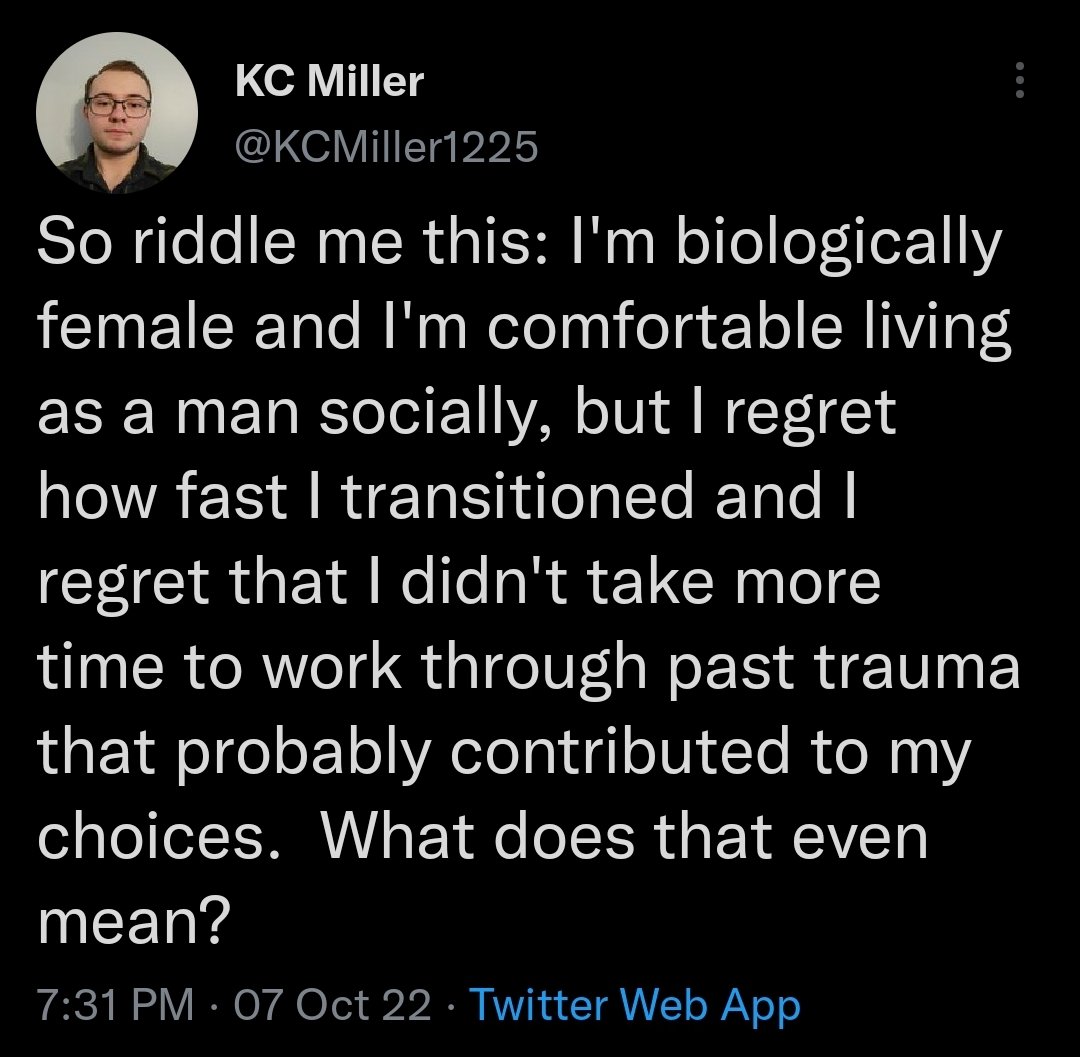
I was surprised to discover that I know, or at least directly know of, Kasey Emerick. We are not acquainted, but she (I am following the article’s guidance on pronouns) is an established ideologically motivated detransitioned activist who was previously active on Twitter under the name “KC Miller”.
Because I was active at the same time as, and adjacent to, Emerick, I can’t help but notice that some of the particulars of her story appear to have changed. For instance, Emerick says she detransitioned because she realised she had been “living a lie”. She joined Twitter after her detransition, yet at that time, she said that she was “comfortable living as a man”:
She also mentioned at the time that she didn’t have any intention of stopping testosterone — which is why it’s somewhat surprising that Paul’s narrative now indicates Emerick had stopped testosterone around that time. Actually, Paul indicates that Emerick said that; there may be a reason Paul isn’t confident enough in the claim to put it in the authoritative editorial voice. But maybe not.
33
Raised in a conservative Christian church, she says ‘I believed homosexuality was a sin’
As someone who’s estranged from a birth family which (apart from a few escapee atheists) consists of several generations of Latter-day Saints and a handful of Pentecostals, I’m entertained by the suggestion that conservative Christianity doesn’t also teach that transgenderism is a sin. What about the Nashville Statement (2017, Art. VII) or the SBC’s 2014 Resolution on Transgender Identity (Burk, 2014)? What are they, a pork chop?
34
To the trans activist dictum …
The use of “dictum” here is intentional. Who issues dicta? Logically, a dictator. Paul is endeavouring to suggest that the filthy trans are attempting to assert a deeply unwholesome authority over your kids.
After I published the original version of this piece on Twitter, a friend suggested I might be giving Paul too much credit — it could quite simply be intended to evoke “dick,” which in context would be equally grim.
35
… says Sasha Ayad, a licensed professional counsellor based in Phoenix
Paul forgets, once again, to mention precisely who her subject is. Ayad is an anti-trans disinformation operator in the same small, tightly-bound network as the other such operators named in this article, and is a core member of it: she is a member not only of Genspect (n.d.) and SEGM (James, 2024c), but of a number of others, including the Gender Exploratory Therapy Association (GETA) (Murphy, 2024) and Sex Matters (James, 2024c). GETA’s stock in trade may be inferred from the fact that “gender exploratory therapy” was previously named “gender reparative therapy” (Countering Hate Speech Aotearoa, 2023) — a euphemism presumably abandoned when it became too well known that “reparative therapy” is simply another name for conversion therapy (Human Rights Campaign Foundation, “The lies and dangers of efforts,” n.d.). Of Sex Matters — more later (#61).
36
[Ayad is] a co-author of When Kids Say They’re Trans: A Guide for Thoughtful Parents
Studies show that around 8 in 10 cases of childhood gender dysphoria resolve themselves by puberty
Wrong! This is an old canard, and I, being a fool, am constantly surprised that it’s still in circulation, but I guess with mastheads as complicit as The Times (and the Financial Review) there was no need to come up with anything new.
The trail of citations here is indirect: Paul cites Kaltiala-Heino et al. (2018), who cite Ristori & Steensma (2015). The figure in question is indeed present in Ristori & Steensma (op. cit., p. 3) — actually 85.2%, by their reckoning. That does not mean it is true. In fact, it is manufactured through what I can only describe as scientific fraud.
Here is how. Gender dysphoria is a common experience that a lot of trans people have. “Gender dysphoria” (GD) is also the name of the clinical proxy for transness, i.e., the concept the medical and psychiatric professions use to understand and interact with transness. We’re going to call this second sense “construct gender dysphoria” (“construct GD”) for the purposes of this article. The strict definition of construct GD is given in the DSM-5 (American Psychiatric Association, 2013); any post-2013 academic work referring to “gender dysphoria” is assumed to be referring to the DSM-5 category.
Ristori & Steensma (op. cit.) present their work as a literature review on “gender dysphoria in childhood,” defining GD explicitly with reference to the DSM-5, i.e., defining it as construct GD. They include 11 studies in the review, claiming that those studies pertain to (construct) GD in children.
This is unambiguously not the truth. The studies used wildly recruitment criteria, some informally using the term “gender dysphoria,” but all using a rubric which was approximately or exactly the pre-DSM-5 construct which included transness in kids, gender identity disorder (GID).
This may not sound like a big deal. This is a huge deal. GID included trans kids, but it also included a far, far larger population of cis kids who were gender-nonconforming (GNC): “sissy” cis boys, tomboy cis girls, and any other kid who was GNC in a way considered troublesome, inconvenient, or annoying — and therefore of course obviously pathological — by the medical, psychiatric, and social authorities of the time.
The studies in the review were longitudinal, meaning they collected data on the same variables at one or more points after initial subject enrolment and data collection (Coggon et al., 2003, ch. 7); the studies in this review typically used a single later point (“follow-up”). They uniformly enrolled and collected initial data from participants recruited based on GID-like criteria. At follow-up, however, they investigated (in some cases among other things) how many participants met a set of criteria far more narrowly centred on what we would recognise as transness — typically “transsexualism,” the pre-DSM-5 construct for transness in teenagers and adults. They then determined what proportion of participants with GID were not trans at follow-up and declared that the rate of what, after later work by the VU University Medical Center clinical research group that included Steensma, came to be called “desistance”.
The problem here is obvious. The initial sample can be characterised as “cis and a little fruity with it, or trans”. There are far more cis people than there are trans people; there are still far more GNC cis people than there are trans people total. Studies that have attempted to ascertain what proportion of the general population are trans, even by the broadest possible definition(s) thereof, have not come anywhere close to 20% (Collin et al., 2016). The most likely reason a “GNC cis and trans” sample was still 85% cis at follow-up isn’t that a big chunk of it stopped being trans, it’s that it was circa 85% cis to begin with.
The authors of the studies reviewed perhaps may be forgiven — loath as I am to do so — because the way cis people understood transness at the time was still evolving. Ristori and Steensma, however, were, and remain, leading authorities in trans healthcare, including in paediatric trans healthcare, to the point that they were co-authors of the current WPATH Standards of Care (Coleman et al., op. cit.). Given that — and given that Steensma separately has a record of very interesting data analysis that “just happens” to boost the apparent desistance rate into the stratosphere (Brooks, 2018) — it is not plausible that this was unintentional. Nor is it plausible that Paul herself didn’t know, because she’s clearly au fait enough with this game that, at this point in the article, she’s about to try some statistical sleight of hand herself.
38
and 30 percent of people on hormone therapy discontinue its use within five years
What Paul is employing here is a different but equally time-honoured propagandistic device — incidentally, a trademark of Tom Steensma (Brooks, op. cit.). I’ve taken to calling it the “lost to follow-up” trick.
Here is how it works. Every longitudinal study which is big enough and runs for long enough has attrition. Attrition is when, at some point after initial enrollment and data collection, one or more participants becomes unavailable for further collection. The term of art is that they become “lost to follow-up”. Attrition can compromise the validity of the study (Bankhead et al., 2017).
One way it can do so is through nonresponse bias. This happens when the likelihood of participation has a direct causal link to a variable of interest in the study, i.e., when whether you are part of a certain subgroup of interest to the study is something, or is caused by something, that determines whether you can respond to the study at all (Turk et al., 2019). For a straightforward example of a survey consisting of a single question, “Do you have time to answer a survey? (Y/N)” is going to return a higher apparent “Yes” rate than exists in the general population, because only the people who would answer “Yes” are participating at all.
It is necessary to be aware of attrition and nonresponse bias. What you cannot do is arbitrarily assume that attrition entails the specific kind of nonresponse bias you want. So of course Paul is doing exactly this.
The study cited, Roberts et al. (2022), examined a sample of trans and gender-diverse patients who were getting hormones through Tricare, the United States military’s health insurance program, between 2009 and 2018 inclusive. It concluded that “>70% of TGD individuals who start gender-affirming hormones will continue use beyond 4 years”.
Paul asserts that this by definition means the other 30% stopped hormones altogether, implying that they did so because they realised they weren’t trans. That’s not how “lost to follow-up” works; the only thing you by definition know about people who are lost to follow-up is that they’re lost to follow-up.
It may be possible to determine why you lost who you lost, and who you never had in the first place. Erin Reed (2024), for instance, notes several reasons the study may have overestimated discontinuation rates or failed to capture all eligible trans people, based on the social and political context that existed during the study period (2009–2018);
increasing movement of trans customers toward online pharmacies, which have grown more popular, as well as GoodRx plans, which offer more privacy;
political pressure from the Trump administration (2017 onward), which had executive control over Tricare and which had begun pursuing trans service members, and other decisions by U.S. military leadership which may have forced study subjects off HRT other than voluntarily;
Tricare’s notoriously poor trans health coverage even under ideal circumstances and without active political interference.
The study’s authors, meanwhile, note in their ‘Discussion’ section several limitations which are inherent to the study itself as designed:
“We only collected information on medication refills obtained using a single insurance plan. If patients elected to pay out of pocket for hormones, accessed hormones through nonmedical channels, or used a different insurance plan to pay for treatment before and/or after obtaining gender-affirming hormones using TRICARE insurance, we did not capture this information”; and
“We would miscategorize patients as terminations if patients elected to obtain their gender-affirming medications using alternative payment options while continuing to receive other medical care using TRICARE,”
and, significantly, conclude that “our findings are likely an underestimate [of] continuation rates among transgender patients”.
Paul could have done the same as either of these, drawing on the sociopolitical environment or the study design to contextualise the results. She simply asserts what is most advantageous to her, and then sails onward, knowing that the preconceptions of her mostly cis readership will carry her the rest of the way.
39
At the end of her freshman year of college, Powell, horrifically depressed, began dissociating, feeling detached from her body and from reality, which had never happened before
This is an interesting one because the framing is a variation of accusation in a mirror. Paul appears to be trying to dogwhistle toward the right-wing “body dissociation” theory about trans healthcare, which has been floating around for a while (Leveille, 2021b). This theory, in turn, appears to function as a mirror-propaganda-type response to the observation, made by both trans people — notably and rigorously by Gender Analysis’ Transgender Depersonalization Project (Jones, n.d.) — and to a lesser extent by the cis clinicians studying us (Fisher et al., 2014; Colizzi et al., 2015), that unmanaged dysphoria is attended by symptoms similar to depersonalisation/derealisation disorder (DP/DR).
The Project corpus and others like it reflect that the DP/DR aspect of dysphoria is relieved by access to medical transition. The conspiracy theory — the one in whose direction Paul is winking here — therefore holds that access to medical transition causes dissociation. But that accusation can’t work with this timeline: on the dates in the article, Powell started dissociating, seemingly quite abruptly based on the wording, more than a year after she started testosterone, and indeed more than a year after the last change of any kind in her regimen of gender-affirming care. It therefore does not make sense to assume that gender-affirming care caused it.
40
“I expected it to change everything, but I was just me, with a slightly deeper voice,” she adds.
Yes, that’s, uh, that’s the value proposition. T stands for “testosterone,” not “transsubstantiation”.
41
[Powell] tried in vain to find a therapist who would treat her underlying issues, but they kept asking her: how do you want to be seen? Do you want to be nonbinary?
This is interesting, because what this passage says and what it wants you to think it says are different. You’re supposed to read it fast enough that you take away the meaning that Powell’s therapists were trying, through intrusive, repeated questioning (“they kept asking her”), to push her into a specific, presumably begin rainbow text gender-ideological end rainbow text, way of thinking about herself.
What the words actually say, however, is that “she tried in vain to find a therapist … they kept asking her,” which means: she went to more than one therapist, and each one asked her at least one of these questions at least once. If these questions are asked repeatedly by the same therapist, of the same person, they sure do look like inappropriate browbeating, because just about any questions repeated in that way would be inappropriate browbeating in that context. But what Paul says is just as open to the interpretation that Powell’s therapists asked her basic framing questions or questions that logically followed from what she’d been through, and the issue is simply that the questions were trans-friendly at all.
42
Powell wanted to talk about her trauma, not her identity or her gender presentation
As a sometime adherent of feminist theory, I am intrigued by the contention that trauma, identity, and gender presentation can be separated with such surgical neatness. It seems inconsistent with the fact that, for instance, trans people are 4× as likely to be victims of violent crime, including sexual violence (Flores et al., 2021) — both typically fairly traumatic by nature.
Drawing even closer to the core of the issue, trans people are about twice as likely as cis people to have experienced sexually violent victimisation in childhood (Thoma et al., 2021) — the exact kind of victimisation of which Powell was a survivor. I am inclined to say it would have been very nearly a breach of due diligence for therapists not to at least have inquired about the subject.
43
The [ex-Tavistock] therapist asked questions like “Who is Grace? What do you want from your life?”
The thing is, these are substantially the same questions Powell’s other therapists were asking her, so the difference can’t be the questions. “Do you want to be nonbinary?” is extremely clearly a subset of “Who is Grace?”. Similarly, “How do you want to be seen?” is extremely clearly a subset — and not a small subset — of “What do you want from your life?”
What Powell, as Paul represents her, seems to want, is for therapists to simply completely avoid any conversation which might lead to mention of her transition. I am also of the view that your average psychiatroid should be kept on a leash, but given the outsized role that Powell’s transition played in her life — enough so that she is now speaking about it to The New York Times! — I do not see how that is a viable ask.
44
Many detransitioners say they face ostracism and silencing because of the toxic politics around transgender issues
Ah yes, the toxic politics. Not otherwise specified.
The thing is that when Paul says “detransitioners,” she’s talking about a very specific kind of detransitioned person. I know a number of detransitioners and retransitioners myself — they decided transition wasn’t for them after all, or that it was for them but they didn’t want it to develop any further, so they stopped HRT, or went onto different HRT, and/or changed their gender presentation, maybe back to the one they had before HRT, maybe to a different one.
Those aren’t the people Paul is talking about. It’s not particularly true that detransitioned people can’t get a platform in liberal media, but it is absolutely true that right-wing media both can, and are willing to, provide them a disproportionately large and loud platform. Consequently, the kind of detransitioners most represented in media narratives, with the complicity of people like Paul, are a very specific, in my experience politically nonrepresentative subset. When you know that, you can really see the classic conservative routine at work here. “They silenced me for my views!” “Which views?” “Oh, you know …” “On taxes?” “No …”
45
“It is extraordinarily frustrating to feel that something I am is inherently political,” Powell says.
And to think that the trans-exclusionary radical feminist (TERF) movement arose from second-wave feminism, she of “the personal is political”. We’ve come so far.
46
In a recent study in the Archives of Sexual Behavior, about 40 young detransitioners out of 78 surveyed said they had suffered from rapid onset gender dysphoria.
Oh, look, it’s the Archives. Even if that weren’t the case, though, simply knowing this study’s authors would give me an idea of its quality. Lisa Littman and Stella O’Malley I have already mentioned. Helena Kerschner is an advisor to Genspect (n.d.) — no surprise there at this point. J. Michael Bailey, for his part, is a disgraced ex-Northwestern psychologist, who Andrea James (2024g) calls, in an extensively researched entry for Transgender Map, “one of the most unethical sexologists in history,” which I think is laudably restrained given the account she then provides of his career.
Of course, this is all just ad hominem. Don’t worry, there are also huge glaring problems with both the study and its use in this context. To name three:
Sampling was non-random. Of the three named recruitment sources, one was Pique Resilience Project, a since-dissolved “ex-transgender” organisation which worked with conservative politicians and media (James, 2024b), and /r/detrans, a large reddit community infamous for its anti-trans bent, which at and until some time after the time of the survey had an overwhelming majority of non-detransitioned subscribers, according to its own internal polling (DetransIS, 2022).
A central part of the survey instrument was based on the proposal that “traumatic events can contribute to the occurrence of gender dysphoria” without any more evidence than that this is “[a] common belief among clinicians who favor ROGD theory”.
Finally, as you might expect from all of the above, the study unquestioningly treated Littman’s ROGD — as well as Ray Blanchard’s autogynaephilia and autoandrophilia — as real conditions, despite the complete absence of evidence for their existence. The study does not prove the existence of ROGD because it did not set out to do so — it took the existence of ROGD as an unquestionable fundamental assumption.
(To be fair, “I assume things therefore they are real” appears to be Paul’s methodology, too.)
47
Trans activists have fought hard to suppress any discussion of rapid onset gender dysphoria
As Zinnia Jones has pointed out, this is not the case. I will append that it’s also another case of projection. Trans people are an underrepresented (Vyse, 2019), impoverished and economically marginalised (Carpenter et al., 2020) group. We do not either individually or collectively have the power to suppress anything.
What trans people have actually done is confront the pseudoscientific spectre of ROGD and show it to be completely baseless and without merit, time and time again (Duck-Chong, 2018; Restar, 2019; Ashley, 2020). We’re participating in the public discourse and, despite being constantly stomped on, we’re winning because we’re right. But this is inconvenient for Paul, so she decides to lie instead.
48
the activist organization GLAAD warns the media against using the term [ROGD] as it is not “a formal condition or diagnosis”
Given that this is true it seems like a good reason to me. Things do not become untrue simply because advocacy groups are saying them. Granted throughout this very piece I’ve cited Genspect and SEGM affiliation as the first line evidence that a source is biased, but in every single case I have then gone on to show that it is in fact biased. Paul is just citing the fact that GLAAD is an activist group as if that means something on its own. Should we, as a matter of principle, take the position that elephants don’t exist simply because the Republican Party has one in its logo?
49
a group of professional organisations put out a statement urging clinicians to eliminate the term from use
I’m familiar with the group in question, the Coalition for the Advancement & Application of Psychological Science (2021), and I must say that “a group of professional organisations” is masterful downplaying of “both APAs — the American Psychological Association and the American Psychiatric Association — and several of their major international peers”.
50
But those studies, which often rely on self-reported cases to gender clinics, probably understate the actual numbers. None of the seven detransitioners I interviewed even considered reporting back …
See? Paul knows very well what attrition and non-response bias are, and therefore, as above, knows full well she’s full of shit. But sure — let’s do this.
First, 7 people is a comically small sample size to be asserting anything at all. Even if this were a peer-reviewed paper instead of a hit piece in The Times, you couldn’t call it evidence of anything. With an extremely sympathetic funder you might be able to make the case that it was grounds to give you more money to do a pilot study for further research. But it is nowhere near a result on its own.
Second, the mere fact that attrition is present at all does not automatically invalidate a study, as Paul is implying. It is present in pretty much every study, including every randomised controlled trial, and they’re still considered the gold standard (Hariton & Locascio, 2018). Paul even goes on to advocate for them later in the argument. Attrition becomes a problem when it rises to an unsustainable level (Bankhead et al., op. cit.).
What Paul would have to be alleging for her position to make sense is that trans healthcare research has a systematic problem with attrition at an invalidating level. You cannot make this claim without pointing to some actual studies and their attrition rates. You need a more solid basis for alleging that a systematic problem is present than “it would be politically convenient for me if it were”.
Moreover, you could have a hundred detransitioners — which honestly I think is about as many as the right has managed to scrame up between them worldwide — and it still wouldn’t mean shit because their existence alone does not prove compromising attrition bias. If I’m running a longitudinal study at a gender clinic in Australia with a sample of 1,000 patients an attrition rate of, say, 3% — well within the “perfectly fine” zone (Bankhead et al., op. cit.) — then the fact that someone in Idaho stopped T and didn’t tell their doctor affects the validity of my findings not at all.
51
Unlike the current population of gender dysphoric youth, the Dutch study participants had no serious psychological conditions
This is a lie (of omission). Paul’s argument here is lifted directly from Abbruzzese et al. (op. cit.), the SEGM paper previously cited. The SEGM paper notes that the two Dutch studies to which Paul refers here (de Vries et al., 2011; de Vries et al., 2014) were carried out with a cohort of gender clinic patients who had previously been screened using criteria including the following:
Second, they must be psychologically stable (with the exception of depressed feelings, which often are a consequence of their living in the unwanted gender role) and function socially without problems (e.g., have a supportive family, do well at school).
Personally I think this is a stupid set of criteria to gatekeep youth transition anyway but as I’m arguing against the strong form of Paul’s argument, which is the form made by Abbruzzese et al., let’s see what these new “serious psychological conditions” are that the Dutch team failed to consider:
… significant preexisting mental illness such as depression and anxiety or neurocognitive challenges such as autism spectrum disorder (ASD) or attention deficit hyperactivity disorder (ADHD) …
So, to recap: the “significant preexisting mental illness” that the SEGM paper refers to — which is the same as the “serious psychological conditions” to which Paul refers — consists in part of two neurodivergences that are not at all incompatible with the Dutch clinic screening criteria. The actual mental illnesses that Abbruzzese et al. contend makes modern trans kids meaningfully different from the Dutch gender clinic cohort are … depression and anxiety, i.e., the specific disorder cluster which the Dutch clinic explicitly, and for very good reason, considered OK.
In short, Paul’s argument here is directly and unambiguously false — “the current population of gender dysphoric youth” and “the Dutch study participants” are not different at all and there’s zero possibility that she doesn’t know that. She’s just relying on you not to look.
52
There was no evidence that any intervention was lifesaving
This argument is also lifted from the SEGM paper, which cloaks its point in the more comfortably detached language of “lack of research equipoise”. In both guises, this point is based on the contention that any and all research showing that trans healthcare is lifesaving is invalid because it doesn’t have a control group. That’s dark. Really dark. Like “at this point, maybe this person should be arrested” levels of dark.
Studies of new medical interventions typically have two groups of subjects, the experimental group and the control group. The experimental group receive the novel intervention. The controls are selected for statistical similarity to the experimental group, but don’t receive the intervention; they provide a “normal” baseline against which the performance of the novel intervention can be assessed.
The control and experimental groups are “blinded,” prevented from knowing who’s receiving the treatment and who’s not. The way this is typically achieved is with a placebo, a treatment which resembles the novel treatment but doesn’t do anything (Kendall, 2003). However, the principle of nonmaleficence in research stipulates that an experiment is unethical and therefore impermissible if it places subjects at risk of harm (Alele & Malau-Aduli, 2023). Where a placebo would do that, the control group must instead be provided with the existing standard treatment (Millum & Grady, 2013).
In this case, though, the treatment being disputed is the existing standard treatment, because decades of reactionary propaganda have been able to successfully present interventions that have been used, in one form or another, for over a century, as “novel”.
What Paul and SEGM are saying, consciously, with clear eyes and no regrets, is that every study showing that trans healthcare saves lives is invalid because they didn’t take an equal-sized, equally miserable and desperate control group, give them sugar pill “E2” and saline “T,” and count the corpses at follow-up. Couched in technical language though it might be, I cannot help but regard this as hate speech. Use as many five-dollar words as you like, but this is incitement to murder.
53
There was no long-term follow-up with any of the [Dutch] study’s 55 participants
Both Dutch studies — Paul does not seem to have been paying close enough attention to remember that there were 2 — were longitudinal studies which took place over a set time period. Any rubric which invalidated them for having “no long-term follow-up” would also invalidate any other study that didn’t run literally forever. (Notably, Paul does not attempt to apply this standard to any of the studies she actually likes.)
54
or any of the 15 who dropped out
Per de Vries et al. (2014, p. 697), no one dropped out. 70 people were invited to participate. 15 didn’t: 1 had died, 1 had left that clinic, 4 were medically ineligible for various reasons, 2 didn’t reply, and 2 refused to participate. Post-enrolment attrition was 0.
There were a further 15 participants who did not contribute complete data. There was a set of 5 survey instruments which were not completed at initial collection by 8 participants because those instruments were added to the study after initial collection. There was 1 survey instrument for which 10 participants did not ultimately have complete data at initial collection due to unspecified “clinician error” (ibid., p. 699). None of those further 15 participants even temporarily “dropped out” in any sense of the term.
55
A British effort to replicate the study said that it ‘identified no changes in psychological function’ and that more studies were needed
Paul intentionally does not mention which of the Dutch studies was replicated because it would destroy her argument. de Vries et al. (2011) was concerned with puberty blockers; de Vries et al. (2014) was concerned with HRT. The British replication (Carmichael et al., 2021) is of the 2011 study.
The thing with puberty blockers is that they’re not supposed to cause changes in psychological functioning; they’re supposed to stop them where they are and give trans kids “time to decide”. (Editorially: The fact that circa 100% of trans kids decide to continue reveals that this is, more than anything, an artifact of cis people desperately hoping the trans kids in question can somehow be led to “decide otherwise”.)
Some of the participants in the British replication started blockers before Tanner stage III, i.e., the point where puberty de facto really kicks in. Most did not. The reason for no psychological change in the pre-Tanner III kids is that they went from “never really having experienced puberty” to … “still never really having experienced puberty”.
Carmichael et al. themselves give measured support to this position, saying that a situation where “[puberty blocker] treatment brought no measurable benefit nor harm to psychological function … is consonant with the action of [puberty blockade], which only stops further pubertal development and does not change the body to be more congruent with a young person’s gender identity” (Carmichael et al., op. cit., p. 20).
The reason for no psychological change in the post-Tanner III kids, meanwhile, is likely that puberty suppression has its own set of unpleasantnesses literally regardless of where you go from there. Sex hormone blockade without hormone replacement sucks — as Carmichael et al. (op. cit., p. 5) note, its “anticipated side-effects … includ[e] … headaches, hot flushes, fatigue, loss of libido and low mood”. It’s a compromise by trans people, not a concession to us.
56
Britain’s Tavistock was ordered to be shut down in March after a[n] investigation found deficiencies in service and “a lack of consensus … about the nature of … dysphoria and therefore about the appropriate clinical response”.
Oh, “after”, my old friend. Paul is trying to dog-walk her readers into inferring a causal link: “after, therefore because of”. Paul is leading the reader to believe that the Tavistock was seeing too many kids, some sensible and moderate individual pulled the fire alarm, credible authorities verified that this was the case, and the clinic has been shut down as a result.
But in this case, the truth is quite the opposite. The Tavistock was shut down because, according to the Interim Report:
It has become increasingly clear that that a single specialist provider model is not a safe or viable long-term option in view of concerns about lack of peer review and the ability to respond to the increasing demand.
Additionally, children and young people with gender-related distress have been inadvertently disadvantaged because local services have not felt adequately equipped to see them. It is essential that they can access the same level as psychological and social support as any other child or young person in distress, from their first encounter with the NHS and at every level within the service.
In short: the Tavistock was shut down not because it was seeing too many kids, but because it was seeing too few. This admission is all the more remarkable because it comes from a Review which is now known to have been compromised throughout by Paul’s ideological allies (Jones, 2023; Ruuska et al., 20243). The Review could not avoid admitting this much despite having a very clear interest in not doing so.
But, of course, Paul can’t mention any of this, and wouldn’t if she could. So she simply implies that things are as she wishes they were, and leaves the reader to fill in the blanks.
57
The American Academy of Pediatrics only recently agreed to conduct more research
None of these words are untrue and yet it is a lie anyway.
The lie is in the words “only recently” and “agreed”. “Agreed” implies the decision was made as a concession after being prevailed upon by another party. “Only recently” implies that the concession was secured through several years of such prevailing. The use of both terms falsely links the AAP agreement to several years of semi-publicised internal anti-trans agitation by clinicians such as, e.g., paediatrician and SEGM member Julia Mason (Block, 2023).
In reality, the “agreement” was a measure adopted by a vote of the AAP Board of Directors on its own initiative. In the measure, the AAP specifically reaffirmed its commitment to the principles Paul and her allies politically oppose, reiterating its “support [for] giving transgender adolescents access to the health care they need,” and indicating that the measures were a practical decision intended to address “restrictions on access to health care with bans on gender-affirming care” (Wyckoff, 2023).
Second, Paul makes the assertion that the AAP is “conduct[ing] more research” because it implies more primary (original) research, which in turn implies that the AAP is materially conceding the common anti-trans claim that the current evidence base is insufficient to support its position. This is incorrect. The AAP authorised a systematic review, a scholarly synthesis of the existing evidence. In effect, the AAP is reorganising the existing research for more efficient use.
58
in response to years-long efforts by dissenting experts including Dr Julia Mason, a self-described ‘bleeding-heart liberal’ …
As noted above, and as not noted by Paul, Julia Mason is, among other things, an advisor to Genspect (n.d.) and a co-founder of SEGM (Block, 2023).
59
politics should not influence medical practice, whether the issue is birth control, abortion or gender medicine
And yet, observably, they do. Politics determines how and what laws are made. Medical practice is subject to those laws. Politics therefore influences medical practice. It’s not a matter of “should” — the fact that it does so is both unavoidable and cannot be attenuated in any way, and Paul knows that.
This means this statement does not serve the ends it pretends to. Rather, when authors like Paul say, with an affectation of high-minded idealism, that certain matters bound by law should be ‘above politics,’ what they’re really saying is that those matters should be bound by only those politics that have already become embodied in the law prior to now, without right of appeal, in perpetuity.
60
Last year, The Economist published a thorough investigation into America’s approach to gender medicine. Zanny Minton Beddoes, the editor, put the issue into political context.
Ah yes, The Economist. That place where Helen Joyce used to hang out. For anyone not in the loop: for most of the two decades to 2023, The Economist employed and platformed columnist/editor Helen Joyce, who formally quit in 2023 to devote more time to her work as advocacy director at Sex Matters (“Helen Joyce joins Sex Matters,” 2022), an extremist anti-trans advocacy group (Trans Safety Network, 2023). She is on record with the following view of trans people:
… we have to try to limit the harm and that means reducing or keeping down the number of people who transition. That’s for two reasons — one of them is that every one of those people is a person who’s been damaged. But the second one is every one of those people is basically, you know, a huge problem to a sane world.
I am not overfamiliar with Zanny Minton Beddoes, who became editor of The Economist in 2015 (Kemp, 2015). However, Joyce has consistently said she was introduced to anti-trans politics by her editor (Jones, 2021; Joyce, 2022). Joyce herself joined The Economist‘s editorship in 2014 as international editor (Australian Broadcasting Corporation, n.d.), meaning that at the time she says this happened, in 2017 (Jones, 2021), there is only one person of whom I am aware who could credibly have been described as “her editor”.
61
Paul Garcia-Ryan is a psychotherapist in New York who cares for kids and families seeking holistic, exploratory care for gender dysphoria
(Pamela) Paul neglects to mention that Garcia-Ryan is a member of GETA (James, 2024d). There are no empirical claims here to disprove; since Garcia-Ryan’s contribution to the article consists solely of his personal and clinical opinion, the fact that he is a member of a conversion therapy promotion group discredits his entire contribution.
62
Instead of promoting unproven treatments for children, which surveys show many Americans are uncomfortable with, transgender activists would be more effective if they focused on a shared agenda
Read: Persuading people is good when I do it in The Times, but not when the troons do it on the internet and in the streets.
63
Most Americans across the political spectrum can agree on the need for legal protections for transgender adults
This claim is sourced to two different graphics from the same Pew Research Center poll (Parker et al., 2022). For the sake of argument, let’s put aside that this data, which is polling data and therefore by nature has a short shelf life, is two years old. The first source, which superficially appears to support Paul’s point, is a simplified, summarised version of the second, which doesn’t. Let’s look at the second.
This section of the poll is concerned with whether respondents favor or oppose particular types of laws being imposed on trans Americans across the country at the time of the poll. Paul is leaning on the headline figure, which shows that 64% of Americans Strongly favor/Favor laws that will “Protect transgender people from discrimination in jobs, housing and public spaces,” while only 10% of Americans Strongly oppose/Oppose them, a margin of 54%. (25% of Americans neither favoured nor opposed.)
Sounds good, right? Now let’s look at the other questions— oh.
Require that trans athletes compete on teams that match the sex they were assigned at birth: Strongly favor/Favor (41% margin);
Make it illegal for health care professionals to help someone under 18 with medical care for gender transition: Strongly favor/Favor (15% margin);
Require trans individuals to use public bathrooms that match the sex they were assigned at birth: Strongly favor/Favor (10% margin);
Make it illegal for public school districts to teach about gender identity in elementary schools: Strongly favor/Favor (3% margin);
Investigate parents for child abuse if they help someone under 18 get medical care for gender transition: Strongly favor/Favor (1% margin).
As you may have noticed, the other laws which Pew respondents favour are not quite as benign in their effects as the one to which Paul was so keen to direct her readers’ attention. But this last one sounds nice, what about—
Require health insurance companies to cover medical care for gender transitions:Strongly oppose/Oppose (17% margin).
—ah. So, to clarify, Americans think we should be protected from discrimination. They also want to ban us from sports — just for the hell of it, since there’s no actual evidence (Pérez Ortega, 2023). And make us out ourselves to anyone in sight if we need to piss in public. And schools shouldn’t be able to talk about us, and if parents support their trans kids and let them get medically necessary paediatric care then it’s child abuse. And if we want to transition when we’re adults then it should be made as expensive as possible to make sure we can’t. Does that sound like “protection” to you?
What this graph shows is that Americans are fine with anti-discrimination protections for trans people on general principle — no one wants to think of themselves as a bigot. But they resolutely oppose any measure that might actually ameliorate that discrimination in any way. In a way, they want trans people to have equal rights — they don’t want trans people to have any rights they can’t imagine wanting themselves.
This is ultimately about equality vs. equity. As a queer teenager in the 2000s, I often heard a particularly insufferable strain of right-winger say, in the most self-satisfied imaginable tone, “Gays already have equal rights — the right to marry the opposite sex” (see, e.g., Prell, 2009). Anatole France put the quandary slightly more elegantly:
… la majestueuse égalité des lois … interdit au riche comme au pauvre de coucher sous les ponts, de mendier dans les rues et de voler du pain.
… the majestic equality of laws … prevents rich and poor alike from sleeping under bridges, begging in the streets, and stealing bread.
Vulgar equality, being as able as the majority to do only those things that are necessary for the majority, is no equality at all. What is required is equity — the ability to do those things that are necessary for one to live as well as the majority does without needing to do them. Trans people need rights that cis people don’t.4 There is no serious debate on the necessity of those rights, simply a political and media establishment which is implacably opposed to our getting them.
But enough about that, let’s get back to Paul. Paul pretends she believes she’s advocating a sensible moderate agenda focusing on a core demand. But she cited this graph herself, so she read it, and she therefore knows as well as I do that this poll says Americans are not up for any actual substantial relief of discrimination at all, no matter how minor. If that’s the case then the agenda that Paul proposes we should rally around is no more survivable than the “maximalist” agenda, of demanding the basic human rights and care we are owed, which she opposes. And she knows it. But she chooses to lie anyway.
64
They would also probably support additional research on the needs of young people reporting gender dysphoria so that kids could get the best treatment possible
As a former trans kid, I’d love that too! If only that was what Paul actually meant.
Unfortunately we are caught in a catch-22 where everyone wants more data, but any attempt to actually get it is immediately seized upon by the media as superficially plausible “proof” that the existing knowledge base is insufficient and all current care should therefore be stopped regardless of the consequences.
We’ve also seen what “research on trans kids” looks like under the aegis of current institutions: for instance NHS England (2023), which has advised “the intention that the NHS will only commission puberty supressing [sic] hormones as part of clinical research” and that “outside of a research setting, puberty suppressing hormones should not be routinely commissioned”. This means trans kids will be under constant surveillance for an excuse to forcibly detransition them and/or their peers. It also suggests that if NHS England feels it has enough data, or that at any rate it has no need for any more research, then your child can go jump off a bridge.
65
It would require rising above culture war politics and returning to reason
The intimation here is clearly that the burden of doing these things is on trans people. To that I am forced to say: asserting that trans people should “return to reason” is pretending we didn’t have a demonstrable monopoly on it in the first place. What Paul has is bias, junk science, and vibes.
As for “culture war” politics: the thing about trying to “rise above” a war is that if the other side haven’t stopped firing you just get shot down — and in this case it is very much Paul’s side which is doing the firing. I would say that for the war to stop Paul’s side needs to choose to stop it but that’s not quite true. It is a fact that the war will eventually end. Paul’s faction can choose to stop now, or be compelled later to stop on much worse terms, but one way or another, they are going to stop whether they want to or not, and on that day the “culture war” will have ended.
I’m done with my critique of Pamela Paul. Let’s move on to the Financial Review.
66
This piece was a flaming bag of shit that The Times should never have published, but they did. Nine decided to bring it here, so now it is just as much their flaming bag of shit.
When Nine acquired Fairfax Media, it reaffirmed the 1988 Charter of Editorial Independence, whose jurisdiction includes the Financial Review. The Charter stipulates
that editorial staff shall not be required to work other than in accordance with the Media, Entertainment and Alliance journalist code of ethics and in line with rulings of the Australian Press Council
Now, there is some controversy over whether the Charter of Editorial Independence actually applies — Anthony Klan (2020) alleges Nine never actually signed it and therefore it is not legally binding, which would not surprise me; as he notes in another article, it would be consistent with the state of affairs which has persisted since no later than 2006 (Klan, 2022). The synchronised right turn of the Ninefax mastheads suggests the question of the Charter‘s legal effect is moot: whether or not they are bound by it de jure they clearly do not treat it as binding de facto.
However, despite all of that, clause 3 of the Charter is automatically true. Editorial staff cannot be made to work other than in accordance with the MEAA Journalist Code of Ethics (2018) or the rulings of the Australian Press Council (“Press Council”) because they can simply quit. Given the importance and prominence of their job I would go so far as to say they are obliged to. There is a commonsense ceiling to the stringency of the ethical scrutiny that people are obliged to apply to their employers — Gerry Harvey is a repellent human being who uses the immense influence that his wealth gives him to advocate an actively anti-human politics (Evans, 2008; Godfrey & van den Broeke, 2014), but nobody is suggesting that Harvey Norman cashiers with no influence over corporate policy should quit their jobs and starve. This analogy, however, does not apply here. When you are a member of the editorial staff of a Nine masthead, what you do matters.
Now of course you could simply say that you meant well — you could say that this piece was syndicated from another paper, that you can’t expect every editor to be a world-leading expert in trans healthcare, paediatric psychology, paediatric endocrinology, and so on and so forth, etc. But the thing I noticed is that someone at Nine cleaned this up.
The day I first read this piece, 16 February, I took a snapshot of the Financial Review‘s copy at 01:55 AEST (Australian Eastern Standard Time, UTC+10; 15 February 15:55 UTC). I took a snapshot of The Times‘ copy at 02:32 AEST (15 February 16:32 UTC). Both are available through the “Archived copy” link in their reference list entries (Paul, 2024a & 2024b). No changes to either piece were made in the interim.
As discussed throughout this essay, Paul’s assertions are “substantiated” in The Times‘ copy with external links to various sources, however dubious those sources might be. In the Financial Review‘s copy, however, several of those links have been removed. It’s not, as you might expect, a case of accidentally purging all links during the syndication process — links have been selectively removed. Specifically and precisely those links, in fact, whose veracity has been identified as an issue.
Check out, for example, the passage referred to in #7. In The Times‘ copy, as I — and Erin Reed (2024) and Evan Urquhart (2024) — mentioned, two phrases are hyperlinked. The words “some controversy” link to Diaz & Bailey (2023a), which did not bother to solicit its participants’ “wr’tten informed consent to participate in scholarly research, … to have their responses published in a peer reviewed article, … [or] to have their data included in this article,” a consent violation sufficiently severe that publisher Springer Nature twisted the Archives‘ arm into retracting the paper (Diaz & Bailey, 2023b).5 To put in perspective how huge of a fuckup this is on Bailey’s part — and therefore how huge of a fuckup it is for Paul to cite him — the Archives never retracts anything. I mentioned above a study by Robert Spitzer which benefited from a laissez-faire approach to peer review on Zucker’s part; Zucker refused to retract that study even when, years later, Spitzer — having recognised the methodological unsoundness of the study (Arana, 2012) — personally asked him to (Dreger, 2012).
The words “tween and teenage girls” link to the article (Littman, 2018) that made Lisa Littman famous — because, as previously noted, it was forced, amid massive scandal (Heber, 2019), to correct out its major “finding”: that “rapid onset gender dysphoria” exists (Littman, 2019). This is the precise finding for which Paul is citing it as a source.
It is a truism that newspapers don’t care, and have cared less and less over at least the course of my life — born 1994, for reference — whether what they print is true. But fuckups this large have a great deal of potential to be converted into the kind of leverage that can force newspapers to care.
Someone at Nine clearly understood this. How do I know? Because those two hyperlinks have silently, without a printed correction, or any other editorial notation, been removed. The assertions they were sourcing, however, remain in the piece unaltered.
There were almost 2 weeks between The Times‘ publication (2 February) and the Financial Review‘s syndication (14 February). Maybe whoever changed it read Evan’s teardown, or Erin’s. Maybe they evaluated the sourcing themself. How they knew is immaterial. What matters is that they knew. Someone at Nine knew that this piece was a tissue of hate speech and lies, and they actively, consciously, decided to deal with that not by retracting it and apologising, not by correcting it, but by making it harder for Australian readers to realise what it was.
Nine is a member of the Australian Press Council. Running this piece, and actively helping to launder it, clearly violates General Principles 3 and 6, which are binding (Australian Press Council, n.d.). For all the good it will do, I have therefore initiated a complaint with the Press Council, and sent a similar but shorter editorial complaint to Nine directly. I have also judged that since someone at the Financial Review could read Paul’s 4,500-word piece closely enough to pick the sunflower seeds out of its teeth, they are therefore capable of reading this one too. Accordingly, I have publicly asked Nine and the editors of the Financial Review the following questions (Moreton, 2024):
Who made the decision to run this piece?
Who made the conscious decision to launder it?
Why?
What are you going to do about it?
If you found this piece useful or interesting in any way, please consider supporting me via Patreon, Ko-fi, or PayPal.
Footnotes
1 — In virtually all literature on the topic, including I believe Blanchard’s, the concept is spelled “autogynephilic,” but I’m Australian, so I spell it “autogynaephilic,” with an a.
2 — This is a long as hell article so here’s a fun little experiment to break it up: remember that Lana and Lilly Wachowski, creators of The Matrix, are both trans women. Look up The Architect (Helmut Bakaitis) from The Matrix Reloaded. Now look up Ray Blanchard. Go on, I dare you.
3 — The relevant part is the interest disclosure by Riittakerttu Kaltiala-Heino, uncharacteristically modestly credited as the fourth author, who gives “The Cass Review, member of advisory board” as one of her competing interests. h/t Zinnia Jones, who Tweeted about this about a day before I published this article.
4 — Cis people will of course get any rights that trans people get that cis people didn’t already have; that’s the nature of the game. But they still won’t need them.
5 — Bailey has form for violating research subjects’ consent, by the way, the same thing got him fired from Northwestern (Conway, 2004/2005).
Accountable for Equality, Advocates for Youth, Alaskans Together For Equality, Caraballo, A., Ali Forney Center, … & Drucker, Z. (2023, February 15). New York Times sign on letter. GLAAD. Retrieved 20 February 2024.
Alele, F., & Malau-Aduli, B. (2023). 6.3: Principles of research ethics. In F. Alele & B. Malau-Aduli (Eds.), An introduction to research methods for undergraduate health profession students. James Cook University; Pressbooks. Retrieved 20 February 2024.
American Psychiatric Association (1952). Diagnostic and statistical manual of mental disorders.
American Psychiatric Association (1974). Diagnostic and statistical manual of mental disorders (2nd ed.).
American Psychiatric Association (2013). Diagnostic and statistical manual of mental disorders (5th ed.).
Andrews, A., Edwards, A., Nicolle, A., Bainbridge, A., Maida, A., … & Schlanger, Z. (2023, April 6). NYT letter. (Original letter published 15 February 2023.) Retrieved 20 February 2024.
Arana, G. (2012, April 11). My so-called ex-gay life. The American Prospect (The American Prospect, Inc.). Retrieved 22 February 2024.
Benestad, R.E., Nuccitelli, D., Lewandowsky, S., Hayhoe, K., Hygen, H.O., … & Cook, J. (2015, August 20). Learning from mistakes in climate research. Theoretical and Applied Climatology, 126, 699–703. doi: 10.1007/s00704-015-1597-5. Retrieved 21 February 2024.
Better Health Channel (2022, November 8). Obsessive compulsive disorder. Victorian State Government. Retrieved 18 February 2024.
Cohen-Kettenis, P.T., & van Goozen, S.H.M. (1997, February). Sex reassignment of adolescent transsexuals: A follow-up study. Journal of the American Academy of Child & Adolescent Psychiatry, 36(2), 263–271. doi: 10.1097/00004583-199702000-00017. Retrieved 20 February 2024.
Davenport, C.W. (1986, December). A follow-up study of 10 feminine boys. Archives of Sexual Behavior, 15, 511–517. doi: 10.1007/BF01542316. Retrieved 22 February 2024.
Dhejne, C., Van Vlerken, R., Heylens, G., & Arcelus, J. (2016, February 2). Mental health and gender dysphoria: A review of the literature. International Review of Psychiatry, 28(1), 44–57. doi: 10.3109/09540261.2015.1115753. Retrieved 18 February 2024.
Diaz, S., & Bailey, J.M. (2023c, October). Rapid-onset gender dysphoria: Parent reports on 1,655 possible cases. Journal of Open Inquiry in the Behavioral Sciences (Society for Open Inquiry in the Behavioral Sciences), online ahead(?) of print(?); Researchers.one. doi: 10.58408/issn.2992-9253.2023.01.01.00000012. Retrieved 18 February 2024.
Kaltiala-Heino, R., Bergman, H., Tvöläjärvi, M., & Frisén, L. (2018, March 2). Gender dysphoria in adolescence: current perspectives. Adolescent Health, Medicine and Therapeutics, 9, 31–14. doi: 10.2147/AHMT.S135432. Retrieved 18 February 2024.
Kimberly, A., Newgent, S., Angel, B., Terrell, A., & Pirie, K., “et al.” (2021, July 25). Trans men fight back. Gender Dysphoria Alliance Canada; Wayback Machine (Internet Archive). Retrieved 18 February 2024.
Nashville statement (2017). Council on Biblical Manhood and Womanhood; Ethics & Religious Liberty Commission (Southern Baptist Convention). Retrieved 18 February 2024.
Nine Publishing (2022, September). Charter of editorial independence. The Australian Financial Review (Nine Entertainment Company). Retrieved 20 February 2024.
Reisner, S.L., Choi, S.K., Herman, J.L., Bockting, W., Krueger, E.A., & Meyer, I.H. (2023, September 15). Sexual orientation in transgender adults in the United States. BMC Public Health, 23, 1799. doi: 10.1186/s12889-023-16654-z. Retrieved 18 February 2024.
Rohde-Dachser, C. (1991). Expedition in den dunklen Kontinent: Weiblichkeit im Diskurs der Psychoanalyse. Springer Berlin, Heidelberg.
Ristori, J., & Steensma, T.D. (2016, January 7). Gender dysphoria in childhood. International Review of Psychiatry, 28(1), 13–20. doi: 10.3109/09540261.2015.1115754. Retrieved 18 February 2024.
Schlatter, E., & Steinback, R. (2011, February 27). 10 anti-gay myths debunked. Intelligence Report (Southern Poverty Law Center). Retrieved 18 February 2024.
There was also a Several Problems Special this week. When I publish the article version on this website I’ll replace this paragraph with a link to the special.
International
Gomez-Lumbreras & Villa-Zapata on HRT
On 12 February, the Annals of Pharmacotherapy published a research article, “Exploring safety in gender-affirming hormonal treatments,” by Ainhoa Gomez-Lumbreras and Lorenzo Villa-Zapata (2024). It received an immediate follow-up in the Daily Mail, emphasising the scary risks of HRT (Morrison, 2024). Editorially, I suspect this is a “vaccine injury”-style scare study — it has a very small sample size and does not give an indication of the prevalence of hormone adverse events in cis people who take HRT.
Babbs et al. on trans emergency department use
Also on 12 February, JAMA Internal Medicine published a research letter, “Emergency department use disparities among transgender and cisgender Medicare beneficiaries, 2011–2020,” by Gray Babbs et al. (2024). While the paper to which the research letter is related is currently embargoed, the JAMA Network (2024) press release said the study results “suggested that transgender and gender-diverse Medicare beneficiaries use significantly more emergency department services than cisgender beneficiaries, particularly for psychological care, and those visits were more likely to be followed by an admission”.
Kalavacherla et al. on prostate cancer
On 14 February, JAMA Network Open published an original investigation in urology, “Prostate cancer screening update in transgender women,” by Sandhya Kalavacherla et al. (2024). The study group concluded that “disparities in [prostate-specific antigen] screening among transgender women may be associated with clinician patterns of care [i.e., whether their doctors tell them to] rather than differences in sociodemographic characteristics or access to care”.
SportAccord World Sport & Business Summit 2024
From 7 to 11 April, in Birmingham, England, United Kingdom, the SportAccord World Sport & Business Summit will take place. SportAccord is the umbrella organisation for all sporting International Federations (IFs) and organisations which work closely with them.
Based on the Summit’s media release (Lingeswaran, 2024; Sweaney, 2024) it seems particularly concerned with the regulation and restriction of trans athletes. Individuals featured on the programme (SportAccord, 2024) include World Aquatics executive director Brent Nowicki, who previously defended that IF’s ban on transfem athletes (Melnick & Carpenter, 2022), and Prof Yannis Pitsiladis, a member of the International Olympic Committee (IOC) Medical and Scientific Commission who is at least perceived by anti-trans activists such as Jon Pike (2023) as an advocate of trans inclusion.
Australia
Federal
AMA 2023 LGBTQIASB+ Health Position Statement
On 6 February, the Australian Medical Association (AMA) published its 2023 LGBTQIASB+ Health Position Statement (Australian Medical Association, 2023).1 The Position Statement calls on the Australian Government to:
“urgently enhance access to beneficial gender-affirming treatment … including through appropriate avenues under the Pharmaceutical Benefits Scheme and Medicare Benefits Schedule” (clause 2.4);
“add sensitive, evidence-based, and community-guided questions on gender, sexual orientation, and intersex variation to the Australian Census, in order to better understand the distribution of people who are LGBTQIASB+ and thus provide appropriate services where needed” (clause 2.8);
“improve school-based sexual education curricula to be more inclusive of the sexual and reproductive health needs of people who are LGBTQIASB+” (clause 2.9),
and notes that “measures [of the size of LGBTQIASB+ populations in Australia]” through “the Census or other … research studies” are “widely acknowledged as underestimates due to the restrictive wording and criteria of questions,” and notes that “the lack of nationally representative data on LGBTQIASB+ populations makes it difficult for governments to plan and design appropriate health services for those communities” (clause 6.2).
On 12 February, ABC Radio National’s RN Breakfast broadcast an interview (Karvelas, 2024) with Professor Steve Robson, president of the AMA, following up the Position Statement.
Jones v Pesutto; Keen-Minshull v Australian Broadcasting Corporation; Keen-Minshull v Pesutto
Anti-trans organisers Angela “Angie” Jones and Kellie-Jay Keen-Minshull (“Posie Parker”) have filed suit in the Federal and Family Court of Australia against John Pesutto MLA (LPA–Hawthorn), the Leader of the Liberal Party of Australia in the Parliament of Victoria. Both are represented by Alexander Rashidi Lawyers, Bridie Nolan, and Katherine “Kath” Deves.
Keen-Minshull has also issued a concerns notice against the Australian Broadcasting Corporation (ABC), accusing the ABC show 7.30 “of making 11 defamatory imputations against [her], implying that she either is a neo-Nazi or sympathises with people who are” (Baxendale, 2024).
Pamela Paul strikes again
On 14 February, The Australian Financial Review republished (Paul, 2024b) a 2 February hit piece by Pamela Paul from The New York Times (Paul, 2024a). As this brought the article to the attention of an Australian domestic audience, I felt I had to say something about it, so I wrote a Several Problems Special about it. This paragraph will be edited to include a link to the finalised article version of the SP Special when I’ve published it.
This March, Australia becomes 100% more divorced
In March, Graham Linehan will reputedly arrive in Australia on a book tour organised by the Free Speech Union of Australia (McKenzie, 2024; Napier-Raman, 2024), which is an offshoot of the London-based Free Speech Union, and which was co-founded and continues to be co-directed by Institute of Public Affairs (IPA) research fellow Dara Macdonald. The FSUA says Linehan will stop “in all capital cities of Australia, as well as some regional venues” (Quattrochi, 2024).
Canada
Alberta
Florence v the machine
On 15 February, a group of 36 law professors, legal researchers, and other staff from the University of Alberta and University of Calgary — including well-known trans law expert Florence Ashley — published an open letter, “Re: ‘Preserving choice for children and youth’ announcement”. In the letter, they “express[ed their] deep concerns with [Danielle Smith’s UCP] government of Alberta’s announcement of restrictions targeting transgender youth,” and urged the Alberta Government not to implement the proposed restrictions and not to invoke the notwithstanding clause (The Canadian Press, 2024).
Greece
Hellenic Parliament approves the Equality in Civil Marriage Bill
the Κομμουνιστικό Κόμμα Ελλάδας Kommounistikó Kómma Elládas (KKE; “Communist Party of Greece”);
Σπαρτιάτες Spartiátes (“Spartans”), which is a de facto successor to the internationally better-known Golden Dawn (Fallon, 2023).
Outside Parliament, the bill was also opposed by the Church of Greece, the main Eastern Orthodox church in Greece (Paphitis, op. cit.).
While the Bill gives full parental rights to married same-gender partners who have children, it does not allow them to become parents through surrogacy. It also does not make any provision for trans people (Paphitis, op. cit.).
India
Telangana
Hate violence in Nizamabad and Kamareddy
In Nizamabad, a 50-year-old trans person was lynched by a group believed to have been motivated by rumours about the kidnapping of children in the area. In Kamareddy, 2 cis women conducting a survey were mistakenly clocked as trans and consequently barely avoided a similar attack (Basheer, 2024).
Nepal
HRW reports on Nepali gender recognition; assessment scathing
On 15 February 2024, Human Rights Watch published a report, “We have to beg so many people”: Human rights violations in Nepal’s legal gender recognition practices (Knight, 2024). According to the accompanying press release (Human Rights Watch, 2024), major issues with the gender recognition process in Nepal include:
that the Government of Nepal has been delinquent in implementing the 2008 order of the Supreme Court of Nepal pursuant to Pant v Nepal (2007), which required the Government to legally recognise a third gender category based on self-ID;
that Nepali authorities commonly deny correct documentation to trans people, or deceive or mislead them about the requirements to be eligible for it;
that Nepali trans women are commonly forced to undergo “an invasive and humiliating physical exam in a medical setting” in order to be legally recognised as female.
On Saturday 10 February at 7pm, at a birthday party at the Harrow Leasure Centre in Wealdstone, London (Padgett, 2024), a 19-year-old cis woman (whose name I am not providing) attacked an 18-year-old trans woman who has not been identified, stabbing her 14 times. The victim was hospitalised and survived (Kirk, 2024), and had been discharged as of 13 February (Shields, 2024). The Metropolitan Police (2024) have confirmed they are treating the attack as a transphobic hate crime.
Scotland
Simon Fanshawe elected Rector at Edinburgh
On Tuesday 13 February, the University of Edinburgh (2024) announced that Simon Fanshawe OBE had been elected unopposed as the University’s Rector, having filed the only valid nomination for the post.
As the University’s announcement notes, Fanshawe is one of the six co-founders of Stonewall. As the University’s announcement does not note, Fanshawe is an outspoken anti-trans activist. in 2019, he joined an open letter to The Sunday Times with a number of other anti-trans activists, including Julie Bindel, Stephanie Davies-Arai (Transgender Trend), Kate Harris and Bev Jackson (both LGB Alliance), Jane Clare Jones, Kathleen Stock, and Miranda Yardley, which accused Stonewall of undermining “women’s sex-based rights and protections” (Best et al., 2019). In 2022, Fanshawe penned an anti-Stonewall hit piece for the Daily Mail, in which he accused Stonewall of “preach[ing] extreme and divisive gender ideology … fast eroding women’s rights and their protection … [and] posing a potential risk to children” (Fanshawe, 2022).
United States
Federal
Donald Trump rails against “transgender insanity”
On 11 February, former US President Donald Trump, who is currently considered the frontrunner for the Republican nomination (Reid et al., 2024), held a campaign rally in Conway, South Carolina. During the rally, he told the crowd that if elected, he would sign an executive order to cut federal funding “for any school pushing critical race theory, transgender insanity, and inappropriate racial, sexual, or political content onto the lives of our children” (Tomazin, 2024).
HRC/UConn 2024 Black LGBTQ+ Youth Report published
On 14 February, the Human Rights Campaign Foundation in partnership with the University of Connecticut published the 2024 Black LGBTQ+ Youth Report (Fiohr et al., 2024). The report polled 1,200 Black LGBTQ+ kids aged 13 to 17 inclusive from across the United States (Keller, 2024). I strongly recommend taking the time to read it.
M.C. v. Indiana Department of Child Services
On 15 February, in the Supreme Court of the United States, attorneys for Mary and Jeremy Cox filed a reply brief seeking to appeal the Indiana Supreme Court’s ruling in M.C. v. Indiana Department of Child Services. Plaintiffs Cox and Cox are Catholics who lost custody of their trans daughter partly because they persistently deadnamed and misgendered her (“Parents turn to Supreme Court,” 2024).
Medical Licensing Board v. K.C.
On 16 February, the U.S. Court of Appeals for the Seventh Circuit heard oral arguments in Medical Licensing Board v. K.C., appealed from the U.S. District Court for the Southern District of Indiana, Indianapolis Division. The District Court previously issued an injunction blocking Senate Enrolled Act (SEA) 480, Indiana’s ban on gender-affirming care for people under 18, from going into effect. The Board is asking the Seventh Circuit to overturn that injunction and allow SEA 480 to take effect.
Colorado
Kent v. Children’s Hospital Colorado
On 14 February, in the Colorado District Court in Denver, the American Civil Liberties Union (ACLU) of Colorado filed suit against Children’s Hospital Colorado (CHCO), on behalf of Caden Kent (a pseudonym). Plaintiff Kent alleges that on or about 13 July 2023, CHCO abruptly and “without warning, notice, or plans for ensuring continuity of care” (American Civil Liberties Union of Colorado, 2024) adopted a policy of refusing to provide medically necessary gender-affirming surgery to trans patients, and cancelled all pending surgeries, including Kent’s. He further alleges that CHCO continues to provide these interventions to cis patients. He contends that CHCO’s conduct “unlawfully discriminates on the basis of sex, gender identity, gender expression, and disability in violation of the Colorado Anti-Discrimination Act”. Kent is seeking:
declaratory relief — “an order finding that CHCO discriminated against Plaintiff on the basis of his sex, gender identity, gender expression, and disability”;
injunctive relief — “an injunction and order requiring CHCO’s compliance with [the Colorado Anti-Discrimination Act]”;
damages;
costs.
Georgia
SB 88
On 14 February, the Education and Youth Committee of the Georgia Senate approved Senate Bill (SB) 88. If passed by the Georgia General Assembly, SB 88 will require private schools to obtain written permission from “each parent of each child who will participate” before instruction “addressing issues of gender identity, queer theory, gender ideology, or gender transition” (lines 77–78).
Iowa
HF 2389
On 13 February, the Education Committee of the Iowa House of Representatives amended House File (HF) 2389. As noted in SP Weekly #2, HSB 649, Governor Kim Reynolds’ initial proposal for HF 2389, would have allowed trans people to change their gender markers on their drivers’ licenses only to include both their assigned sex and their (binary) gender, i.e., “M–F” for transfeminine people or “F–M” for transmasculine people. The House Education Committee amended it to remove that requirement (Opsahl, 2024a).
In addition, Iowa Capital Dispatch reportage on HF 2389 quoted advice from attorney Breanna Young, who said that the definition of “female” used in the bill would exclude cis women who have medical conditions that prevent them from producing ova. This includes women with, for example, polycystic ovary syndrome (Opsahl, 2024b).
Kansas
HB 2791, HB 2792, HB 2793
On 14 February, the Committee on Appropriations of the Kansas House of Representatives referred two bills back to the House Committee on Health and Human Services (“House HHS Committee”):
House Bill (HB) 2791, which would ban any organisation that receives state funds from recommending gender-affirming care for trans people under the age of 18;
HB 2792, which would prohibit all gender-affirming surgical intervention for people under the age of 18, and would institute the outdated 2017 Endocrine Society Clinical Practice Guideline (Hembree et al., 2017) as the legally binding standard for all other gender-affirming care (Mipro, 2024).
The House HHS Committee, for its part, also held hearings on HB 2793, which prohibits the provision of healthcare services to minors without the consent of their parents — any healthcare services, including in emergency or crisis situations such as mental health crises or physical or sexual abuse (Mipro, op. cit.).
Maryland
SB 119
On 15 February, the Finance Committee of the Maryland Senate held a hearing on SB 119, which
would make Maryland a sanctuary state for transgender individuals and providers fleeing other states. The bill would add gender-affirming care to a law passed last year that shields abortion patients and providers from out-of-state prosecution and investigations”.
On 9 February, in the Montana Supreme Court, the State of Montana filed its opening brief in Montana v. Van Garderen. Last year, the state District Court issued an injunction blocking SB 99 of 2023, Montana’s ban on gender-affirming care for people under 18, from going into effect. The State, appellant, is asking the state Supreme Court to overturn the injunction and allow SB 99 to take effect (Miller, 2024).
New Mexico
Transgender Resource Center of New Mexico launches Casa Lola
In Albuquerque, the Transgender Resource Center of New Mexico is opening Casa Lola, a transitional housing program that will allow 6 people to live in a home, rent free, for up to 18 months (Sosa, 2024).
North Carolina
Mark Robinson back at it again (“it” is fascism)
On 3 February, at a campaign stop in Cary, Lieutenant Governor Mark Robinson (R), who is considered the frontrunner in the Republican gubernatorial primary in early March, advocated for violence against trans women. Specifically, media quoted him as saying:
If you’re a man on Friday night, and all the sudden on Saturday you feel like a woman, and you want to go in the women’s bathroom in the mall, you will be arrested — or whatever we got to do to you. We got to protect our women.
This is not new behaviour for Robinson, who has previously:
said that people “who support this mass delusion called transgenderism” are trying “to turn God’s creation backwards, and make it into a sickening image of rebellion to glorify Satan”;
promoted the fascist conspiracy theory that former First Lady Michelle Obama is a trans woman (Campbell, 2020);
in June 2021, told a Baptist Church in Seagrove that “there’s no reason anybody anywhere in America should be telling any child about transgenderism, homosexuality — any of that filth” (Yurcaba, 2021).
He also says cultural acceptance of queer people is “part of a slide toward pedophilia and ‘the end of civilisation as we know it’,” (Fain, 2020), denies anthropogenic climate change, and denies the Holocaust (Campbell, op. cit.).
Oklahoma
HB 3219
On 14 February, the General Government Committee of the Oklahoma House of Representatives referred HB 3219 to the house with a “do pass” recommendation. If passed, HB 3219 would prohibit the amendment of sex on Oklahoma birth certificates (Ferguson, 2024).
Pennsylvania
Perkiomen Valley School Board rescinds Policy 720
In Montgomery County, the Perkiomen Valley School Board voted to rescind Policy 720, enacted by a Republican-majority board in October 2023. Policy 720 stipulated that students, staff, and visitors at any of the district’s buildings were only allowed to use bathrooms corresponding to their assigned sex at birth (Assunção, 2024).
Texas
Lakewood Church mass shooting
In Houston, a shooting took place at Joel Osteen’s Lakewood Church, injuring a middle-aged man (Williams et al., 2024). The shooter herself was killed by responding police officers, who also shot her 7-year-old son in the head, apparently non-fatally (Faguy, 2024).
Right-wing misinformation networks instantly started promoting the intentionally false narrative that the shooter was trans, despite the near-immediate and clear dismissal of that claim by investigators (Stanton, 2024). The pretext was the previous use of a masculine name in the context of forgery by the shooter, who was a cis woman (Drennen, 2024).
Participants in the disinformation effort included:
Continuing a story reported in SP Weekly #2, the Utah State Board of Education (USBE) has officially censured Board Member Natalie Cline (R–District 11), who made the mistake of transvestigating a cis girl where people could see her. While the USBE cannot currently expel Cline, Axios Salt Lake City reports that the State of Utah is investigating potentially impeaching Cline in the Legislature, or empowering the USBE to impeach her (Bojórquez, 2024).
In the meantime, however, the Board has requested that Cline resign from the Board by 19 February, and announced that, pursuant to Board policy and bylaws, “she will be removed from all committee assignments, not be allowed to place items on upcoming Board agendas, and prohibited from attending any Board advisory committee meetings” (Utah State Board of Education, 2024). Cline (2024), for her part, has claimed that the disciplinary measures “constitute election interference” and that the Board is denying her “appropriate due process … that must be afforded me”.
Virginia
Shenandoah County School Board adopts 2023 Model Policies
On 15 February, in the Virginia 9th and 15th Circuit Courts, the ACLU of Virginia filed suit separately on behalf of two different plaintiffs, respectively Jane Doe and Lily Loe (both pseudonyms), against the Virginia Department of Education (VDOE). Both allege harm arising from the 2023 Model Policies.
Doe is a high school student in York County who experienced persistent deadnaming by at least one teacher. Her school claimed that, under the 2023 Model Policies, it had to allow that behaviour, and gave Doe no options to escape other than rearranging her entire class schedule.
Loe is a middle school student in Hanover County who was prevented from participating in a girls’ sports team for which she was, at the time, unambiguously eligible, by a board which cited the 2023 Model Policies as pretext and then immediately changed the eligibility policy to definitively exclude her (American Civil Liberties Union of Virginia, 2023).
Plaintiffs contend that the 2023 Model Policies go beyond the limits of the VDOE’s Va. Code § 22.1–23.3 statutory authority for the issue of Model Policies of that kind. They are asking the Court to:
set aside the 2023 Model Policies, which it has the authority under Va. Code § 2.2–4029 to do;
issue a declaratory judgement that the VDOE exceeded the scope of its statutory authority in issuing the 2023 Model Policies, that the policies are contrary to law, that local school divisions are not required to adopt them, and that the Northam administration’s 2021 Model Policies remain in effect;
The legislation says “equal” does not mean “same” or “identical” with respect to equality of the sexes. It would define in statues [sic] and official public policies that a person’s sex is determined at birth and that gender equity terms may not be substituted. It would also establish that limiting certain environments, such as athletics, locker rooms, and bathrooms, to the use of people of one assigned sex only, is not discriminatory.
On 12 February 2024, in the Wyoming House of Representatives, Rep. Rachel Rodriguez-Williams (R–HD50) introduced HB 156. If passed, HB 156 would require courts and other child protection entities to assume that it is not in a child’s best interest to receive gender-affirming medical care (McFarland, 2024).
HB 50
On 15 February 2024, HB 50 failed introduction in the Wyoming House. HB 50 would have defined “gender” as “sex assigned at birth” for all purposes of statutory interpretation, and would have banned trans people from using correctly gendered public accommodations of any sort.
The vote was 37–24 in favour. It failed anyway because the Wyoming State Legislature is in budget session until 8 March. During a budget session, introduction of a bill requires a two-thirds majority. Notably, the Wyoming House is 57–5 Republican; the bill failed because 19 Republicans joined the 5 Democrats in voting to kill it, earning them the ire of Wyoming’s far-right Freedom Caucus (Wolfson, 2024).
If you found this bulletin useful in any way, please consider supporting me via Patreon, Ko-fi, or PayPal.
Footnotes
1 — Lesbian, gay, bisexual, transgender, queer, intersex, asexual, sistergirl, brotherboy, and others. Sistergirl and brotherboy are trans identities specific to Australian Aboriginal and Torres Strait Islander people.
2 — i.e., the Greek parliament. “Greece” is an exonym derived from the Latin name of a Greek tribe who settled in Roman Italy; the Greek-language short name for Greece is Ελλάδα Elláda or Ελλάς Ellás, the people are Έλληνες Éllenes, the country is the Ελληνική Δημοκρατία Elleniké Demokratía (“Hellenic Republic”), and its institutions are named accordingly.
Fiohr, C.J., Goldberg, S.J., Jones, R., & Lewis, T. (2024, February). 2024 Black LGBTQ+ youth report. Human Rights Campaign Foundation; University of Connecticut. Retrieved 15 February 2024.
Paul, P. (2024b, February 14). As kids, they thought they were trans. They no longer do. The New York Times (The New York Times Company); The Australian Financial Review (Nine Entertainment Company); Archive Today. Retrieved 18 February 2024.
This entry covers Sunday 4 — Saturday 10 February. Apologies for the delay in posting it; I lost access to my ADHD medication and therefore had to cram this all in on Sunday and Monday.
This week I am adding headings so hopefully it is a bit easier to find your way around if you need to come back and skim read at some point in the future.
International
parkrun no longer publishing performance data
parkrun is no longer publishing certain data about participants’ performance, including most first-place finishes and speed records by age grade and gender category. parkrun has been an explicitly noncompetitive fun run since it was established, and the organisation says the records have been removed to counter the growing perception that the event is in some way a competition (“parkrun removes speed records,” 2024). According to the organisation, the decision has been in the works since before the COVID-19 pandemic (“parkrun removes speed records,” op. cit.), and GB News reports that parkrun chief executive officer Russ Jeffereys has denied the timing of the decisions is influenced by an ongoing campaign by anti-trans groups (Trapnell, 2024).
Dave Chappelle wins Grammy Award
On 4 February, the 66th annual Grammy Awards ceremony was held at the Staples Center (footnote: “Staples Center”) in Los Angeles, California. The Grammy for Best Comedy Album was awarded to Dave Chappelle for What’s In a Name? (Hughes, 2022). This is relevant because the entire album is a byproduct of Chappelle’s decision to go all in on transphobia. The title is a reference to the controversy that ensued when Chappelle’s high school, the Duke Ellington School of the Arts, tried to rename its theatre after him (Stein & Andrade-Rhodes, 2022). The controversy occurred because of the anti-trans remarks that Chappelle had already made in his previous special (Horowitz, 2024), The Closer (Lathan, 2021). Anecdotally, the primary content of the album is Gervais-esque jerking off about the “importance” of “comedians” as “social commentators”.
Joe Rogan attacks trans kids’ healthcare
On 7 February, The Joe Rogan Experience published episode 2099 (Rogan, 2024), featuring US National Football League (NFL) quarterback Aaron Rodgers, whose far-right political views are a matter of public record (Rosenberg, 2021; Salvador, 2022; Simonetti, 2024). During the episode, Rogan expressed his opposition to allowing trans kids to access gender-affirming care on the grounds that “children are … manipulated by this emerging market” (Rogan, 2024; Hookstead, 2024).
Irish dancing says trans rights
On 8 February, Ain Coimisiún Le Rincí Gaelacha (CLRG; “The Irish Dancing Commission”), the de facto world governing body, adopted a binding motion that trans Irish dancers can compete in the correct categories for their genders. Motions to force trans dancers to misgender themselves, or to establish a separate-but-equal “open” category, were defeated at the meeting by majority vote. CLRG is now drafting a new diversity, equality, and inclusion policy which will reflect its position on trans dancers, to be voted on at its annual meeting in May (Coyne, 2024).
Australia
New South Wales
Midcoast Christian College copping it from Binary
Starting 5 February, Midcoast Christian College in Taree, New South Wales, became the subject of targeted harassment by Binary Australia for “allowing [a trans girl student] to lie about being a girl and making the staff and students go along with it” (Smith, 2024a).
South Australia
Proposed select committee on trans kids
On 7 February, the South Australian Legislative Council considered a motion by Frank Pangallo MLC (Ind–A/L), carried over from November 2023, to establish a select committee to inquire into and report on gender-affirming care for trans kids in South Australia. Remarks by Pangallo and other advocates of the proposal, as well as the language of the proposal, use standard language which made it evident that the intention of the committee was similar to other inquiries into gender-affirming paediatrics proposed or secured by conservative politicians in other Western states — namely to engage in politically motivated “investigation” of the care in question in order to use the fact that it was being investigated as a basis to deny it. For instance, Pangallo said that his rationale was
a pretty clear-cut issue of child protection … We need to make sure these kids aren’t making a decision that is ill-informed, or that they’re being pressured or rushed into it, or that they aren’t perhaps suffering from some other kind of mental health issue that can be resolved from other treatment.
Prior to debate on the motion there was some speculation in right-wing media (see, e.g., Penberthy, op. cit.) that it might pass if Premier Peter Malinauskas (ALP–Croydon) were to permit a conscience vote to MPs of the Labor Party’s Right faction. It may have been considered plausible that Malinauskas would do this because he is affiliated (Dayman, 2022) with the Shop, Distributive and Allied Employees’ Association (SDA), the union “representing” Australian retail and service workers, whose affiliates in federal and state parliament represent the far-right wing of the Labor Party (Seccombe, 2014; Schneiders & Millar, 2016; Australian Associated Press, 2019). However, in the event, Malinauskas did not permit a conscience vote and the motion did not pass (Baxendale, 2024).
Victoria
Geelong Grammar and the Child Safe Standards
Right-wing media appear to have become aware of the Victorian Department of Education’s Ministerial Order No. 1359, which took effect 1 July 2022, and which implements the Victorian Child Safe Standards. Standard 5.3 requires schools to:
[pay] particular attention to the needs of children and young people with disability, children and young people from culturally and linguistically diverse backgrounds, those who are unable to live at home, and lesbian, gay, bisexual, transgender and intersex children and young people.
The media actors in question are, naturally, misrepresenting this as schools being required to pay attention to the needs of trans students specifically, to the detriment of other students if necessary, as opposed to paying attention to children’s safety needs in general (O’Brien, 2024).
The catalyst for this sudden upsurge in interest appears to have been that one parent has removed his child from Geelong Grammar School, an elite private school previously attended by King Charles III, among others. The student is not Geelong Grammar’s first trans student by a long shot — although right-wing media are admitting this reluctantly, e.g. in the second last paragraph of O’Brien & Borg (2024), or not at all, e.g. in Hannaford (2024) — and the school has noted that its handling of the student is consistent with its Inclusivity Policy, first issued 2015. The matter has, of course, attracted the interest of local political bottom-feeders including Binary Australia (Smith, 2024b).
Moira Deeming and the 2017 study
On 7 February, in the Victorian Legislative Council, Moira Deeming MLC (Independent LPA—Western Metropolitan Region) raised a previous question on notice, #1264, to the Minister for Mental Health, “regarding the progress or fate of a very well-funded and much-needed long-term study established in 2017 into the health outcomes of children and adolescents with gender dysphoria attending the Royal Children’s Hospital”. I am unsure of the context here, but given Deeming’s well-established views on trans people (not positive!), I am very curious to know.
Canada
Alberta
More fallout from Smith anti-trans policy package
On 4 February, the Alberta Medical Association’s Section of Child and Adolescent Psychiatry issued a statement of concern about Premier Danielle Smith’s new anti-trans policy package, mentioned in SPW #1 (Alberta Medical Association, 2024).
On 5 February, Randy Boissonnault MP (LPC–Edmonton Centre, AB), federal Minister of Employment, Workforce Development and Official Languages, indicated the Liberal federal government of Canada would not seek to challenge the Smith UCP Government of Alberta’s anti-trans policy package through the courts, according to CBC News (Tasker, 2024).
Northwest Territories
Possible knock-on effects from Alberta
CBC News this week reported that the anti-trans policy measures taken by the Smith UCP Government of Alberta might adversely affect care in the Northwest Territories (NWT). While the NWT is not part of Alberta, due to its much smaller population and therefore much smaller base of medical expertise, the NWT Health and Social Services Authority is often forced to refer patients to specialists in Alberta (Krymalowski, 2024).
India
Delhi
Free bus travel for trans people
On 5 February, Delhi Chief Minister Arvind Kejriwal MLA (AAP–New Delhi) announced that his government would provide free travel for members of the transgender community on buses operated by or under contract to the Delhi Transport Corporation, Delhi’s government-owned mass transit operator. The measure comes in the context of several years of lobbying followed by public interest litigation in the High Court of Delhi; it is similar to pre-existing initiatives for women and senior citizens (Rao, 2024).
Local LGBTQ+ groups have welcomed the scheme, albeit conditionally. For instance, Rupika Dhillon, director of the Society for People’s Awareness, Care and Empowerment (SPACE), a non-governmental organisation (NGO) which works with the trans community, has noted that trans women already qualify for free travel under the women’s free travel scheme, while trans men may have difficulty accessing the trans free travel scheme (Gupta, 2024).
Rudrani Chhetri, managing director of Mitr Trust, a trans health and human rights NGO, says it is important that the Delhi Government should clarify whether trans people who aren’t Delhi residents can use the free service, and how the scheme can be accessed without correctly-gendered legal identification, as access to correctly gendered ID for trans people is very slow (Gupta, op. cit.).
Dhillon also noted, more broadly, that the free transport initiative is not sufficient in and of itself, and indicated that if the Government was really interested in improving the plight of trans people — per Kejriwal’s remarks when introducing the scheme — then it should also draw up a policy to tackle the employment inequality faced by trans people (Gupta, op. cit.).
Maharashtra
Mumbai’s first Pride march in four years
On 3 February, the first Pride march in Mumbai in four years took place. According to organisers before the event, expected attendance was about 1,000 (Ferlita, 2024a).
Pakistan
Federal
On 8 February, elections were held for the National Assembly of Pakistan. Nayyab Ali (Ind), a trans woman who is a well-established trans community advocate, contested the NA-46 and NA-47 districts, in the Islamabad area (Ali, 2024).
Khyber Pakhtunkhwa
Elections for the provincial assemblies of all four provinces of Pakistan were also held on 8 February. In Khyber Pakhtunkhwa, Sobia Khan (Ind), a trans civil rights and judicial activist, contested Provincial Assembly district KP-84, in the Peshawar area (Arshad, 2023).
On 19 January, Charlotte Nichols MP (Labour–Warrington North, England) filed a written parliamentary question with the Women and Equalities portfolio, “to ask the Minister for Women and Equalities if she will reform the Gender Recognition Act 2004 to allow transgender people who are deceased to be legally remembered by the gender they lived by”.
On 29 January, the question was answered by Stuart Andrew MP (CUP–Pudsey, England), the Parliamentary Under-Secretary of State for Women and Equalities, who said:
We recognise the sensitivity of these situations, particularly when family and friends are dealing with the loss of a loved one. The Gender Recognition Act (GRA) 2004 provides for people to change their legal gender. Those who have undergone this process and acquired a Gender Recognition Certificate (GRC) before the time of their death will, of course, be recognised in their new gender.
Without undergoing the process of legal gender recognition and acquiring a GRC under the provisions laid out in the GRA 2004, a person has not legally changed gender. Therefore they would not be recognised in their new gender upon the unfortunate event of their death. That said, where a person was using their new gender with an organisation prior to their death, and that was on their personal records, then we anticipate that the organisation would engage with their family members using the new gender. These organisations could include the NHS, their place of work or community groups.
We recognise that everyone who decides to undergo a change in how their legal sex is recorded deserves our respect, support and compassion throughout the process. The process does not currently allow for third-party applications, such as posthumous applications on behalf of a deceased friend or relative, as any application will be a deeply personal undertaking and choice.
Following the GRA consultation and the subsequent changes we made to the application process, we have no plans to further amend the Act.
(emphases mine)
Esther Ghey, mindfulness, and the internet
On 6 February, Esther Ghey appeared on BBC Breakfast. Ghey is the mother of Brianna Ghey, 16, who was murdered partly because she was trans. One of Brianna’s killers, then known as Girl X, told the Crown Court she “enjoyed watching videos of murder and torture on the dark web” (Pidd, 2024). Presumably in reaction to this, Ms Ghey is campaigning for “under-16s to be blocked from accessing social media on smartphones and stronger parental controls to flag potentially harmful searches to parents”. She voiced her approval of the Online Safety Act 2023, which commenced in part on 10 January this year, but said “we do need something a little bit more drastic for children” (Landi, 2024). She is also raising money to “deliver mindfulness training” in schools (Standley, 2024).
As Trans Safety Network’s Mallory Moore notes in social media commentary (Moore, 2024a & 2024b), Ms Ghey’s goals are unfortunately likely to do more harm than good. Any expansion of the Online Safety Act is more likely to be targeted at restricting trans interest content than it is at restricting the content in which Brianna Ghey’s killers were interested; s 121 of the Act introduces a monitoring regime described by The Register as “encryption busting” (Clark, 2023), and described by Stonewall as “endanger[ing] LGBTQ+ people on a global scale” because LGBTQ+ people facing repression have to use end-to-end encrypted services of the kind being “busted” to communicate with caseworkers in — or to communicate within — the UK (de Santos, 2023). Moreover, the kind of school counselling for which Ms Ghey is advocating has been shown not to work (“Mindfulness in schools,” 2023).
Rishi Sunak does the impossible
On 7 February, in the House of Commons, an exchange took place between Prime Minister Rishi Sunak MP and Opposition Leader Sir Keir Starmer MP (Labour—Holborn and St Pancras, England) that attracted significant media interest in the United Kingdom and abroad. Hansardgives the exchange as follows:
KEIR STARMER: He says he stands by his commitments. He once insisted that if he missed his promises,
“I’m the Prime Minister…it’s on me personally”.
Today we learn from his own officials that he is the blocker to any deal to end the doctors’ strikes. Every time he is asked, he blames everyone else. What exactly did he mean when he said “it’s on me personally” if he does not meet his promise?
THE PRIME MINISTER: We are bringing down waiting lists for the longest waiters and making progress. It is a bit rich to hear about promises from someone who has broken every single promise he was elected on. I have counted almost 30 in the last year: pensions, planning, peerages, public sector pay, tuition fees, childcare, second referendums, defining a woman — although, in fairness, that was only 99% of a U-turn. The list goes on, but the theme is the same: empty words, broken promises and absolutely no plan.
KEIR STARMER: Of all the weeks to say that, when Brianna’s mother is in this chamber—shame! […]
The reason generally given for the media interest is that, as Starmer noted, Brianna Ghey’s mother Esther (mentioned separately above) was in the chamber at the time. Sunak’s remarks have been condemned by, among others,
Dehenna Davison MP (CUP—Bishop Auckland, England), who said it was “disappointing to hear jokes being made at the trans community’s expense”;
Penny Mordaunt MP (CUP—Portsmouth North, England), Leader of the House of Commons, who said the PM should “reflect” on his remarks.
Jess Phillips MP (Labour—Birmingham Yardley, England), who called Sunak “an absolute disgrace”.
as well as Ghey’s father Peter Spooner, who has demanded an apology, which Sunak has staunchly refused to provide (A. Mitchell, 2024). In short, Rishi Sunak has stumbled unenviably into doing the impossible: telling a transphobic joke that the British political media and class didn’t laugh at.
Informally, while the offence given to Brianna Ghey’s parents is the reason now being cited for why the story has had so much traction, I am not sure I believe it is the actual reason. While Sunak’s remarks are bigoted and fascist without context, and horrific with context, the British press is transparently a highly coordinated right-wing propaganda machine with a small number of points of centralised direction. Had it wished to, it could simply have chosen not to notice that anything occurred.
I am inclined to speculate that the actual reason that this is sticking, to the extent that it has done so, is that Sunak, the fifth prime minister of the Conservative Government initially installed under David Cameron’s leadership, appears himself to be the subject of yet another coup plot. Members of the plot may include Kemi Badenoch MP (CUP—Saffron Walden, England), the Minister for Women and Equalities (Crerar & Courea, 2024). If the media is foregrounding Sunak’s wrongdoing here in order to elevate Badenoch, that would be grimly hilarious given that Badenoch has been a leading exponent and architect of the specific transphobic Conservative Party policy agenda which motivated Sunak to say what he did (see, e.g., Bancroft, 2021; Ramsay & Bychawski, 2022; Adu, 2023).
I would like to believe, as some of my international correspondents do, that this might instead represent the high-water mark for transphobia in the British political and media class, and be the start of a turning of the tide. I do not believe it, but I would be very grateful to be proven wrong.
England
’52 Monologues for Young Transsexuals’
Playbill advises that from 4 to 16 March this year, Laurie Ward and Charli Cowgill’s 52 Monologues for Young Transsexuals, which was a hit at the Edinburgh Fringe Festival, will play at the Soho Theatre in London. The production, which is for adults only, “dives into the reality of life as a trans woman,” and “was inspired by verbatim interviews with a wide variety of trans women about romance, sex, and the relationship between the mind and the body” (Hall, 2024).
United States
Federal or interstate
Saying the quiet part out loud
On 27 January, Republicans and anti-trans activists held a Twitter Space. Prominent attendees included:
Ohio State Rep. Gary Click (R–HD88, OH), who has a history of anti-trans activism (Riedel, 2022);
Michigan State Rep. Tom Kunse (R–HD100, MI);
Michigan State Rep. Brad Paquette (R–HD37, MI);
Michigan State Rep. Josh Schriver (R–HD66, MI);
Sen. Jonathan Lindsey (R–SD17, MI);
Sen. Lana Theis (R–SD22, MI), who has a history of comparing her LGBTQ+ and allied opponents to child molesters (King, 2022/2023);
Prisha Mosley, an ideologically motivated detransitioned activist (Urquhart, 2023).
In-depth reporting of the Space is available from Erin Reed (2024a). Notable remarks during the Space include (ibid.):
Rep. Click: “… Planned Parenthoods; they pass out hormones like candy, [Ohio Governor Mike DeWine]’s put a stop to that. That’s one of the places a lot of adults go. There’s also Euphoria and Plume …”
Rep. Schriver: “… why are we allowing these practices [i.e., gender-affirming care] for anyone? … we have to be … using that to move the window to say that this isn’t just wrong zero to eighteen, it’s wrong for everyone and we shouldn’t be allowing that to happen.”
Mosley: “I did want to say that … you cannot consent to a lie. Most of thse doctors are straight up lying about the effects and saying … that you can magically change sex.”
Vitsaxaki v. Skaneateles Central School District
On 31 January, in the U.S. District Court for the Northern District of New York, Syracuse Division, the Alliance Defending Freedom (ADF), a right-wing anti-trans pressure group whose activity has been reported on in detail elsewhere, filed suit against Skaneateles Central School District in Onondaga County. In the complaint, plaintiff Jennifer Vitsaxaki alleges Skaneateles CSD allowed her child to use a chosen name and pronouns and provided the child with resources for medical transition. Vitsaxaki alleges infringement of her right to religious freedom, as well as infringement of her parental rights and consequent deprivation of liberty. She is seeking declaratory relief, damages, and attorneys’ fees.
House Bill 7187 & Senate Bill 3729
On 1 February, in the U.S. House of Representatives, Rep. Greg Steube (R–FL-17) filed House Bill (HR) 7187, which would prohibit governing bodies recognised by the United States Olympic Committee (USOC) from allowing trans women to participate in women’s athletic events. In the Senate, Senator Tommy Tuberville (R–AL) introduced a companion bill, Senate Bill (S.) 3729 (Migdon, 2024).
New ACPeds position statement, same conga line of suckholes
On 1 February, the American College of Pediatricians (ACPeds), a United States-based anti-trans pressure group, published a position statement “Mental health in adolescents with incongruence of gender identity and biological sex” (Anderson et al., 2024). While ACPeds is transparently a pressure group with no scientific credibility, right-wing media have, naturally, picked up the story and treated it as if it had scientific validity (Bukuras, 2024a & 2024b; Foley, 2024a; Rosiak, 2024; Rudy, 2024).
NY Times platforming Pamela Paul again
On 2 February, The New York Times published an opinion article, “As kids, they thought they were trans. They no longer do,” by Pamela Paul (2024). As Erin Reed (2024b) notes in the Advocate, the article:
misrepresents the credentials and professional record of therapist Stephanie Winn to present her as credible. In reality, Winn is a conversion therapist and relatively eccentric even given that context; she has advocated the use of acupuncture to “help spark desistance” and has suggested trans men should be forced onto estrogen.
revives the old canard that trans people are just gay and transition is a form of conversion therapy. If this allegation were true it would be extremely ineffective conversion therapy, as the percentage of trans people who self-identify as gay, bisexual, queer, etc., is astronomically higher than the corresponding fraction among cis people (Reisner et al., 2023).
revives the baseless claim that 80% of self-identified trans kids “desist” — stop being trans — by the time they reach adulthood. This canard dates back to the 1980s and was manufactured for exactly this rhetorical purpose. It was manufactured by falsely classifying gay kids who never considered themselves trans as having “gender identity disorder,” the diagnostic construct used to represent transness in “scientific” study at the time; by noting that those gay kids still did not consider themselves trans at the end of the study period; and therefore immediately claiming that those kids had “desisted” (Brooks, 2018; Reed, 2023).
On 10 February, The Times published letters following up the piece (Yale et al., 2024). I could not verify the provenance of several of the letters published. One letter is noted as being from a Women’s Declaration International (WDI) organiser, but The Times does not bother to clarify that WDI is a single-purpose anti-trans pressure group (Allday, 2023; McLamore et al., 2023), allowing readers who are not deep in the weeds to make their own assumptions.
The War on Children
On 2 February, Robby Starbuck’s fascist propaganda film The War on Children premiered on Twitter. The film is best known for having been caught by Eli Erlick (2023) attempting to deceive LGBTQ+ people and allies into participating under false pretences (McCann Ramirez, 2023). At that time, the film’s external communications claimed that it aimed
to delve deeper [into] exposing how these recent drag bans and gender-affirming care bans have been made, look at how it has affected the mental health of trans people and look forward into what future progress will look and sound like.
In practice, the film was unable to secure significant usable participation from LGBTQ+ people, and instead heavily features right-wing and fascist figures including
Riley Gaines, a professional anti-trans activist
Rand Paul, the Republican Senator for Kentucky
Chaya Raichik, the influencer behind Libs of TikTok;
representatives of The Heritage Foundation, a broad pressure group with a significant record of anti-trans advocacy;
representatives of White Rose Resistance, an anti-abortion pressure group.
The film directly accuses several notable trans activists and medical practitioners of “grooming” children and being “pro-child mutilation” (McCann Ramirez, 2024).
Trump shills(?) for Bud Light
On 7 February, former US President Donald J. Trump, the frontrunner for the 2024 Republican presidential nomination, published a Truth Social post advocating for right-wingers to stop the boycott of Budweiser brewers Anheuser-Busch (Trump, 2024), which was launched over an Instagram promotion for Bud Light featuring TikTok influencer Dylan Mulvaney, who is a trans woman (Foley, 2024b). The Christian Post, normally very sympathetic to Trump but more sympathetic to transphobia, speculated that the post might have been precipitated by financial links between Trump’s campaign and Anheuser-Busch (Foley, 2024b).
Arizona
House Bill 2183
On 5 February, the Arizona House of Representatives passed House Bill (HB) 2183, which the Human Rights Campaign describes as “a forced outing bill that would require healthcare entities to provide access to minors’ medical records, including for services that do not require parental approval, such as emergency mental health treatment” (Wolf, 2024).
Senate Concurrent Resolution 1013
On 7 February, the Education Committee of the Arizona Senate voted 4–3 to recommend “do pass” for Senate Concurrent Resolution (SCR) 1013. SCR 1013 proposes to require teachers to obtain written parental permission before using a student’s preferred pronouns or name, and mandate that schools separate their toilet facilities, locker rooms, and sleeping accommodations by assigned sex at birth, providing separate-but-equal single-occupancy alternatives for trans students (Gomez, 2024). In effect, it combines two Senate bills which failed to pass in the previous Legislature — SB 1001, which targeted correct pronoun use, and SB 1040, a bathroom bill.
If SCR 1013 is adopted by both chambers of the Arizona Legislature, the proposed measures will be placed on this November’s general election ballot as a ballot initiative, which will then need to be adopted by Arizona voters in order to become law.
Senate Bill 1066
On 7 February, the Education Accountability and Reform Committee of the Arizona Senate voted 4–3 with no abstentions to recommend “do pass” on SB 1166, which would require a public school to notify a student’s parent within 5 days of the first time their child requests the use of a name that doesn’t match the given name they were enrolled under, or pronouns that are not conventionally associated with their assigned sex at birth (Gomez, 2024).
Colorado
On 16 January, the Chuck Colson Center for Christian Worldview, a Colorado-based Christian dominionist pressure group established by Richard Nixon’s hatchet man Chuck Colson, “presented a discussion on how to think about and engage gender ideology”. Guests included Miriam Grossman, who is an anti-trans activist clinician (James, 2023), and Stephen Grcevich, with whom I am unfamiliar (Plasterer, 2024).
Florida
Florida Congressional Democrats seeking federal intervention
On 2 February, the Democratic members of Florida’s delegation to the U.S. Congress sent a joint letter to Alejandro Mayorkas, U.S. Secretary of Homeland Security, urging him to issue new rules on the federal Real ID Act to counter Florida’s new policy of not allowing trans people to list their correct genders on their driving licenses (Frost, 2024).
House Bill 1639
On 5 February, the Insurance & Banking Committee of the Florida House of Representatives referred HB 1639 to the House Infrastructure Strategies Committee. The ACLU of Florida says the bill “requires health plans to cover the widely discredited practice of conversion therapy and creates additional obstacles for health plans to cover gender-affirming care” (American Civil Liberties Union of Florida, 2024); the Human Rights Campaign characterises it as an “anti-transgender healthcare ban” (Wolf, op. cit.).
Prism die-in against the Kynoch memo
On 9 February, trans community advocates staged a die-in protest at driver’s license offices around Florida. Groups organising the protest included PRISM, which was the primary coordinator, as well as Equality Florida, GLSEN Central Florida, Hope CommUnity Center, SPEKTRUM Health, and the Youth Action Fund (H. Mitchell, 2024). The catalyst for the protest was the 26 January memo issued by Robert Kynoch, deputy executive director of Florida Highway Safety and Motor Vehicles, stipulating that trans people could no longer change the gender indicator on their driver’s licenses (Kynoch, 2024; H. Mitchell, op. cit.).
Iowa
House Study Bill 649/House File 2389
On 1 February, in the Iowa Legislature, Governor Kim Reynolds introduced House Study Bill (HSB) 649. On 8 February, the House Education Committee approved the bill, whereupon it was renumbered House File (HF) 2389. HSB 649/HF 2389 provides that:
in all Iowa code, the term “sex” refers to a person’s assigned sex at birth — this would functionally terminate all legal recognition of trans people by the State of Iowa;
gender marker changes on state documentation such as driver’s licenses and birth certificates are only allowed for those who have a letter from a “doctor and surgeon” showing that the “sex designation has changed”;
only a single type of gender marker change is allowed, namely listing both assigned sex and actual gender on the license (if that gender is binary); e.g., a trans woman’s driver license might read “M–F”.
Reynolds has issued the following statement on HF 2389:
Women and men are not identical; they possess unique biological differences. That’s not controversial, it’s common sense. Just like we did with girls’ sports, this bill protects women’s spaces and rights afforded to us by Iowa law and the Constitution. It’s unfortunate that defining a woman in code has become necessary to protect spaces where women’s health, safety, and privacy are being threatened like domestic violence shelters and rape crisis centers. The bill allows the law to recognise biological differences while forbidding unfair discrimination.
The bill represents a broader push to impose “separate-but-equal” facilities on trans people across the United States, a fact which it more or less admits, explicitly asserting that “separate accommodations are not inherently unequal” (Russell, 2024).
Erin Reed (2024c) notes that this bill is significantly more dangerous than previous anti-trans bills introduced in Iowa, because, as its HSB status indicates, it was introduced by the Governor, “indicating that it may have stronger backing and is considered a policy priority”.
Kansas
Kobach’s bum rush
On 8 February, the office of Kris Kobach, Attorney General of Kansas, issued a media release, “School districts ‘socially transitioning’ students without parental consent, despite AG warning” (Attorney General of the State of Kansas, 2024). The release accused six unified school districts of allowing trans students to use their correct names and pronouns without notifying their parents:
As the Associated Press has noted (Hanna & Mulvihill, 2024), the actions of which Kobach is accusing the Unified School Districts are perfectly legal under Kansas law; he is acting without a legal basis. This is on brand for Kobach, who in 2023 managed to secure the termination of a consent order which compelled Kansas state officials to let trans Kansans update their birth certificates to reflect their gender identity (Condon, 2023).
Michigan
Four pro-LGBTQ+ bills: HB 5300, 5301, 5302, and 5303
On 7 February, the Judiciary Committee of the Michigan House of Representatives held hearings on four pro-LGBTQ+ bills:
HB 5300, which “would allow family court to change names for individuals, including minors, upon request” (Wolf, op. cit.);
HB 5301, 5302, and 5303, which collectively “would allow individuals to indicate a sex designation of ‘M’, ‘F’, or ‘X’ on their applications for driver’s licenses, state identification cards and birth certificates” (Wolf, op. cit.).
Kingsley v. Wojciechowski
On 7 February, in Pontiac, Oakland County, the Michigan 50th District Court dismissed Kingsley v. Wojciechowski and countersuit. Original plaintiff Brianna Kingsley, who is trans, filed in small claims in August 2023 over original respondent William Wojciechowski’s failure to return her testicles, which had been removed during her sex reassignment surgery (SRS), plus US$6,500 in damages. Wojciechowski countersued for emotional harm over the “humiliation” inflicted on him by world media coverage of the case, seeking $6,500 in damages (Hunter, 2024).
Ohio
Revised Department of Health draft rules
On 7 February, the Ohio Department of Health published a revised draft of proposed rule #3701-3-17, “Reporting gender-related condition diagnoses and gender transition care” (Ohio Department of Health, 2024).
The new draft omits language from the original draft that restricted gender-affirming care for adults. However, despite overwhelming opposition from Ohioans, the new rules still ban all medical interventions, including puberty-delaying medication, for trans people under 18 (Riedel, 2024).
South Dakota
Settlement with The Transformation Project
On 30 January, the State of South Dakota issued a letter of apology and paid a cash settlement of US$300,000 to The Transformation Project, a trans advocacy group. The settlement stems from South Dakota’s abrupt cancellation of a contract with The Transformation Project in December 2022 (Hult, 2024).
Utah
Salt Lake County misgendering incident
On 6 February, Utah State Board of Education member Natalie Cline (R–District 11) made a public Facebook post containing a flyer for the girls’ basketball team of a Salt Lake County high school, with the caption “Girls’ basketball…”, implying in context that a particular player was a trans girl (Tanner, 2024).
The 16-year-old in question is not transfem (Curtis, 2024), and now needs police protection due to threats (Tanner, op. cit.). Cline has been condemned by the student’s parents (“Parents of female student-athlete,” 2024), by Governor Spencer Cox and Lieutenant Governor Deirdre Henderson, both Republicans (Cox, 2024), and by the Utah Democratic Party (Utah House Democrats, 2024). The Board of Education has also condemned Cline (Utah State Board of Education, 2024), who has been the subject of previous internal proceedings for anti-trans hatred (Cortez, 2021; Houck, 2023); however, regardless of the outcome of any additional proceedings, the Board does not have the power to expel her (Utah State Board of Education, op. cit.). Cline, for her part, shared an “apology” (Cline, 2024) but continued to discuss the 16-year-old student’s body and did not allow comments on the post.
Utah State Rep. Kera Birkeland, the architect of HB 11 of 2022, which upon passage de facto banned trans girls from participation in high school sports, also commented on the original post — demanding that Cline take it down, oddly enough. In the process of doing so, she quoted an apparent figure for how many trans kids have sought clearance to play in Utah. Disclosing such a figure is a criminal offence per Utah Code § 63G-2-801(1)(a) (Tanner, op. cit.; Tanner & Stern, 2024). Whether Birkeland will face charges is, of course, unclear.
Virginia
ETSI health clinic opens in Portsmouth
In the week of 4 February, the ETSI (Ending Transmission of Sexual Infections) Health Clinic opened in downtown Portsmouth. The clinic, which is funded by the Virginia Department of Health and pharmaceutical company Gilead Sciences, Inc., will offer, at no cost:
hormone therapy;
human immunodeficiency virus (HIV) and sexually transmitted infection (STI) testing as well as treatment;
mental health services, through referrals and an on-site psychologist;
substance abuse services and referrals (Payne, 2024).
If you would like me to correct an error, you have additional information, or you think there’s a story I should keep an eye on, please feel free to contact me. If you found this informative or useful in any way, please consider supporting my work via Patreon, Ko-fi, or PayPal.
Note, 12 February 2024: Updated to reflect that Penny Mordaunt MP is the leader of the British House of Commons. Thanks Emma (@hasrock36)!
References
A Bill to modify eligibility requirements for amateur sports governing organizations, HR 7187, 118th United States Congress (2024). No text available at date.
A Bill to modify eligibility requirements for amateur sports governing organizations, S 3729, 118th United States Congress (2024). No text available at date.
Bukuras, J. (2024b, February 7). Pediatric pushback on ‘trans kids’ treatments. National Catholic Register (Eternal Word Television Network, Inc.); Catholic News Agency (Eternal Word Television Network, Inc.). Retrieved 11 February 2024.
Reisner, S.L., Choi, S.K., Herman, J.L., Bockting, W., Krueger, E.A., & Meyer, I.H. (2023, September 15). Sexual orientation in transgender adults in the United States. BMC Public Health, 23, 1799. doi: 10.1186/s12889-023-16654-z. Retrieved 12 February 2024.
Seccombe, M. (2014, March 8). Shoppies boss Joe de Bruyn bows out. The Saturday Paper (Schwartz Publishing); Archive Today. Retrieved 12 February 2024.
Sweeney, M. (2024, February 5). Maryland ‘fairness in girls’ sports’ bill dies in committee. The Gazette (The Anschutz Corporation); The Center Square (Donors Trust); Washington Examiner (The Anschutz Corporation). Retrieved 6 February 2024.
If you’re reading this you may be familiar with the original Several Problems format, which involved fisking news articles on trans affairs that contained misinformation, disinformation, or deception. This will continue under the label Several Problems Special. However, I am now trying something new.
Several Problems Weekly will be a roundup of the news in trans affairs that comes across my desk every week. Stories are collected using a keyword-based change detection and notification dragnet, currently based on Google Alerts and Talkwalker Alerts. There will likely be more coverage of United States news, because it produces such a huge majority of English-language news content, and more detailed of Australian news, because I live there.
This week’s issue covers stories from 28 January through 3 February 2024 inclusive. Most issues will likely include events that occurred outside the timeframe they cover but first received significant media in that timeframe — for instance, this issue includes a peer-reviewed study which was published in early January but whose accompanying university media release was published on 2 February. Please feel free to send me any stories that you think I should include.
All peer-reviewed academic work is automatically treated as being of Global relevance. You may of course decide whether it is relevant to you.
On 7 January, Hormones and Behavior (Elsevier) published a study, “Gender minority stress and diurnal cortisol profiles among transgender and gender diverse people in the United States,” by L. Zachary DuBois et al. (2024). According to its 2 February press release (Université de Montréal, 2024), the study found that “feeling connected to community may alleviate the adverse health effects of chronic exposure to stigma” and that “transgender women and gender-diverse people who were assigned male at birth … experience more overall stigma than the rest of the community”.
On Tuesday 30 January, BMC Public Health (Springer Nature) published a research article, “Health literacy of trans and gender diverse individuals—a cross sectional study in Germany,” by Rieka von der Warth et al. (2024). The conclusion of the study was that trans and gender-diverse Germans might have poorer general health literacy, on average, than the German population at large.
In its February 2024 issue, The Lancet Public Health (Elsevier) published an online article, “Gender-related self-reported mental health inequalities in primary care in England: A cross-sectional analysis using the GP Patient Survey,” by Ruth Elizabeth Watkinson et al. (2024). Key findings were generally unremarkable, including that the proportion of trans people experiencing mental health conditions such as depression or anxiety was 1 in 6, compared to 1 in 10 in the general population (Pickles, 2024).
However, as the GP Patient Survey, which provided the data, used standard questions drawn from the UK’s 2021 Census, the study came under attack from anti-trans groups including Sex Matters as part of a broader, clearly coordinated wave of attacks on the Census (see also, e.g., Hazell, 2024). The (to be clear, spurious) talking point is that the Census questions on gender identity may have been imprecisely worded in such a way as to cause the trans population of the UK to be overreported, which anti-trans campaigners allege means the study “has unreliable figures at its core, and cannot be used to draw conclusions about complex mental health needs” (Forstater, in Pickles, op. cit.).
Judicial
In a media release dated Friday 26 January, the Court of Arbitration for Sport (2024) confirmed that an arbitration request, Thomas v/ World Aquatics, brought by Lia Thomas against World Aquatics’ ban on transfem swimmers, has been in process since September 2023.
Australia
National
On Thursday 25 January, Rip Curl, a Geelong-based surfwear brand, published an Instagram video featuring trans surfer Sasha Jane Lowerson as part of its Meet the Local Heroes of Western Australia campaign. This started an immediate right-wing backlash which appears to have been spearheaded by established US-based anti-trans mouthpieces Riley Gaines and Taylor Silverman (Flint, 2024) and which filtered up in a steady, stage-managed fashion through gradually less niche right-wing media to, eventually, news.com.au (“Boycott threats turn to destruction,” 2024) and Channel Ten (“Rip Curl faces backlash,” 2024) over the course of the next week. On 1 February, Rip Curl Women published a grovelling apology statement which amounted to a formal disavowal of Lowerson and campaign material featuring her (Rip Curl Women, 2024).
New South Wales
On Wednesday 31 January, in Taree, New South Wales, Taree Local Court declined to grant an Apprehended Personal Violence Order to Stephanie Blanch against consistent online transphobic harassment by Kirralie Smith, executive director of anti-trans campaign group Binary Australia (Watson, 2024).
Queensland
On Sunday 28 January, Queensland health minister Shannon Fentiman MP (ALP–Waterford) announced a review into the operations of the Queensland Childrens’s Gender Service (Sinnerton, 2024), which according to anti-trans journalist Bernard Lane (2023) had already begun as of 19 December 2023. There has been a flurry of right-wing discontent over the panel appointed to conduct the review, which, according to anti-trans activist Nastassja Freischmidt, includes Dr Victoria Featherstone of Holdsworth House, current Australian Professional Association for Transgender Health (AusPATH) president Dr Ashleigh Lin, and Transcend Australia chief executive officer Jeremy Wiggins (Freischmidt, 2024).
Tasmania
On Thursday 1 February, in Tasmania, the Tasmanian Anti-Discrimination Commissioner, Sarah Bolt, convened a directions hearing into a complaint by Hobart City Cr Louise Elliot (LPA–A/L) that she was prevented from hiring Hobart Town Hall under false pretences related to her anti-trans views. The matter will now proceed to a full hearing (Denholm, 2024).
Canada
Federal
On Thursday 1 February, the Federal Court of Canada issued its ruling in Canada (Minister of Citizenship and Immigration) v Bellamy. The ruling overturns an October 2022 decision by the Refugee Appeal Division which granted refugee status to a trans woman and United States national, Daria Bloodworth, whose surname at that time was Bellamy, on the grounds that “a combination of gun culture and rising transphobia left her at risk of persecution in the United States”. Bloodworth has indicated she will appeal (Proctor, 2024).
Alberta
On Wednesday 31 January, Danielle Smith MLA (UCP—Brooks–Medicine Hat), Premier of Alberta, unveiled a broad suite of new trans-exclusionary politics targeting children. Under the new policy, puberty blockers are now illegal in Alberta for people under 16, and top surgery is illegal for people under 18; the package also purports to ban bottom surgery for people under 18, but that was already illegal (Bellefontaine, 2024). Schools will now be required to notify parents and obtain their consent to alter the name and pronouns of students under 16, and to notify parents in the case of students who are 16 and 17 (Black, 2024). According to Smith, the new policy will be legislated in the fall sitting, which will begin on 28 October. She has suggested she is willing to invoke the notwithstanding clause to implement the policy (Heidenreich, 2024).
Members of Canada’s Liberal federal government, including Prime Minister Justin Trudeau MP (LPC—Papineau, QC), Employment Minister Randy Boissonnault (LPC–Edmonton Centre, AB), Health Minister Mark Holland MP (LPC—Ajax, ON), and Attorney-General Arif Virani MP (LPC—Parkdale–High Park, ON), have strongly condemned the policy (Zimonjic, 2024). However, the government has not to my knowledge so far indicated whether it intends to take any action to oppose the new policy:
when asked whether he would mount a judicial challenge, Virani appears to have evaded the question (Tasker, 2024);
Holland, for his part, said only that he would “talk” to his Alberta counterpart (Nardi, 2024).
Alberta New Democratic Party (NDP) leader Rachel Notley MLA (NDP—Edmonton-Strathcona), for her part, has announced she will be investigating whether Smith’s policy breaches the Canada Health Act (Heidenreich, op. cit.).
India
In December 2023, at Renai Medicity in Kochi, Kerala, an unnamed woman gave birth to a baby conceived using one of her husband’s cryopreserved eggs and donor sperm. Dr Jisha Varghese, who oversaw the process, said in remarks to media on Friday 2 February that this is the first time this procedure has been carried out successfully with the involvement of a trans donor in India (Press Trust of India, 2024; Times News Network, 2024).
Italy
On Tuesday 23 January, Italian Health Minister Orazio Schillaci initiated an investigation into the Azienda ospedaliero-universitaria Careggi (AOUC, AOU Careggi; “Careggi University Hospital”) in Florence, Tuscany, specifically into its Andrologia, Endocrinologia femminile e incongruenza di genere (“Andrology, Women’s Endocrinology and Gender Incongruence”) unit, which provides paediatric gender services. According to Il Giornale d’Italia, the investigation is being carried out over the objections of the Regional Council of Tuscany (“Careggi di Firenze,” 2024).
The pretext appears to be “concern” about whether the unit is observing Agenzia italiana del farmaco (AIFA; “Italian Medicines Agency”) rules in its prescription of the gonadotropin-releasing hormone (GnRH) agonist puberty blocker triptorelin. The political impetus appears to be coming from the right-wing Forza Italia party, and from lawyer and journalist Annamaria Bernardini de Pace (Arachi, 2024; “Careggi di Firenze,” op. cit.).
Corriere della Sera‘s coverage (Arachi, op. cit.) specifically notes that the hospital is the home base of Alessandra Fisher and Jiska Ristori, who I recognise as WPATH SOC 8 co-authors (Coleman et al., 2022); whether this is specifically relevant is unclear. Input from Italian trans people and allies on this story would be most welcome.
United Kingdom
On Wednesday 31 January, in the UK, the Consortium for Stronger LGBT+ Communities (2024) initiated the Supportive Schools Campaign. The campaign is a result to HM Government’s draft guidance “Gender questioning children: draft schools and colleges guidance” and the accompanying consultation. The Campaign says that
The proposed guidance … seeks to deny the existence of transgender pupils, discouraging them from coming out and being their authentic selves, and could lead to young people being forcibly outed to parents and teachers
Signatories include Amnesty International UK, Gendered Intelligence, the Good Law Project, Mermaids, Stonewall, and TransActual.
England and Wales
On Friday 2 February, in the Crown Court at Manchester, the girl and boy convicted of killing Brianna Ghey were sentenced. The two were known as Girl X and Boy Y during the trial, but the order protecting their identities was lifted during the sentencing and their names are now public. However, due to my personal views on naming hate-motivated assailants, I have chosen not to identify them in the body of this article, although they are named in the reference list in the interest of accuracy. Both were sentenced to be detained at His Majesty’s pleasure, i.e., indefinitely — juvenile defendants cannot be sentenced to life without parole (a whole life order) in the United Kingdom under the Sentencing Act 2020 s 259. The former Girl X will serve a minimum non-parole period of 22 years; the former Boy Y will serve a minimum of 20 (R v X [34]–[35]).
The trial judge, Dame Amanda Yip, recognised “hostility toward transgender people’ as a material part of the killers’ motivation (R v X [21], [25]; UPI, 2024). This is important because throughout the trial, media and anti-trans activists have incorrectly or untruthfully asserted that transphobia did not form part of the killers’ motive or that, if it did, it was not a sufficiently significant part of their motive to warrant legal recognition as such. This assertion was often based on the observation that the killing “was not charged as a hate crime”. This narrative took advantage of popular assumptions about the functioning of the legal system influenced by United States culture. In the United States, it is more common than in England and Wales for hate-related motives to be legally reflected in the initiation of hate crime charges against the defendant(s). In the England and Wales legal system, only racial and religious motivations are reflected at the charging stage, under the Crime and Disorder Act 1998. Other types of hate-related motives, including “hostility related to transgender identity,” are legally reflected as aggravating factors in sentencing under the Sentencing Act 2020. Therefore, Mrs Justice Yip’s recognition of anti-trans hostility as an aggravation in sentencing represents the same degree of legal recognition of a hate motive that would have been reflected by a hate crime charge in a United States court.
United States
Federal
All actions in federal court, including those at the District Court level, are classified as being of “federal” interest.
On Thursday 25 January, the Transgender American Veterans Association (TAVA) filed suit in the U.S. Court of Appeals for the Federal Circuit. The action, In re Transgender American Veterans Association, seeks to compel the U.S. Department of Veterans Affairs to observe its legal obligations and provide gender-affirming surgery through the Veterans’ Health Administration system. The Biden administration promised to provide this care in 2021; however, it never came about (Eaton-Robb, 2024; Padilla, 2024). On 29 January, the UCLA School of Law’s Williams Institute filed an amicus (UCLA Williams Institute, 2024).
On Thursday 25 January, in the U.S. District Court for the Southern District of Ohio, the Independent Women’s Law Center, an anti-trans legal advocacy group, filed suit against the women’s fraternity Kappa Kappa Gamma (KKG). The suit, Levang v. Kappa Kappa Gamma, is on behalf of two plaintiffs, both activists with a related anti-trans pressure group, the Independent Women’s Network (2024), who were both dismissed from KKG last year for smearing a trans sister as a sexual predator and using KKG internal resources, as well as speaking to media in KKG’s name, to advocate for her expulsion (Land, 2023).
The legal pretext on which the suit is brought, per Evan Urquhart (2024), appears to be that KKG admitting trans women reflects an interpretation of Title IX gender discrimination protections as applying on a basis other than sex assigned at birth, which if accepted as valid might force nominally gender-specific fraternities and sororities to admit members of all genders. The suit seeks to compel KKG to stop recognising trans women as women and to immediately dismiss the elected student leadership who were willing to do so, as well as to reinstate the plaintiffs as life members, etc. (Downey, 2024).
On Tuesday 30 January, the U.S. Court of Appeals for the Ninth Circuit issued an order in the case of Poe v. Labrador, allowing a district court’s injunction blocking enforcement of Idaho HB 71 to remain in effect. HB 71, the Vulnerable Child Protection Act, signed May 2023, bans gender-affirming medical care for trans people under 18 (American Civil Liberties Union of Idaho, 2024).
Alaska
On Wednesday 31 January, in the Superior Court for the State of Alaska, the American Civil Liberties Union of Alaska filed suit against the Matanuska-Susitna (“Mat-Su”) Borough School District. The action, X.A. v. Matanuska-Susitna Borough School District, challenges Mat-Su’s Policy No. 5134 BP, approved October 2022, which prevents students from using bathrooms and locker rooms which match their gender identity. The ACLU contends that the policy contravenes the Constitution of the State of Alaska, specifically the Equal Protection Clause (Art. I § 1) and the constitutional right of privacy (Art. I § 22) (American Civil Liberties Union of Alaska, 2024).
Arizona
On Monday 29 January, State Senator Janae Shamp (R–SD29) introduced SB 1511, which is intended to force insurance companies and medical practitioners who fund or provide gender-affirming healthcare to also provide detransition care, and to report the number and details of detransitioners to the Arizona Secretary of State. It also requires state agencies to implement a number of “expedited” administrative processes to legally recognise detransition — it does not, of course, require similarly expedited legal processes to recognise transition (Fischer, 2024).
California
On Monday 29 January, Judicial Watch, a right-wing legal pressure group, filed suit in the Superior Court of California against the City and County of San Francisco. The suit, Phillips v. Breed, seeks an injunction halting payouts from the City’s Guaranteed Income for Trans People (GIFT) program. Currently, GIFT is scheduled to continue paying out US$1,200/month to 55 low-income trans Californians until the program finishes its 18-month run in July (Charles, 2023). Judicial Watch claims GIFT violates the Constitution of the State of California, specifically Art I § 7, the Equal Protection Clause (Judicial Watch, 2024).
Florida
On Friday 26 January, Robert Kynoch, the deputy executive director of the Florida Department of Highway Safety and Motor Vehicles, issued a memorandum (Kynoch, 2024) changing the requirements for listing gender on driver licenses (Rahman, 2024). The memorandum asserts that “the term ‘gender’ in s 322.08, F.S., does not refer to a person’s internal sense of [their] gender, but to … [sex assigned at birth],” and that therefore the previous policy from 2011, which had allowed trans people to change the gender marker on their driver’s licenses with a letter from their doctor (Migdon, 2024), was invalid and had no force — a legal theory which Simone Chriss of Southern Legal Counsel says the state “just made up” (Ellenbogen, 2024).
Who the action will apply to and what the consequences will be is not clear. On 30 January, when the action became public, Harvard Law’s Alejandra Caraballo suggested that the law could mean any trans person driving in Florida with a changed gender marker, including tourists, could be charged with fraud (Caraballo, 2024). Regarding current licenses, however, HSMV Department communications director Molly Best told the Florida Phoenix that “the recission [sic] pertains solely to replacement license requests” (Moline, 2024).
My sense is that there is broad consensus that Florida cannot treat licenses issued elsewhere as fraudulent due to the Full Faith and Credit Clause of the Constitution of the United States, which obliges each state to recognise “the public acts, records, and judicial proceedings of every other state” as legitimate. However, the action comes in the context of increasing advocacy by prominent Republicans of novel, or at least eclectic, legal theories — for instance, Nikki Haley’s theory that states can unilaterally secede (Kerr et al., 2024), which has previously been tried and foundwanting. What the law actually says may not mean much except insofar as it provides a pretext for police to take armed coercive action, after which events may develop as they will.
Georgia
On 12 January, Georgia State Rep. Josh Bonner (R–HD073) introduced HB 936, which would prevent trans students from using the correct bathroom for their gender.
Idaho
See Federal: Poe v. Labrador, above.
Iowa
On Monday 22 January, in Iowa, Rep. Jeff Shipley (R–HD82) introduced House File (HF) 2082, which would have amended the Iowa Civil Rights Act to “partially” delete anti-trans discrimination protections — “partially” because HF 2082 would have “protected” some trans Iowans, namely those with a medical diagnosis of gender dysphoria, by reclassifying them as disabled and subject to disability discrimination protection (Purpura, 2024). Trans Iowans without a diagnosis, including trans Iowans who would previously have qualified for a diagnosis but whose dysphoria had been reduced to a level below the clinical threshold by transition (Sostaric et al., 2024), would no longer have had statutory protections (Murphy, 2024).
On 31 January, the House Judiciary Subcommittee, consisting of 2 Republicans and a Democrat, killed the bill 3–0.
Maryland
On Wednesday 31 January, the Ways and Means Committee of the Maryland House of Delegates took up HB 47, the Fairness in Girls’ Sports Act, which if passed will ban trans girls from school sports. Its Senate companion bill, SB 381, is scheduled to be heard by the Senate Education, Energy, and Environment Committee on 7 February (Pencek, 2024).
Montana
On Monday 29 January, Governor Greg Gianforte released a statement on Twitter (Gianforte, 2024a, b, c, d, e, f, g, h), defending the conduct of the Montana Child and Family Services case surrounding Leo Kolstad to a right-wing audience. MCFS removed Kolstad, 14, from his home in August 2023. They became the subject of a full-court press from right-wing media such as Reduxx (Slatz, 2023), who promoted the narrative that the State of Montana had removed Kolstad from his parents in order to facilitate his transition.
New Hampshire
On Monday 29 January, the House Education Committee heard HB 1205, which would prevent trans girls from participating in girls’ sports (Cullen, 2024).
On Tuesday 30 January, the New Hampshire Senate Education Committee heard SB 375, which would prevent trans girls from participating in girls’ sports. SB 375 is a companion to HB 1205, but goes further and also prohibits trans students from using the correct school bathroom for their gender (Cullen, op. cit.).
New York
On 24 November 2023, in the New York Supreme Court in Bronx County, an anonymous plaintiff, “Rose Doe,” who is a prisoner at Rikers Island, filed suit against the City of New York. Doe says she was sexually assaulted and then raped by a man who secured a transfer to the Rose M. Singer Center, the women’s unit at Rikers, by pretending to be a woman. The plaintiff says she believes her assailant, who had previously been the subject of five complaints under the Prison Rape Elimination Act of 2003, was instructed to pretend to be trans by New York City Department of Correction staff, who she says subsequently covered up the incident (Glorioso & Sola, 2024).
Ohio
On Monday 29 January, the American Civil Liberties Union of Ohio announced it would be challenging HB 68, which bans gender-affirming healthcare for people under 18 (“ACLU suing Ohio over ban,” 2024).
Oregon
On Thursday 1 February, the Supreme Court of the State of Oregon issued its ruling in Knopp v. Griffin-Valade, upholding a 2023 decision by the Oregon Secretary of State that 10 Republican state senators who staged a long walkout to stall bills on abortion, gun rights, and trans healthcare, by depriving the Oregon Legislature of a quorum, cannot run for re-election (Rush, 2024). The basis of the ruling is Measure 113, a ballot initiative adopted by voters in 2022 with the intention of preventing Republicans from pulling exactly this kind of shit (Associated Press, 2023). Predictably, the disqualified Republicans have reacted by announcing they are simply not going to show up (Shumway, 2024).
Texas
On Friday 26 January, QueerMed, a Georgia-based telehealth clinic providing trans healthcare services, confirmed that in December of 2023 it received a request from Texas Attorney General Ken Paxton to provide the medical records of Texas youth who had sought care there. While Texas banned trans healthcare in 2023, QueerMed said Paxton’s request covered records back to 1 January 2022, well before the ban took effect (Rubin, 2024). QueerMed has released a statement saying it will disclose protected patient information “under no circumstances” (Mascarenhas, 2024), and characterising the request as
a deliberate effort to deter healthcare providers who offer gender-affirming care, as well as the families and individuals who seek such services beyond the confines of Texas and other states where prohibitive legislation exists
On Tuesday 30 January, the Supreme Court of Texas heard oral arguments in Texas v. Loe. The appellants, the State of Texas, petitioned the Court to stay the 201st Judicial District Court’s temporary injunction blocking enforcement of SB 14, which prohibits gender-affirming care for Texans under 18 — i.e., the appeal was to allow SB 14 to go into effect (American Civil Liberties Union of Texas, 2024).
Utah
On Friday 26 January, the Utah Legislature passed HB 257, which makes it a criminal offence, specifically criminal trespass, for trans people to enter a changing room or locker room that does not correspond to the sex on their birth certificate; penalty enhancements for lewdness, loitering, or voyeurism are also available if the space is a restroom. The vote was broadly party-line, except that two Republicans, Rep. Marsha Judkins (HD 61) and Rep. Anthony E. Loubet (HD 27), voted Nay. On Tuesday 30 January, Governor Spencer Cox (R) signed HB 257 into law (Curtis, 2024).
On Wednesday 31 January, Utah HB 316 went to a second reading. HB 316 would prevent jails and prisons from assigning inmates to a housing block other than that corresponding with the sex they were assigned at birth (Miller, 2024). Despite being nominally intended to reduce sexual violence in prison, the measures in HB 316 are noncompliant with the federal Prison Rape Elimination Act (Seariac, 2024).
Virginia
On Thursday 1 February, the Virginia Senate killed SB 68 and SB 723. SB 68 would have forced trans girls in grades 9 through 12 to play school sports on boys’ teams, but would have permitted trans girls who transitioned before the onset of puberty to play on girls’ teams. SB 723 would have applied to all trans girls and women, from kindergarten to college, and would have removed the exemption for trans girls who transitioned before the onset of puberty (Schmidt, 2024).
If you would like me to correct an error, you have additional information, or you think there’s a story I should keep an eye on, please feel free to contact me. If you found this informative or useful in any way, please consider supporting my work on Patreon, Ko-fi, or PayPal.
Consortium for Stronger LGBT+ Communities (2024, January 31). Supportive Schools Campaign — Statement. Consortium of Lesbian, Gay, Bisexual and Transgender Voluntary and Community Organisations. Retrieved 1 February 2024.
On 14 November 2023, Israeli pop duo Ness ve Stilla (“Ness and Stilla”) released a song, “Ḥarbu Darbu” (“Swords and Strikes”). It was described by The Times of Israel in a 21 November article as “an angry hip-hop war anthem” (Fiske, 2023). In the same article, The ToI claimed it was the most popular song in Israel at the time.
“Ḥarbu Darbu” is a Hebrew-language pop hip hop release over a drill-esque backing track; one person to whom I spoke linked it to the Israeli subculture known as arsim (“pimps”), stereotypically characterised by machismo, profanity, loud dress sense, and proneness to violence — essentially Israel’s chavs or gopniks.
Over the fortnight or so after its release, the song found its way to English-language Twitter, which was much more politically divided about Israel’s conduct in Gaza. Once there, it immediately attracted a lot of attention for its propagandistic nature, its bluntly aggressive and militaristic tone, and the fact that it openly threatened supporters of Palestine abroad (not a particularly well-received move).
This is a transliteration and translation of the lyrics based on multiple neutral or Israeli sources and my own basic knowledge of Hebrew.
For monolingual English speakers — same — Ḥ/ḥ is a technical representation of the Hebrew letter heth, which can be transliterated as either ‘ch’ or ‘h’; it’s the same letter that appears at the beginning of (C)hanukkah and (C)hasidic. In English and adjacent languages, approximately the same sound appears at the end of the word loch. If you can’t nail the sound, ‘h’ is a better fallback than ‘kh’.
Stilla:
חבורת עכברים פאקרים יוצאים מהמחילה (לה) Ḥavurat achbarim fakerim yots’im mehameḥila (la) Fucking rat pack is crawling out of the hole (la)
עושים אבו עלי יטמבלים וואלה מילה לא תהיה מחילה (לה) Osim Abu Ali ya tambalim wala mila lo tihye meḥila (la) You think you’re big men,1 I swear there will be no forgiveness (la)
על מי ת’ה חושב שת’ה בא לפה צועק פלסטין בחינם? (לה) Al mi ta ḥoshev sheta ba lepo tso’ek “Falastin be-ḥinam?” (la) Who do you think you are coming here, shouting “free Palestine”? (la)
טפיייי, יבני עמלק! (לה) Tfi, ya bne Amalek! (la) Tfi, sons of Amalek!2
שמאל ימין שמאל, איך כל המדינה במדים מגליל עד אילת (לה) Smol yamin smol, ech kol ha-medina be-madim mi-Galil ad Elat (la) Left right left, how the whole country from Galilee to Eilat is in uniform (la)
הבאנו את כל הצבא עליכם ונשבע לא תהיה מחילה (לה) Hevenu et kol ha-Tsava alechem ve-nishba lo tihye meḥila (la) We brought the entire Army against you and swear there will be no forgiveness (la)
טפיייי, יבני עמלק! (לה) Tfi, ya bne Amalek! (la) Tfi, sons of Amalek! (la)
כל היחידות מוכנות? (הקשב!) Kol ha-yeḥidot muchanot? (Hakshev!) Are all the units ready? (Attention!)
כל היחידות בצה”ל במוד לחארבו דארבו על הראש שך Kol ha-yeḥidot be-Tsahal be-mud le-ḥarbu darbu al ha-rosh shcha All the IDF units are ready, in the mood for swords and strikes on your head
כל היחידות בצהל באים לחארבו דארבו על הראש שלהם, וואי וואי Kol ha-yeḥidot be-Tsahal ba-im le-ḥarbu darbu al ha-rosh shelahem, way way All the IDF units are coming, to put swords and strikes on their heads, whoa whoa
Ness:
תכינו את התחת כי זה חיל האוויר Techinu et ha-taḥat ki ze Ḥeil ha-Avir Get your ass ready because this is the Air Force
מרגישים ת’רטט עד תל אביב Margishim taretet ad Tel Aviv Feeling the shocks all the way to Tel Aviv
כל הבנות דופקות לחיילים מבטים Kol ha-banot dofkot le-ḥayalim mabatim All the girls are eyeing the soldiers
וגם ההוא בחדשות פתאום נראה לי חתיך (סמאש) Ve-gam ha-hu ba-ḥadashot pit’om nir’a li ḥatich (Smesh) And even that guy on the news suddenly seems handsome (Smash)
הם צועקים עליי חינם פלסטין Hem tso’akim alay “ḥinam Falastin” They shout “free Palestine” at me
אבל משום מה זה נשמע לי כמו מבצע לחגים Aval mishum ma ze nishma li kmo mivtsa le-ḥagim But for some reason, it sounds like a holiday sale to me
חצי דקה וכל המדינה במדים Ḥatsi daka ve-kol ha-medina be-madim Half a minute and the whole country is in uniform
במילואים, בסדיר, כולם (חת, שתיים שוט!) Be-milu’im, ba-sadir, kulam (Ḥat, shtayim, shut!) In reserves, on active duty, everyone (One, two, shot!)
בשביל אמא ואבא (אוסס) Bi-shvil Ima ve-Aba (os) For Mom and Dad (swear)
כל החבר’ה שלי בחזית Kol ha-ḥevre sheli ba-ḥazit All my buddies in the front18
אחת לסבתא וסבא (אוסס) Aḥat le-Savta ve-Saba (os) One for Grandma and Grandpa (swear)
רושמים שמות על הפגזים Roshmim shemot al hapagazim Write names on the shells
לילד בעוטף עזה (אוסס) La-yeled be-otef Aza (os) For a child in the Gaza envelope19
גליל עליון ומרכז גם (אוסס) Galil Elyon ve-Merkaz gam (os) Upper Galilee and the Centre too (swear)
כולם מוכנים לקאטלה Kulam muchanim le-katla Everyone is ready for a slaughter!20
ראבק, ראבק Rabak, rabak Come on, come on
Stilla:
כל היחידות מוכנות? Kol ha-yeḥidot muchanot? Are all the units ready?
כל היחידות בצה”ל במוד לחארבו דארבו על הראש שך Kol ha-yeḥidot be-Tsahal be-mud le-ḥarbu darbu al ha-rosh shcha All the IDF units are ready, in the mood to put swords and strikes on your heads
כל היחידות בצהל באים לחרבו דרבו על הראש שלהם, וואי וואי Kol ha-yeḥidot be-Tsahal ba’im le-ḥarbu darbu al ha-rosh shelahem, way way All the IDF units are coming to put swords and strikes on their heads, whoa whoa
עוד איקס לנשק Od iks la-neshek Another target for the weapon
כי כל כאלב ביג’ יומו Ki kul kalb bij yomo Because every dog’s day will come
חכו שנפיל עליכם גשם, כחבות Ḥaku shenapil alechem geshem, kaḥbot Wait for us to piss on you,21 whores
כל כאלב ביג’ יומו Kul kalb bij yomo Every dog’s day will come
כל מי שתכנן, כל מי שתמך, כל מי שביצע, כל מי שרצח Kol mi shetichnen, kol mi shetamach, kol mi shebitsea, kol mi sheratsaḥ, Everyone who planned, everyone who supported, everyone who carried out, everyone who murdered,
כל כאלב ביג’ יומו Kul kalb bij yomo Every dog’s day will come
הסתבכת Histabachta You’re in trouble
כל כאלב ביג’ יומו Kul kalb bij yomo Every dog’s day will come
?שמעת Shamata? Did you hear?
כל כאלב ביג’ יומו Kul kalb bij yomo Every dog’s day will come
כל כאלב ביג’ יומו Kul kalb bij yomo Every dog’s day will come
(מח) בלה חדיד, דואה ליפה, מיה קאליפה Bela Ḥadid, Du’a Lipa, Miya Kalifa (meḥa) Bella Hadid,26 Dua Lipa,27 Mia Khalifa28 (yeah)
כל כאלב ביג’ יומו Kul kalb bij yomo Every dog’s day will come
כל היחידות בצהל באים לחארבו דארבו על הראש שלהם, וואי וואי Kol ha-yeḥidot be-Tsahal ba-im le-ḥarbu darbu al ha-rosh shelahem, way way All the IDF units are coming, to put swords and strikes on your heads, whoa whoa
1 — The Hebrew here appears to be a take on the Palestinian Arabic expression “to do an Abu Ali on someone”, meaning “to boss someone around” (Hendry, 2014).
2 — “Tfi” appears to be an interjection expressing disgust: an onomatopoeia for spitting, in the same way “ugh” is an onomatopoeia for vomiting.
In the Torah, Amalek is the eternal enemy of Israel because they mercilessly attacked the vulnerable Israelites on the latter’s journey to the Promised Land. The Book of Deuteronomy contains three mitzvot (commandments) to wipe out the nation of Amalek which have been the subject of much rabbinical discussion over the years (see Freeman, 2009; Morriston, 2011; Kugler, 2020).
The reference in this song is likely prompted by Israeli prime minister Benjamin Netanyahu’s invocation of Amalek at the start of the war; in Israeli politics, “Amalek” is a far-right dogwhistle which is used to suggest that genocide is justified (Aloni, 2004; Klapper, 2020; Lanard, 2023).
3 — Hebrew has two grammatical genders, masculine and feminine. While the gender system is not strict, the plural ending “-ot” is generally feminine, hence “loḥamot” is “female fighters”. As with many other languages with grammatical gender, the masculine gender is “default” and used to refer to objects and groups of mixed or no gender, hence “loḥamim” could be either “fighters” or “fighting men”.
4 — 89th “Oz” (“Courage”) Brigade, Unit 217 “Duvdevan” (“Cherry”): a commando unit which conducts undercover operations including counter-surveillance and targeted killings. As an undercover unit, Unit 217 takes measures to blend in with the Arab populations it infiltrates, essentially using Arab civilians as human shields. In the Western world, Duvdevan is best known indirectly; the unnamed Israeli special forces unit in Netflix’s Fauda is implied to be either Duvdevan or something very similar.
5 — Mishmar ha-Gvul (Magav; “Border Police”): the Israel Police’s gendarmerie and border security branch.
6 — 512th “Paran” Brigade, 33rd “Karakal” (“Caracal”) Battalion: an infantry battalion, one of the few IDF units to be mixed-gender (possibly the first such unit).
8 — 36th Division, 1st “Golani” Brigade: One of the founding brigades of the IDF. Noted for a perceptibly stronger tendency toward arbitrary detention, child abuse, Islamophobia, police brutality, property damage, and reprisal attacks against Palestinians than its IDF colleagues (Hass, 2012).
9 — 162nd Division, 933rd Brigade “Naḥal”: An infantry brigade established in 1982; “Naḥlawim” is a colloquialism for its members and is approximated as “Naḥalers”. Noted for an incident in the year of its founding where 4 PLO operatives managed to capture 8 Naḥal soldiers without firing a single bullet, and then forced Israel to release almost 6,000 Palestinian detainees in exchange for their return (Kamin, 2014).
10 — The IDF Armoured Corps (Ḥeil ha-Shiryon).
11 — 162nd Armoured Division, 84th “Givati” (“Highland”) Brigade: Another of the founding brigades of the IDF. Best known for committing the Abu Shusha massacre during the Nakba (Al-Gamal, 2023), and for a 2004 incident in which a Givati company commander shot a 13-year-old Palestinian schoolgirl, seemingly for fun, and was then acquitted by an Israeli military court despite being very obviously, unambiguously, unarguably guilty (Associated Press, 2004; Lynfield, 2004; Greenberg, 2005; McGreal, 2005; etc.).
12 — The Hebrew common names of the Israeli Navy and Israeli Air Force are Ḥeil ha-Yam (“Sea Corps”) and Ḥeil ha-Avir (“Air Corps”).
13 — The IDF Artillery Corps (Ḥeil ha-Totḥanim).
14 — The IDF 35th Brigade, the Paratroopers’ Brigade (Hativat ha-Tsanḥanim), the IDF’s active duty airborne infantry unit.
15 — The IDF Combat Engineering Corps (Ḥeil ha-Handasa ha-Kravit).
16 — The IDF Combat Intelligence Collection Corps.
17 — 99th Division, 900th “Kfir” (“Lion Cub”) brigade, an infantry brigade deployed in the West Bank, previously in the Gaza Strip.
18 — Note: Sources disagree on this translation. The words translated as “the front” here are also translated as “Gaza” in one other source. While “the front” implies “Gaza”, it does not literally mean it.
19 — The Gaza envelope (otef Aza) is the area in Israel’s Southern District which is within 7 km of the Gaza Strip.
20 — This translation was contested. I, one other person, and the available dictionary read it as “slaughter”; AdamFischer (2023) gave it as “showdown”. It may be a metaphorical usage.
21 — This translation from Orian (2023), who presents themself as Israeli and pro-war. The literal wording refers to “rain”; this appears to be a metaphorical extension of that, similar to “golden shower”.
22 — Hassan Nasrallah, secretary-general of Hezbollah since 16 February 1992.
23 — Mohammad Deif, head of the Izz al-Din al-Qassam Brigades, Hamas’ armed wing, since July 2002.
24 — Ismail Haniyeh, Hamas-affiliated politician, incumbent Chairman of Hamas’ Political Bureau since 6 May 2017, Leader of Hamas of Gaza 2014–2017, Prime Minister of the Palestinian Authority 2006–2014.
25 — I was unable to determine what this meant; “Abu Baklawa”, to my knowledge, literally means “father of Baklava,” but any significance beyond that is lost on me.
26 — Bella Hadid, American model. Hadid’s father Mohammed is Palestinian, and she has a history of expressing support for Palestinian resistance (Borge, 2017; Fiske, 2023).
27 — Dua Lipa, Albanian English musician. Lipa has expressed her support for a ceasefire in Gaza (Aniftos, 2023).
28 — Mia Khalifa, Lebanese American media personality and former adult actress. Khalifa has expressed anti-Zionist views and support for the Palestinian resistance (Shuttleworth, 2023; Vassell, 2023).
This page lists publicly available resources primarily for the use of Australian groups and individuals opposed to the State of Israel’s genocidal attack on the Gaza Strip beginning in October 2023, which was carried out on the pretext of a counterterror operation against the Strip’s ruling party, Hamas.
Groups
These are groups already mobilising against the attack, and usually against Israel’s occupation of the Palestinian territories more generally. After APAN — which as the de facto peak body is listed first — they are listed in alphabetical order.
Australia Palestine Advocacy Network (APAN)
A national coalition harnessing the passion of Australians for Palestinian human rights, justice, and equality
This is a glossary for my Star Trek interquel (First Contact/Enterprise) fanfiction piece “Swansong“.
Alcubierre was a human scientist, a precursor of Zefram Cochrane, who formulated what Solkar described in 2117 as “conjectures” which Solkar nonetheless considered an early part of humanity’s development of warp drive.
Annular warp drive was a technical term for the warp drive design used by Vulcan High Command ships in the early 22nd century. The name (from Latin annulus, meaning the area between two concentric circles) referred to the characteristic shape of the type of warp engine used in this drive: a large ring, typically outside and encircling the (usually rounded) main hull of the vessel.
In 2117, Solkar described the annular warp drive technology then in use by the Vulcan High Command as “functionally a warp five engine pushed beyond its real capacity,” and considered it a “dead end” development path.
This is my more preferred of the two terms for Vulcan warp drive. The other is “coleopteric warp drive” — see XCV, below.
Bozeman was an Earth city where Zefram Cochrane lived or worked. In 2117, Solkar asserted he would not be welcome there while speaking to Cochrane; Cochrane retorted that he himself welcomed Solkar and that Bozeman “owe[d Cochrane] that much”.
The Carterites were a group active on Vulcan in the early 22nd century. While under the impression that Zefram Cochrane, who was human, had a human brother on Vulcan, Christina Chu Kelowitz thought that brother might be a Carterite. While responding to her, Cochrane mentioned that he’d “almost managed to forget about” the Carterites.
This is a reference to Federation: The First 150 Years, which mentions that in 2073, Zebulon Carter, a Central Intelligence Agency operative assigned to infiltrate Vulcan, simply disappeared; it turned out later that he’d “gone native” out of admiration for Vulcan society. In Federation, Earth doesn’t discover this until 2252 (the Discovery end of the Enterprise–Discovery interregnum), but I’ve decided that it’s either known or suspected much earlier in this timeline, because that amuses me.
As Vulcans are often used as a Jewish metaphor, particularly in TOS, I figure Carterites are a metaphor for really intense philosemites. However, since the Vulcans are sufficiently powerful not to be at risk of harm or serious annoyance from the Carterites, Cochrane’s feelings about them are mostly amusement and embarrassment, both as the guy who made first contact and invented warp drive (giving the Carterites Vulcans to annoy and making it possible for them to do so), and on behalf of his species as a whole.
The Christopher twins, Sofia and Fenella Christopher, were United Earth Space Probe Agency astronauts serving on the command crew of the UESPA starship Enterprise (XCV 330) from 2117 onward. They were considered highly energetic, extroverted, fun-loving people; they started a crowd chant at Enterprise’s commissioning ceremony, and Max Forrest confided in Zefram Cochrane that he thought they might have “pregamed a little”. As professional astronauts in the early 22nd century they were nonetheless obviously very competent.
Sofia and Fenella are intended as descendants of Captain John Christopher from TOS: “Tomorrow is Yesterday”, and possibly his son, Shaun Christopher. While writing them, I realised I’d accidentally named them after BioShock 2 character Sofia Lamb and her voice actress, Fenella Woolgar. I don’t know why I did this. No connection is intended. However, I’ve come to see them as being English.
Zefram Cochrane, born 2030, was a human physicist (referred to by Solkar as a “warp field theorist”) known for being the principal theorist responsible for developing human warp field engineering to viability (i.e., developing warp drive), organising the construction of the first successful human warp drive, and piloting the first human warp ship, Phoenix, on her historic flight.
Humans who grew up after Cochrane’s invention of warp drive treated him as, in Christina Chu Kelowitz’s words, “history in the flesh,” a status Cochrane deeply resented. Cochrane preferred that people treat him informally, as an equal, and liked Max Forrest and Ningali, among others, more because they did so.
Remarks and assertions by Cochrane and others suggested that his political views as of 2117 were broadly anti-fascist, anti-imperialist, and anti-militarist.
By 2117, Cochrane was serving as Director of the United Earth Space Probe Agency. While Cochrane still had considerable power in the Agency, he appeared to be voluntarily trying to cede leadership to the degree he felt comfortable doing so, and appeared to believe that other leaders at the Agency were trying to gently manoeuvre him out in any event (although it appeared that, if that did prove to be the case, Cochrane would not have any desire to object).
At that time, Cochrane was 87 years old; he walked with a stick and had some difficulty with his knees that limited the speed at which he could move. He considered himself to have gotten “soft and old” and considered Solkar’s assertion that he “look[ed] well” to have been a lie, but also vehemently objected to being perceived as “frail”. Nonetheless, he believed he would not live to see warp 5.
Judging from their mutual use of the Vulcan term of endearment t’hy’la, Cochrane and Solkar were romantically involved as of 2117, and implicitly for a long time before that. It appeared at that time that they were very infrequently able to see each other due to unclear prevailing circumstances; however, their affection did not appear to have been diminished.
Cochrane’s two major canon appearances are TOS: “Metamorphosis” (played by Glenn Corbett) and Star Trek: First Contact (played by James Cromwell). Of the two, First Contact, which is often considered the best TNG film, is by far the better known.
During First Contact‘s filming, Cromwell was 56; if Cochrane was Cromwell’s age, he’d have been born in 2007. However, virtually every canon and licensed source uses the chronology established by dialogue in “Metamorphosis”, which places Cochrane’s birth in 2030, 2031 or 2032 depending on how you interpret that or later canon, suggesting Cromwell’s Cochrane is actually an extremely rough 32 or 33. I think the psychological implications of that chronology are interesting so I kept it.
Cochrane/Solkar is a much-discussed ship considering its absolute paucity of source material (fan inferences about Vulcan norms concerning physical touch, plus the blocking of one scene in First Contact, plus a trading card game) but I think it’s an interesting ship so I kept it.
A communicator was a device used by United Earth Space Probe Agency personnel to communicate in the early 22nd century. Communicators would chirp to signal an incoming transmission. Communicator calls were generally carried out using radiotelephony procedure.
The definition of “communicator” clearly included both software and hardware; as of 2117, it was possible to reprogram a conventional cellular phone to function as a communicator.
In 2117, UESPA director Zefram Cochrane refused to use a purpose-built communicator, considering it “another piece of easily fried electronic junk”; instead, he reprogrammed his phone to function as a communicator. Cochrane’s reprogramming appears not to have been quite perfect; as well as triggering a chirping alert tone, incoming communicator calls would occasionally trigger Cochrane’s phone ringtone (Francisco de Tarrega’s “Gran Vals”).
Community Memory was a resource available in the early 22nd century which, among other things, allowed users to access general biographical data on prominent individuals, including Zefram Cochrane. In 2117, while under the impression that Zefram Cochrane might have a brother (due to an intentionally misleading choice of words on his part), Christina Chu Kelowitz noted to Cochrane that Community Memory did not mention he had one.
I think of Community Memory as a hardened post-Third World War successor to Wikipedia, which was presumably lost in the war. Infrastructurally, it’s presumably something like a cross between Mastodon and Wikipedia. The use of “Memory” is intended to suggest it’s a predecessor to the canonical Federation archives at Memory Alpha. The use of “Community Memory” is intended to evoke the pioneering proto-BBS by that name.
The Council was an entity which had some control over the affairs of the United Earth Space Probe Agency in 2117.
I have no idea what the Council is, but as I think of UESPA as a distinctly political actor, I think the Council is a cross between the US National Space Council and the Council of Europe.
Diplomatic protocol as of the early 22nd century, and for long enough beforehand to be “old” in 2117, dictated that the correct ceremonial greeting for a human welcoming a Vulcan was “Vulcan honours us with your presence,” and the correct ceremonial response was “Your welcome honours us”.
This is based on Spock’s impersonal ceremonial greeting to Sarek in TOS: “Journey to Babel”.
Enterprise (XCV 330) was a Starliner-class starship in the service of the United Earth Space Probe Agency. She was equipped with a Starfleet Mark One variable-geometry hybrid warp drive, which had a maximum velocity of warp 2 but provided her with exceptional manoeuvrability and power efficiency by contemporaneous human and Vulcan standards.
At the time of her initial commissioning, Enterprise appeared to be operating from Mars’ moon Phobos, as she came to Earth from there for her commissioning ceremony.
The ship’s name was chosen unilaterally by Zefram Cochrane. Privately, Cochrane’s choice of “Enterprise” was inspired by the 24th-century Federation Starfleet ship USS Enterprise (NCC-1701-E), with which and with whose crew he had had a significant encounter surrounding human–Vulcan first contact in 2063.
Publicly — and to some extent genuinely — Cochrane named the ship in reference to the 20th-century NASA Space Shuttle orbiter Enterprise (OV-101). He did so on the grounds that that ship opened the way for later Space Shuttle flights and that he hoped the Starliner might be similarly groundbreaking.
In a personal conversation with Cochrane, Solkar questioned Cochrane’s choice of name, noting that most previous human ships named Enterprise had been ships of war. Cochrane defended his choice on the grounds that he was reclaiming (reappropriating) the name, and that the meanings of the word ‘enterprise’ (“initiative and resourcefulness” and “the willingness and energy to try something new”) were appropriate to the starship’s mission.
The initial command crew of Enterprise (XCV 330) included:
Commander Maxwell “Max” Forrest, command pilot
Dr Alnari Odan, chief medical officer
Senior Mission Specialist Christina Chu Kelowitz, chief engineer
An event happened in February 2064 CE which was significant to Zefram Cochrane and Solkar in such a way that in private conversation, they referred to “February 2064” to indicate an extremely high level of certainty, implied to be greater than 100%.
I have an idea of what happened. It was not romantic for Cochrane or Solkar at the time, but gained romantic significance over time. However, I don’t know if I’ll ever write it so I’m not giving more detail about it here.
Maxwell “Max” Forrest was a United Earth Space Probe Agency pilot as of 2117. He was born in 2089 or 2090, given that Zefram Cochrane referred to him being 27 in 2117.
Max was relatively young, but took a leading role in UESPA’s Starliner Project. He was the command pilot of the UESPA starship Enterprise (XCV 330); during his tenure, he held the position of Commander. In that role, he had final authority over who was assigned to his ship.
Max was close with Zefram Cochrane, who told Christina Chu Kelowitz in 2117 that Max “might as well be my son”. He was also close with Solkar.
When Cochrane affectionately called Forrest “a Semper Fi little gremlin,” the use of Semper Fi suggesting some connection to the United States Marine Corps, Max corrected him by saying “Semper Fortis,” suggesting instead that Max had some connection to the United States Navy.
Maxwell Forrest is, obviously, a canon character from Star Trek: Enterprise, played by Vaughn Armstrong (I don’t recall whether he was ever addressed as Max in that series). The significant difference in Max Forrest’s characterisation here is intended to suggest that, while Max is always very competent, captaining Enterprise (XCV 330) forces him to grow up and get a lot sadder and wiser very fast.
I wondered how Forrest got to be a vice admiral in a Starfleet that didn’t really have any actual fleet to speak of. Pre-Starfleet starship command experience might explain that.
Max’s implied attachment to the US Navy is drawn from beta canon, where he considers joining the Navy while in his teens.
I also thought Max personally insisting on nautical tradition might explain how we get from the more Air Force, civilian aerospace, and unique traditions embodied by existing space agencies, and presumably by UESPA, to the more Navy traditions exhibited in Starfleet from Enterprise onwards.
Based on Vaughn Armstrong’s age in Enterprise, in 2117 Max should actually be about 10 years younger than he is in this fic — but hey, it’s the future.
Gallatin Field was a spaceport serving Bozeman, Montana, United States. In 2117, upon deciding to come to Bozeman on Zefram Cochrane’s invitation, Solkar requested that Cochrane meet him at Gallatin Field.
Bozeman Yellowstone International Airport, informally Gallatin Field, does indeed serve Bozeman. It’s not a spaceport now but presumably after first contact literally happened there it would be one by 2117.
“Gran Vals” was a 1902 composition by Francisco Tárrega. Zefram Cochrane’s cellular phone occasionally played “Gran Vals” to indicate an incoming call.
“Gran Vals,” which is rather nice on its own, is, of course, the Nokia tune. Cochrane was born years after Nokia folded in real life; his ringtone is “Gran Vals” because he’s aware of the history and it amuses him to have it that way.
High Thhaei was a language spoken by Vulcans. Despite tutoring from Solkar, Zefram Cochrane had only ever been able to learn a few words as of 2117.
This is decades before Hoshi Sato develops the Universal Translator (she won’t even be born for another 12 years) so humans would be more front-of-mind aware that Vulcans spoke a different language at this point than they would in the ENT era. However, we don’t have enough canonical information on what the languages of Vulcan are like for me to reconstruct them from solely canonical sources.
I primarily use the Vulcan Language Institute’s Vulkahnsu to represent Vulcan, with the exception that I use two loanwords from Rihan, Diane Duane’s realisation of the Romulan language, as their endonyms: thaessu for the Vulcan people, thhaei for the Vulcan common language. This is because the Vulcans being named anything similar to “Vulcan” — e.g. whl’q’n, as in standard Vulkahnsu — feels a little too convenient for my tastes.
The reason Cochrane never managed to learn much High Thhaei is because I conceive of it as basically Ithkuil.
Impulse drive was a form of sublight propulsion used by human ships, among others. It was known at one point as torchless torch drive, but this term was considered outmoded by 2117. Impulse drives of the type used in 2117 had baffle fins and tended to produce a blue radiance even when inactive.
Impulse drives’ canonical mechanism of operation puts them in the class of high-power, high-specific-impulse, high-thrust reaction drives known as “torch drives”. This is hilarious to me because torch drives are called that because they would produce an extremely large and dangerous ultra-hot drive plume if operated, whereas we never see impulse engines produce a drive plume at all.
Consequently, I have decided that impulse drives are torch drives without the torch (“torchless torch” drives, if you will). Baffles are the handwavia that allow this to happen.
The International Space Station was a United Earth Space Probe Agency space station in Earth orbit in 2117 CE. She was named for a previous station which was operational in the late 20th and early 21st century CE; some older people called her the “ISS-A” to distinguish the two. Her core module was orbited in 2112.
Jamaharon was something Max Forrest jokingly suggested Solkar should “seek” while farewelling him at the commissioning ceremony of Enterprise (XCV 330) in 2117; Forrest was riffing on the standard Vulcan formal valediction.
Live fast and get fucked or whatever.Technically human-Risian first contact comes way after this but it’s not solidly enough established in canon that I couldn’t do this to amuse myself. Maybe Solkar told Max about Risa.
Jon was an individual who Henry Archer had tried or was trying to teach to surf as of 2117. By that date, Archer had mentioned this fact to Zefram Cochrane, who remembered it at the Enterprise (XCV 330) naming ceremony.
This is, of course, Jonathan Archer, who at this point would be about 4 or 5 years old. Maybe Henry already knows he has Clarke’s disease, which canonically will completely disable him by 2122 and kill him in 2124, and is getting as much time in with his kid as he can.
Christina Chu Kelowitz was a United Earth Space Probe Agency engineer in the early 22nd century. When Zefram Cochrane met her in 2117, he thought she could not possibly be older than 25, suggesting she was born no earlier than 2092.
Kelowitz served as chief engineer of the UESPA starship Enterprise (XCV 330) beginning in 2117. As of 2117, she held the grade of senior mission specialist, having been promoted from mission specialist, grade one, three weeks prior. Max Forrest referred to her as “C-dog”.
In 2117, during a conversation with Zefram Cochrane, Kelowitz used the phrase “where no one has gone before” in a way that Cochrane found sufficiently emotionally resonant that he asked if he could borrow it.
Cochrane is canonically the source of the “where no one has gone before” quote, in his Warp Five Complex dedication speech, which he will give in 2119, two years after this fic is set.
Kelowitz is named for a minor character from TOS: “Arena”, but I didn’t have any particular connection in mind.
MARA was an acronym for “matter–antimatter reaction assembly”. In the early 22nd century, it was used as shorthand for the device that would eventually become known by the standard term “warp core”.
Zach Marcus was a United Earth Space Probe Agency engineer in the early 22nd century. As of 2117, they held the grade of senior mission specialist and the position of chief engineer on the International Space Station. They were installed in their position by Zefram Cochrane personally.
I do in fact fully intend that Zach is an ancestor of Carol Marcus and her father Alexander. Don’t know why.
Ningali, whose surname was not mentioned, was the operations officer on the International Space Station in the early 22nd century. Zefram Cochrane, who was legally the station’s commander, considered her to be its real commander. He felt she had a habit of assigning him security personnel as “minders” against his will, but liked her because she didn’t “treat [him] like a god”.
Ningali is presumably Indigenous Australian given that her personal name, which is the only part of her name I established, is from the Western Desert language.
Doctor Alnari Odan was a Trill who was a United Earth Space Probe Agency astronaut and served as chief medical officer aboard the UESPA starship Enterprise (XCV 330).
Alnari is a semi-OC whose presence is based on one of several conflicting canons around XCV 330, specifically that it had a Trill crewmember. Licensed material has tended to imply the Trill crewmember was a host of Dax, but that feels a little small-worldy even for me (and the timeline is a little short; Dax technically shouldn’t have its first host for some time after this).
Instead, Alnari is a host of Odan, the first Trill symbiont portrayed onscreen in TNG: “The Host”.
OKB was an aerospace manufacturer in the early 22nd century. It manufactured a marque of shuttle called the Needletail, which Zefram Cochrane considered to be fairly rare.
Research and design bureaus (OKBs) were a type of Soviet military R&D institution. Subsequent to the fall of the Soviet Union, most major “real” OKBs were privatised and then eventually amalgamated into United Aircraft Corporation. I like to think the new Soviet Union in this fic nationalised UAC and turned it into a single giant OKB.
Hirundapus caudacutus, the white-throated needletail, is a species of bird present in, among other places, Russia.
Paris was an Earth city. In 2117, Solkar suggested it was more likely he would be welcome there than in Bozeman.
Paris is, in beta canon, the capital of the Federation. I’m implying here that, although UE and the Federation haven’t yet formed, Paris is already a common and recognised port of entry for extraterrestrial species and thus, in a period of human–Vulcan tension, Solkar believes he would be more likely to be tolerated there than in Bozeman, which at this point hosts humanity’s most significant defence installation, the Warp Five Complex.
The Phoenix was a human spacecraft which Christina Chu Kelowitz characterised as “a groundbreaking” “human warp ship” in which “the Vulcans ha[d] been involved”.
The Phoenix is, of course, the original warp ship from Star Trek: First Contact.
The Phoenix-type drive was a type of warp drive known in the early 22nd century. Judging from Solkar’s description of it to Zefram Cochrane in 2117, the drive had a maximum velocity of warp 1.
I assume a Phoenix-type drive is any drive which is a direct, mostly unmodified descendant of the warp drive on the Phoenix.
Red Mars was a science fiction novel from the 1990s. It was the first book of a trilogy. It was about human colonisation of Mars, but because it dated from before the development of either warp or impulse drive, it depicted colonisation by chemical rocket ships without the benefit of artificial gravity.
It’s by Kim Stanley Robinson. The trilogy is the Red Mars Trilogy. I liked it. Cochrane is speaking for me there.
Senior mission specialist (SMS) was a staff position in the United Earth Space Probe Agency in the early 22nd century. SMS ranked directly above mission specialist, first class (MS1). Zefram Cochrane considered it “quite impressive” for a 25-year-old to be a senior mission specialist.
Lily Sloane was an aeronautical engineer who worked with Zefram Cochrane. She was sufficiently well-versed in warp field theory and influential in its early development to dispute several theoretical questions with Cochrane; at the unveiling of the Starfleet Mark One variable-geometry hybrid warp drive in 2117, he considered that the drive’s viability proved her to have been right on “pretty much everything”. Judging from the way Cochrane and Solkar spoke about her, she had died by 2117.
Lily obviously appears in Star Trek: First Contact, played by Alfre Woodard. If Lily was Alfre Woodard’s age, then she was born in 2019, which based on the “Cochrane is 33” timeline makes her 11 years older than him. She also lived through the same radiation poisoning that made him look like a 56-year-old James Cromwell at 33. My feeling is she died of natural causes.
Solkar, born 2003, was an officer of the Vulcan High Command. He began serving some time before 2063; his most famous act during his service was his participation in the human–Vulcan first contact in that year, during which he held the rank of commander (equivalent to a contemporaneous naval or later Starfleet captain) and the position of starship captain.
In 2117, Solkar held the position of Vulcan High Command liaison officer to the Starliner Project. He may still have held the rank of commander, as he did not correct Christina Chu Kelowitz when she referred to him as Commander Solkar.
Judging from their mutual use of the Vulcan term of endearment t’hy’la, Solkar and Zefram Cochrane were romantically involved as of 2117, and implicitly for a long time before that. It appeared at that time that they were very infrequently able to see each other due to unclear prevailing circumstances; however, their affection did not appear to have been diminished.
Solkar’s year of birth could be deduced from the fact that Cochrane, who was born in 2030, knew Solkar to be 27 years his senior.
Solkar is a beta-canonical composite of canonical Solkar (an unseen character who we know only as an ancestor of Spock) and the unnamed Vulcan captain from First Contact (played by Cully Fredricksen). The identification was made in behind-the-scenes remarks and a licensed collectible card game, but is well enough accepted that if you refer to “Solkar” this will be the guy that people think about. While it never comes up in this story, Solkar is accepted (with minimal dissent) as the father of Skon (b. 2058), who fathered Sarek (b. 2165), who fathered Spock (b. 2230).
See Cochrane’s entry above for notes on Cochrane/Solkar shipping.
The Soviet Union was a polity active on Earth in the late 21st and early 22nd century. It shared a name with a previous state which dissolved in 1991. Its people were colloquially referred to as “Soviets”. Cities in the Soviet Union included Leningrad.
The presence of the Soviet Union is based on the fact that TOS, like a lot of other science fiction before the late 1980s and early 1990s, assumed the USSR would be around forever. I like to think that after the war, Russian anarchists and communists overthrew the remnants of the Russian Federation and established a new, genuinely compassionate and socialist polity which also happened to be called the Soviet Union, but was significantly different (in the same way that in Charlie Stross’ Singularity Sky, the “United Nations” is actually our Internet Engineering Task Force functioning in a UN-like way).
Space Central was a facility on Vulcan. It operated to at least some degree in a confidential manner, as Zefram Cochrane referred to it as being “hermetically sealed,” but not completely so. During the same conversation with Solkar, Cochrane suggested it would have been worthwhile for Solkar to try to retrieve restricted stardrive information from Space Central.
Space Central is mentioned in TOS: “Amok Time” as the orbital traffic control authority for Vulcan. Out-of-universe it reads most readily as an artifact of nobody having invented the Vulcan High Command yet.
However, as an Enterprise fan I decided to interpret it differently. In Enterprise, the High Command is the de facto military government of Vulcan. I like to think of Space Central as being the beating heart that still oversees all civilian and many military spaceflight operations and is too complex to disassemble — disliked by the High Command but indispensable.
“Sparkling crap from the east of France” was Max Forrest’s characterisation of the beverage with which Alnari Odan helped christen the UESPA starship Enterprise (XCV 330).
This is, of course, Chateau Picard. Max is correct to refer to it as sparkling wine, rather than champagne; Chateau Picard is in La Barre and is therefore not in the Champagne region of France. Canonical evidence suggests Max is also correct to refer to it as crap.
Starfleet 5 was a UESPA Starfleet Program mission, pending as of 2117, during which Enterprise (XCV 330) would travel to Alpha Centauri. Zefram Cochrane expected that Enterprise would remain under Max Forrest’s command at the time, and intended to take ship with him.
Cochrane is identified as “Cochrane of Alpha Centauri” in TOS: “Metamorphosis”, but subsequent canon means he would have had to go there very late in life (we do not, in fact, have confirmation that he ever gets there at all). Starfleet 5 reflects my decision that he does attempt to go there sometime shortly after 2119 (two years after this fic, and the last time he was definitely on Earth per ENT: “Broken Bow”), and that he disappears either on the way or shortly after arrival.
The Starfleet Mark One variable-geometry hybrid warp drive was a form of warp drive developed by human warp field theorist and engineer Henry Archer, based in part on an independent rederivation of the principles of the Vulcan annular warp drive. While the Starfleet Mark One could only achieve warp 2, its manoeuvrability and power efficiency were superior even to the drives of the much faster Vulcan ships then in service. Zefram Cochrane described it as mechanically reminiscent of a “subspace surfboard” (Christina Chu Kelowitz likened it to a “tiller,” while Solkar characterised it as a “sail”).
Cochrane expressed the opinion that the viability of the Starfleet Mark One proved that, on several questions of warp theory, he had been wrong and Lily Sloane had been right.
The first ship to utilise a Starfleet Mark One drive was the UESPA starship Enterprise (XCV 330).
The Mark One is derived from the rings on the canon XCV 330, which came to be seen by some fans as an annular warp drive based on the later introduction of Vulcan annular warp drive craft and the knowledge that humans and Vulcans were semi-cooperating on technology (which may have allowed technological osmosis) during the early period of warp flight, which is the most likely time for the XCV 330 to have existed in canon.
The fact that it’s more manoeuvrable and efficient than Vulcan drives is also consistent with Henry Archer’s canonical character (one thing we know about Henry’s work is he managed to come up with a more elegant solution to “the flux paradox” than any of his senior Vulcan colleagues managed), and Cochrane considering him a “genius” for it explains how Henry ended up heading up the Warp Five Program, which was initiated two years later.
The Starfleet Program was a crewed spaceflight program under the auspices of the United Earth Space Probe Agency which was about to commence in 2117. Starfleet Program missions were designated with sequential ordinal numbers, e.g., Starfleet 1, 2, 3, etc. Starfleet operations were coordinated at the Starfleet Flight Center.
The Starliner-class starship Enterprise (XCV 330) was the first starship built for the Starfleet Program.
As you might expect, I intended the UESPA Starfleet Program to be a forerunner of Starfleet. Obviously they eventually stop using numbered missions. Canonically, the United Earth Starfleet is chartered sometime between 2112 and 2136; I figure the Starfleet Program is such a smashing success that UESPA functionally has to spin it off into its own autonomous entity to cope with the workload.
The Starliner class was a class of starship developed by the United Earth Space Probe Agency with Vulcan involvement during the 2110s. Members of this class were referred to by the generic term “Starliner,” and less frequently by the type designator “XCV”. The Starliner had a maximum warp velocity of warp 2.
When talking to Zefram Cochrane, Solkar described the Starliner class as a “signal achievement,” implicitly for Cochrane and/or the Agency.
Starliner is the existing beta-canonical name of the class and consequently the fandom term of reference for it. I didn’t base the Starliner development timeline in this fic on any existing beta-canonical reference; it’s based entirely on the fact that Enterprise (XCV 330) is agreed by most canonical sources to have served in the 2120s, and I wanted her to be the first Starliner in service.
The Starliner Project was a starship development project active under the auspices of the United Earth Space Probe Agency up to 2117. It produced the Starliner-class starship.
The phrase “star trek” and variations thereof were habitually used by Zefram Cochrane.
Cochrane gets the only use of the exact phrase “star trek” in the entire franchise, during First Contact. It makes some sense as a 1960s show title, but as a 2060s turn of phrase it would be so bizarrely out of context that I have to imagine it can only be explained by Cochrane being the kind of neurodivergent motherfucker who would blithely keep using it, to the bemusement of everyone around him.
Tarasova, who lived or worked in Leningrad, Soviet Union, was the inventor of artificial gravity.
There is as yet no alpha- or beta-canonical attestation of the inventor of artificial gravity. Tarasova is an OC I might use later.
Kotaro Tasaki was a colleague of Zefram Cochrane’s who worked in Bozeman. Max Forrest had done some offence to Tasaki prior to the naming ceremony of Enterprise (XCV 330), leading Cochrane to joke that before inviting Forrest to dinner in Bozeman he would first have to ascertain whether Tasaki had forgiven him.
Tasaki’s existence and work at the Warp Five Complex are alpha-canonical. The name Kotaro Tasaki is beta-canonical. Any interaction between Max Forrest and Kotaro Tasaki is my invention.
T’hy’la was a word in a Vulcan language which had multiple meanings, including “brother”, “friend”, and “lover”; of those, the primary and default meaning was understood to be “lover”. Zefram Cochrane and Solkar used it affectionately for each other when speaking privately. Due to the covert nature of their relationship, when pressed to describe it by other humans, Cochrane used half-truths and equivocation, translating “t’hy’la” misleadingly as only “brother” or only “friend”.
The word t’hy’la (and the definition “friend”, “brother”, “lover”) is from Gene Roddenberry’s personal queerbaiting of the Trek fandom in the novelisation of Star Trek: The Motion Picture, where it’s used by Spock for Jim. Since Solkar is an ancestor of Spock (and what we know of us gives us plenty of reason to assume Spock took strongly after him), it felt appropriate for him to use it here. Since canon hints that Cochrane is much more cosmopolitan, open-minded, and idealist than his Enterprise-era successors, it makes sense that he would use it freely in return.
Torchless torch drive was an early term of art for what eventually became known as impulse drive. By 2117, the term was considered outmoded, but recently enough so that Christina Chu Kelowitz felt obliged to note that explicitly to Zefram Cochrane.
Presumably they changed from a description of how it works (it’s a torch drive but torchless) to its most important function (specific impulse high as fuck).
The Trill were a sapient species. As of 2117, they were known to humanity, implicitly relatively recently so; Zefram Cochrane thought of them as “among our newer friends in the galaxy”.
TNG: “The Host” strongly suggests that the joined nature of the Trill is not common knowledge among human multispecies medical practitioners at the time of that episode, which takes place in 2367. Consequently, Cochrane would think of them as just humanoid aliens.
Type one warp drive was a human warp drive type used in the early 22nd century. Qualifications in type one warp drive were considered desirable for a generalist spacecraft engineer.
I assume this is near-synonymous with the Phoenix-type drive above, since it can’t include Henry Archer’s Starfleet Mark One drive at the time it’s mentioned (as the public and hence classifiable existence of the Starfleet Mark One didn’t begin until after the Type 1 classification was first mentioned).
The United Earth Space Probe Agency (UESPA), referred to briefly as the Agency, was an Earth supranational organisation established in the mid-21st century (preceding the formation of other “United Earth” institutions, including Starfleet and United Earth itself). It superseded national space agencies, carrying out and facilitating spaceflight operations on behalf of all people on Earth. The Agency was supervised by an entity which Zefram Cochrane referred to informally as the Council.
Zefram Cochrane played a role in the establishment and development of UESPA such that by 2117 he considered the Agency to be his magnum opus. In 2117, Cochrane was serving as the Agency’s Director, its executive head.
UESPA programs included the Starfleet Program, which Zefram Cochrane asserted was exceptionally dangerous compared to other programs operated by the Agency. The Starfleet Program appeared to be coordinated from the Starfleet Flight Center.
Facilities and vessels operated by UESPA included the International Space Station and the starship Enterprise (XCV 330).
I consider UESPA to be as much a political organisation as a space agency, which is why Cochrane is so concerned about its internal politics in this fic.
V’Las was a senior official in the Vulcan High Command as of 2117. He was a powerful personal and political enemy of Zefram Cochrane and Solkar, both of whom considered his “true motives” to be “obscure,” in Solkar’s words. He had sufficient power to have Solkar’s clearance to access sensitive engine data held by Vulcan Space Central revoked.
As of 2117, Cochrane personally resented V’Las for refusing to share the scientific knowledge underpinning the Vulcans’ warp drive, which was more powerful than humans’, describing him as an “arrogant bastard” who “winged [the Starliner] before she [could] even take flight”. Cochrane believed that V’Las secured Solkar’s assignment as the Vulcan High Command liaison at the naming ceremony of Enterprise (XCV 330) so that, owing to Cochrane’s attachment to Solkar, Cochrane would be less likely to ask searching questions.
There was some private matter to which Cochrane and Solkar were both privy as of 2117 to which, at that time, they believed V’Las was not. When considering the possibility that V’Las might have attained knowledge of the matter, Cochrane was aghast and began to apologise to Solkar. Solkar, for his part, believed that V’Las did not yet know, but appeared resigned to V’Las eventually knowing, suggesting he would “meet [that] with dignity when it [did]”.
V’Las is portrayed by Robert Foxworth in Enterprise, in which he is a significant antagonist and Administrator of the Vulcan High Command. He doesn’t have an alpha- or beta-canonical date of birth, but given that Vulcans age at ~2.35× the speed of their characters, he’s likely old enough to have already been a senior High Command official by 2117.
The type designation XCV was used by Solkar in 2117 to refer to the Starliner class of starship. Zefram Cochrane objected, prefering to call it simply the Starliner.
The XCV hull classification symbol is alpha-canonical for Enterprise (XCV 330). Mike Okuda backronymed it to Experimental Coleopteric Vehicle (XCV), but I respectfully disagree on the grounds that I hate the word “coleopteric” (meaning “sheathed wing”); it feels contrived. Cochrane speaks for me here.